
Vodafone SIM Card Europe: 4 Travel Options Compared

Choose an Orange option if you want stated calls and texts, or the 60-day data-only SIM if your trip is longer and you do not need calling.
A travel SIM connects an unlocked device to mobile networks abroad; check that your phone accepts a physical SIM and supports the destination’s network bands.
We earn a commission if you buy through links on this page. As an Amazon Associate I earn from qualifying purchases. Products are compared on manufacturer specifications, not hands-on testing.
- Best overall: Vodafone 25GB Global Data SIM – The Vodafone option names 25GB, 30 days, and roaming in 55+ countries.
- Best for calling: Orange Holiday Europe 20GB SIM – The Orange SIM includes unlimited local calls and texts in Europe, plus international allowances.
- Best for longer trips: Europe 50GB 60-Day Data SIM – The data-only SIM provides 60-day validity and 50GB for 36 countries.
| Product | Best for | Data | Validity | Calls and texts | Shop |
|---|---|---|---|---|---|
| Vodafone 25GB Global Data SIM | Vodafone travelers | 25GB | 30 days | — | Check Price on Amazon |
| Orange Holiday Europe 20GB SIM | Calls in Europe | 20GB | 30 days | Unlimited local calls and texts | Check Price on Amazon |
| Orange Europe 20GB 30-Day SIM | Simple Orange setup | 20GB | 30 days | Unlimited local calls | Check Price on Amazon |
| Europe 50GB 60-Day Data SIM | Longer data trips | 50GB | 60 days | — | Check Price on Amazon |
Vodafone SIM Card Europe and Alternatives
Compare the direct Vodafone match with other travel SIMs by data allowance, validity, and calling needs.
Vodafone 25GB Global Data SIM
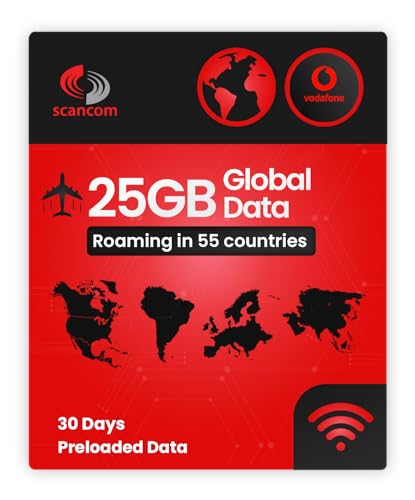
The title also describes easy activation and use in unlocked devices, making this the closest match for someone set on Vodafone rather than simply any Europe travel SIM. Its global framing may suit an itinerary extending beyond Europe.
Bottom line: Pick this if Vodafone branding and a multi-country trip matter most.
Orange Holiday Europe 20GB SIM

Orange Holiday Europe 20GB SIM is an Orange alternative rather than a Vodafone SIM, with a specific calling allowance alongside 20GB of European data. Its 30-day validity begins with first use, and the SIM has standard, micro, and nano cutouts. Travelers who specifically want Vodafone service should choose another option; the call and text package is the distinctive reason to consider this one.
Bottom line: Choose this when calls and texts matter more than Vodafone branding.
Orange Europe 20GB 30-Day SIM

Orange Europe 20GB 30-Day SIM is another Orange option, with a French number and a 30-minute international calling and 200-text allowance. The features say that local European calls are unlimited, tethering is allowed, and no registration is required; validity runs for 30 days from first use. The triple-cut SIM fits standard, micro, and nano trays and is intended for unlocked phones, tablets, and mobile hotspots. This differs from the Vodafone match by offering Orange service and an explicit local calling feature. It is not the fit for buyers who require Vodafone.
Bottom line: Pick this for an Orange SIM with a French number and local calls.
Europe 50GB 60-Day Data SIM

Europe 50GB 60-Day Data SIM trades Vodafone branding and voice service for a longer stated validity: 60 days with 50GB of data across 36 named countries. Its features say the SIM can switch among 77 operators and permits hotspot sharing, but it is explicitly data-only, with no calls or texts included. That makes it a possible alternative for a long itinerary or a traveler who uses internet calling, not a replacement for a Vodafone plan or a SIM needed for ordinary voice calls. Verify that the named coverage includes every destination on your route.
Bottom line: Choose this for a longer data-only trip across its named countries.
How to choose a Europe travel SIM
Choose by destinations, trip length, and whether voice calls matter; a data allowance alone does not tell you if a SIM suits your route. European travel SIMs may use a single carrier or multiple partner networks, and coverage can differ between cities, rural areas, and islands. A multi-operator plan can switch networks, while a single-network SIM depends more heavily on that operator’s local reach. Match the validity window to the full trip, including arrival and departure days. For a trip over 30 days, a 60-day option can avoid a mid-trip replacement, while a 30-day plan may be enough for a shorter visit. If you need regular voice calls, avoid data-only plans.
Check whether validity starts on first use, activation, or another trigger; that changes when the clock begins. Confirm the included countries against every border crossing, especially if the itinerary includes non-EU destinations.
SIM size, phone compatibility, and activation
Confirm that your phone is unlocked and accepts a physical SIM before traveling; a carrier-locked phone may reject a foreign SIM even when its size fits. The common removable formats are standard, micro, and nano, with many travel SIMs sold as a triple-cut card. Phone compatibility also depends on network bands: check the device’s supported LTE or 5G bands against the operator networks used at your destination. A 5G label does not guarantee 5G service everywhere, since local coverage and device support both matter.
Activation rules differ: some prepaid SIMs start on first call, text, or data connection, and others may require an activation step. Keep the SIM tray tool and original SIM somewhere safe, and save any required setup instructions offline before swapping cards. For a phone with an eSIM-only design, a physical travel SIM will not fit.
Travel SIM types compared
Data-only SIMs cover internet access but do not provide ordinary cellular calls or SMS; voice-and-data SIMs add a calling allowance or local number. Pick the type by how you expect to communicate, not only by the data figure.
| Need | SIM type | Trade-off |
|---|---|---|
| Maps, browsing, app calls | Data-only | No included standard calls or texts |
| Local calls and texts | Voice-and-data | International allowances may be limited |
| Several countries | Multi-country roaming | Verify the route’s country coverage |
App-based calls use data and require a working internet connection at both ends; they are not equivalent to a cellular voice allowance. If a two-factor login relies on receiving SMS at your home number, check whether the phone can keep that number active alongside the travel SIM.
Data use and safe connectivity abroad
Navigation, video, and app updates can consume data quickly; downloading offline maps over Wi-Fi before leaving helps reserve mobile data for live directions. Turn off automatic photo backups and large app updates on cellular data if the plan has a fixed cap. A hotspot shares the SIM’s connection with other devices, but every connected device draws from the same allowance, so tethering does not multiply data.
For account access and payments, use trusted networks and avoid entering sensitive credentials on unfamiliar public Wi-Fi. A travel SIM can provide mobile data, but it does not make every site or connection inherently secure. Keep the phone’s roaming setting aligned with the plan’s coverage and avoid assuming that border regions will connect to the intended country network.
Frequently Asked Questions
Will a travel SIM work in a locked phone?
Usually not; the phone must be carrier-unlocked to accept a different provider’s SIM. Verify the device’s unlock status before departure, because physical size compatibility does not bypass a network lock.
How much data does a week in Europe need?
A week of basic maps, messaging, and web browsing can often fit within 3GB to 5GB, while frequent video streaming can use several gigabytes in a single day. Download offline maps and restrict background updates if you need to conserve a capped plan.
Can a travel SIM share data with a laptop?
Only if its plan permits tethering or hotspot use and the phone supports it. A hotspot draws from the SIM’s same data allowance, so connected laptops can exhaust a cap faster than a phone alone.
Does a Europe SIM include the United Kingdom?
Some do, but Europe is not a consistent coverage definition across travel plans. Check the plan’s supported-country list for the UK specifically, especially if the trip crosses between the UK and EU countries.
When does prepaid SIM validity begin?
Validity commonly starts at first use, activation, or a defined registration step, depending on the plan. A 30-day period can begin with a first data connection, call, or text, so identify the trigger before inserting the card.