
Rear Main Oil Seal Stop Leak: 4 Additives Compared

For a rear main oil seal stop leak, Bar’s Leaks Rear Main Seal Repair, 16.9 oz is the most targeted choice because its maker says it is specifically designed for rear main leaks. Choose BlueSeal Oil Stop Leak, 8 oz if you want a petroleum-free formula with additional system uses; an additive may not help when the seal is torn or the leak comes from another component.
We earn a commission if you buy through links on this page. As an Amazon Associate I earn from qualifying purchases. Products are compared on manufacturer specifications, not hands-on testing.
- Best overall: Bar’s Leaks Rear Main Seal Repair, 16.9 oz – Its maker says the formula is specifically designed for rear main leaks and other engine oil leaks.
- Best for multi-system use: BlueSeal Oil Stop Leak, 8 oz – Its maker says the petroleum-free formula can be used in several fluid systems beyond the engine.
- Best for oil burning: Bar’s Leaks OS-1 Oil Seal Repair, 16.9 oz – Its maker says it addresses oil burning and worn valve seals as well as leaks.
- Best for multiple fluid systems: Bar’s Leaks One Seal Stop Leak, 11 oz – Its maker says one bottle treats minor leaks in engine oil, transmission fluid or power steering fluid.
| Product | Best for | Volume | Primary use | Other system use | Shop |
|---|---|---|---|---|---|
| Bar’s Leaks Rear Main Seal Repair, 16.9 oz | Targeted engine leaks | 16.9 oz | Rear main and other engine oil leaks | — | Check Price on Amazon |
| BlueSeal Oil Stop Leak, 8 oz | Multi-system formula | 8 oz | Engine oil seal conditioning | Transmission, steering, differential | Check Price on Amazon |
| Bar’s Leaks OS-1 Oil Seal Repair, 16.9 oz | Oil burning concerns | 16.9 oz | Main seals and gaskets | — | Check Price on Amazon |
| Bar’s Leaks One Seal Stop Leak, 11 oz | Minor fluid leaks | 11 oz | Minor seal and gasket leaks | Engine oil, transmission, power steering | Check Price on Amazon |
Rear Main Oil Seal Stop Leak Additives
Compare each formula’s purpose and use before deciding whether an additive suits the leak.
Bar’s Leaks Rear Main Seal Repair, 16.9 oz
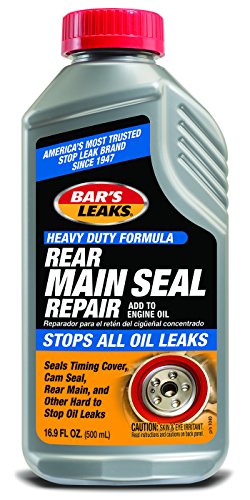
For a formula aimed directly at rear main leaks, this additive is the most focused option in this group. Bar’s Leaks says it is designed for rear main leaks and also targets timing cover, cam seal and other hard-to-stop engine oil leaks. The maker instructs users to add the full bottle to the crankcase, where engine oil is added, at or between oil changes, without overfilling. It suits someone addressing an engine oil leak with an additive; it is less suitable when the seal is physically damaged or the source has not been identified.
Bottom line: Choose this when a rear main leak is the suspected target and you want a specifically focused formula.
BlueSeal Oil Stop Leak, 8 oz

BlueSeal stands apart with a petroleum-free, non-clogging formula and broader system use than the engine-focused options. Its maker says it conditions rubber seals in gasoline and diesel engines, and can also be used in transmissions, power steering, differentials, rack-and-pinion systems and hydraulic systems. The 8-ounce bottle is poured into the oil sump or crankcase for engine use, with no special tools required. That range makes it a fit when a buyer wants a multi-system additive, but it does not make it a repair for a failed or mechanically damaged rear main seal.
Bottom line: Choose this if you want a petroleum-free additive with uses beyond engine oil.
Bar’s Leaks OS-1 Oil Seal Repair, 16.9 oz

Unlike a rear-main-focused formula, OS-1 is positioned for broader oil seal concerns, including oil burning and worn valve seals and guides. Bar’s Leaks says it is intended for gasoline and diesel engines, including turbocharged, hybrid and racing engines, and says it is a candidate when oil consumption is no more than one quart per day. Its added focus may suit someone dealing with blue exhaust smoke as well as a leak. The wider scope is a drawback if the only goal is a targeted rear main seal product.
Bottom line: Choose this when oil burning or valve-seal concerns accompany the leak.
Bar’s Leaks One Seal Stop Leak, 11 oz

One Seal differs from the other choices by covering minor leaks in three fluid systems rather than focusing solely on engine oil. Bar’s Leaks says one bottle treats one engine oil, transmission fluid or power steering fluid system leak, and describes the product as a seal-and-gasket formula for wear and age. That makes it relevant if the leak might involve one of those systems. Its broad purpose is less tailored than a rear main seal-specific product, and it should not be treated as a substitute for repairing a badly damaged seal.
Bottom line: Choose this for a minor leak in one of its three stated fluid systems.
How to choose a rear main oil seal stop leak
Choose an additive by the leak source and the product’s system, not by the word “stop leak” alone. A rear main seal sits at the back of the engine where it meets the transmission; oil there can be confused with leaks from nearby engine parts. If the source is uncertain, clean the area and look for the highest fresh oil trace before adding a product. A useful decision rule is to reserve a rear-main-specific formula for a confirmed or strongly suspected rear main leak, and consider a multi-system formula only when its other applications matter. Additives cannot correct a torn seal, a damaged sealing surface or a loose component. Never exceed the engine’s oil capacity: check the dipstick before and after adding any treatment.
How to identify a rear main seal leak
A rear main seal leak appears near the engine-to-transmission junction, but oil can travel down from higher components and mimic that location. Check above the wettest area for fresh oil at the valve cover, oil pan edge or other seams before settling on a diagnosis. A clean engine area makes the next oil trace easier to follow; use appropriate caution around hot or moving parts. Oil reaching hot exhaust components can smoke and may create a fire hazard, so stop driving and address a substantial leak or visible smoke promptly. Rear main seal replacement commonly requires transmission removal, which is why confirming the source matters before choosing a chemical treatment. Persistent dripping after treatment is a reason to seek mechanical diagnosis rather than adding repeated doses.
How rear main seal additives differ
Rear main seal additives generally fall into targeted engine-oil formulas and broader seal-conditioning or multi-fluid products. Their intended applications differ, so a claim covering transmission or steering fluid does not mean the product should be added to engine oil for those purposes. Use the fluid system named on the container and avoid mixing a treatment into the wrong reservoir. The table gives a simple selection rule based on purpose rather than assuming that a wider application is always better.
| Need | Choose by |
|---|---|
| Suspected rear main engine oil leak | Rear-main-focused engine oil additive |
| Engine oil plus other seal concerns | Formula whose applications include those concerns |
| Leak in another fluid system | Product explicitly intended for that system |
When the source is unknown, diagnosis is more useful than choosing the product with the longest list of possible applications.
Safe application and follow-up
Measure the engine oil level before adding an oil treatment, because overfilling can damage an engine. Pour only into the engine oil fill or crankcase when the product is intended for engine oil; never put an engine additive into coolant or brake fluid. Follow the dose and application directions printed on the actual container, since formulations and vehicle capacities differ. After application, recheck the dipstick on level ground and watch for fresh oil under the engine. Do not rely on an additive to make an unsafe leak safe: a fast drip, falling oil level, oil-pressure warning, or oil reaching hot exhaust calls for prompt attention. Keep any additive away from children and pets, and clean spills to reduce slip and fire hazards.
Frequently Asked Questions
Can stop leak fix a damaged rear main seal?
An additive cannot repair a torn seal or damaged sealing surface. If oil continues to drip or the engine oil level falls, arrange a mechanical diagnosis; rear main seal replacement commonly requires transmission removal.
How can I tell where engine oil is leaking?
Look for the highest fresh oil trace after cleaning the area, because oil can run downward from a source above the rear main seal. Check nearby seams such as the valve cover and oil pan before assuming the engine-to-transmission junction is the source.
Can I add a rear main seal product between oil changes?
Some formulas allow application at or between oil changes, while directions vary by product. For the 16.9-ounce rear-main-focused formula here, its maker says to add the entire bottle to the crankcase without overfilling.
What should I do if oil leaks onto the exhaust?
Stop driving if oil is reaching hot exhaust components, since oil can smoke and create a fire hazard. A fast drip, falling dipstick level or oil-pressure warning also calls for prompt attention rather than waiting for an additive to work.
Can one additive go in power steering fluid?
Only use a product in power steering fluid when its directions explicitly allow that system. A multi-system formula may name power steering, but an engine-oil treatment should not be assumed safe for a different reservoir.