
Raybestos Brake Pads: Lines and Vehicle Fit Compared

Raybestos brake pads vary by friction line and vehicle application, so the deciding factor is an exact year, make, model, and axle match. Choose an Element3 set only if its rear fit covers your vehicle; drivers seeking a general-purpose fit should consider another part number.
Brake pads create friction against the rotor to slow a vehicle, and front and rear pads are not interchangeable by default.
We earn a commission if you buy through links on this page. As an Amazon Associate I earn from qualifying purchases. Products are compared on manufacturer specifications, not hands-on testing.
- Best overall: Raybestos R-Line Brake Pad Set – Element3 combines ceramic and semi-metallic friction materials and has specific application ranges.
- Best for Subaru rear fit: Raybestos Reliant Ceramic MGD1391CH – Its applications cover several Subaru models and years.
- Best for Mazda 6 rear fit: Raybestos Element3 Mazda 6 Rear (EHT1874) – Its application range is limited to 2016–2021 Mazda 6 rear brakes.
| Product | Best for | Vehicle fit | Position | Friction formulation | Shop |
|---|---|---|---|---|---|
| Raybestos Element3 Mazda 6 Rear (EHT1874) | Mazda 6 rear | 2016–2021 Mazda 6 | Rear | Ceramic and semi-metallic hybrid | Check Price on Amazon |
| Raybestos Element3 Subaru Rear (EHT1114H) | Subaru rear fit | Specified Subaru models, 2005–2023 | Rear | Ceramic and semi-metallic hybrid | Check Price on Amazon |
| Raybestos Element3 Buick, Chevrolet & Pontiac Rear (EHT698H) | GM rear applications | Specified Buick, Chevrolet, Pontiac | Rear | Ceramic and semi-metallic hybrid | Check Price on Amazon |
| Raybestos R-Line Brake Pad Set | R-Line replacement | Not vehicle-specific in supplied fields | — | Ceramic or semi-metallic | Check Price on Amazon |
| Raybestos Reliant Ceramic MGD1391CH | Reliant ceramic | Vehicle-specific; model not identified | — | Ceramic | Check Price on Amazon |
Raybestos brake pads compared by vehicle fit
Match the axle and vehicle application first, then compare friction-line features.
Raybestos Element3 Mazda 6 Rear (EHT1874)

This Element3 set is the Mazda-specific option in this group, covering the 2016–2021 Mazda 6 rear application. Raybestos says its Enhanced Hybrid Technology combines ceramic and semi-metallic friction materials, with a multi-layer shim intended to damp noise and a blend aimed at wear and stopping performance. That makes it the clearest fit for owners of a covered Mazda 6 who want the Element3 formulation. Its application is narrow: it is not a general-purpose set, and the fit does not cover other Mazda models or front brakes.
Bottom line: Choose this set for a covered 2016–2021 Mazda 6 rear application.
Raybestos Element3 Subaru Rear (EHT1114H)
This Element3 set covers the broadest mix of named vehicle lines here, with rear applications across the Forester, Crosstrek, Impreza, Outback, Legacy, XV Crosstrek, and WRX within the year ranges. Raybestos says the EHT formulation combines ceramic and semi-metallic friction materials and uses a multi-layer noise-damping shim. The broad model list can suit Subaru owners comparing multiple generations, but the year ranges differ by model and should not be treated as one universal Subaru fit. Verify the precise model and year before choosing it.
Bottom line: Choose it when your Subaru model and year fall within its specified rear applications.
Raybestos Element3 Buick, Chevrolet & Pontiac Rear (EHT698H)
This Element3 set is the group’s match for several older Buick, Chevrolet, and Pontiac rear applications, including specified Impala, Century, Grand Am, Monte Carlo, Rendezvous, Grand Prix, and Regal years. Raybestos says its Enhanced Hybrid Technology combines ceramic and semi-metallic friction materials, while the multi-layer shim is designed to damp noise. This makes it useful for an owner whose exact vehicle appears in the application range. The part is not a fit for every vehicle from these brands, and the ranges end at different years.
Bottom line: Choose it only for one of its specified Buick, Chevrolet, or Pontiac rear applications.
Raybestos R-Line Brake Pad Set
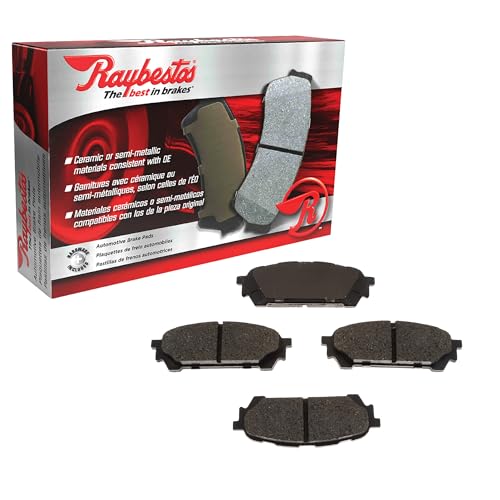
This R-Line set differs from the vehicle-specific Element3 options by offering either ceramic or semi-metallic friction rather than a model-year application. Raybestos says its slots and chamfers follow OE design to help release brake gases and reduce noise, vibration, and harshness; the set also has a layered steel shim, with hardware included where applicable. It may suit a buyer already matching an R-Line part number to a vehicle.
Bottom line: Choose it if an R-Line part number is confirmed for your vehicle.
Raybestos Reliant Ceramic MGD1391CH
This Reliant set is identified as ceramic and vehicle-specific, distinguishing it from the R-Line set, which offers a choice of ceramic or semi-metallic material. Raybestos says its noise-damping layered shim and OE-style chamfers and slots are intended to reduce noise, vibration, and harshness. The model code gives a more definite starting point for a vehicle-specific replacement than a generic pad description. The matching vehicle and axle are not identified in the fields, so verify that MGD1391CH fits your exact application.
Bottom line: Choose it when MGD1391CH is confirmed for your vehicle and axle.
How to choose Raybestos brake pads
Start with the exact vehicle application and axle, then compare friction line and construction. A vehicle’s front and rear brakes commonly use different pad shapes, and trim or brake-package changes can also affect fit, so a brand match alone is not enough. These options span R-Line, Reliant, and Element3; Element3 sets here are rear-specific and name particular vehicle years. Ceramic and semi-metallic formulations trade off traits such as dust, noise, and heat behavior, but the result depends on the compound and vehicle rather than the label alone. Choose a set only when its part number and application match your vehicle; if no exact application is available, check the catalog or your vehicle’s brake specifications before purchasing.
Understanding ceramic and semi-metallic pad types
Ceramic pads use ceramic-based friction material, while semi-metallic pads contain metal fibers; neither label alone guarantees quieter braking or longer service life. Raybestos describes Element3 as combining ceramic and semi-metallic formulations, while its R-Line offering comes in either material. Pad performance also depends on rotor condition, vehicle weight, driving pattern, and the specific compound. Frequent hard stops and steep descents create more heat than steady highway driving, so a pad’s application suitability matters as much as its material family. Do not select a pad solely by color or a broad material category; match the part to the vehicle and intended axle.
Brake pad fit and replacement basics
Brake pads should be replaced as an axle pair, not one side at a time, to preserve balanced braking. Front pads often wear faster because braking transfers weight toward the front wheels, but driving conditions and vehicle design change wear rates. A common inspection threshold is about 3 millimeters of remaining friction material; replace sooner if the manufacturer’s limit or a warning indicator calls for it. New pads generally need a bedding-in period to establish an even transfer layer on the rotor, so avoid repeated hard stops immediately after installation unless the pad maker specifies otherwise. Inspect rotor condition and caliper movement during the same service.
Common mistakes when selecting brake pads
The most common error is choosing by brand or vehicle name without checking the exact year, axle, and brake configuration. A rear-only application cannot substitute for a front set, and model-year spans differ among the Element3 applications here. Another mistake is assuming all ceramic pads perform alike: compound, pad shape, rotor pairing, and operating temperature all matter. Use this comparison as a shortlist, then verify the part number against the complete vehicle identification and brake package. For safe installation, support the vehicle with rated jack stands on a firm surface, never rely on a hydraulic jack alone, and torque fasteners to the vehicle maker’s specification.
Frequently Asked Questions
How often should brake pads be inspected?
Inspect brake pads at least once a year or around every 12,000 miles, with more frequent checks for heavy city driving, towing, or mountain routes. Replace them when friction material approaches roughly 3 millimeters or the vehicle’s service limit.
Can ceramic and semi-metallic pads be mixed?
Avoid mixing different pad compounds across the same axle because braking response may differ side to side. Replace both pads on the axle with a matched set intended for the vehicle.
Do new brake pads need bedding in?
Yes, new pads generally need controlled stops to establish an even friction layer on the rotors. Follow the pad maker’s procedure, and avoid repeated hard braking during the initial bedding period.
When should brake rotors be replaced with pads?
Replace or machine rotors when they are below the vehicle’s minimum thickness, deeply scored, cracked, or heat-damaged. Rotor thickness and limits are vehicle-specific, so measure against the service specification rather than judging by appearance alone.