
Best Hot Air Gun for Soldering: 5 Stations Compared

The WEP 882D 2-in-1 Rework Station suits most soldering benches because its 2-in-1 design pairs an adjustable hot air station with a soldering iron in one compact unit. Choose a dedicated hot air station instead if you already have an iron or want a separate setup.
We earn a commission if you buy through links on this page. As an Amazon Associate I earn from qualifying purchases. Products are compared on manufacturer specifications, not hands-on testing.
- Best overall: WEP 882D 2-in-1 Rework Station – Combines an adjustable 212–896°F hot air station and soldering iron in a compact body.
- Best for compact benches: WEP 8858-V Hot Air Rework Station – Palm-sized design includes integrated holders for the gun and nozzles.
- Best for high-power rework: ATTEN ST-862D 1000W Station – 1000W output and quick-change nozzle holder support frequent nozzle swaps.
| Product | Best for | Station type | Hot air temperature | Distinctive feature | Shop |
|---|---|---|---|---|---|
| WEP 882D 2-in-1 Rework Station | All-in-one bench | Iron + hot air | 212–896°F | 3 nozzles | Check Price on Amazon |
| WEP 8858-V Hot Air Rework Station | Small workspaces | Hot air only | — | Integrated holders | Check Price on Amazon |
| ATTEN ST-862D 1000W Station | Frequent nozzle swaps | Hot air only | — | 1000W; quick-change | Check Price on Amazon |
| Beaiguna 2-in-1 Soldering Station | Dual-control setup | Iron + hot air | — | Independent controls | Check Price on Amazon |
| YIHUA 959D Digital Hot Air Station | Preset settings | Hot air only | 212–932°F | 3 preset channels | Check Price on Amazon |
Hot air guns for soldering
Compare combination and dedicated rework stations by their temperature controls and bench-friendly features.
WEP 882D 2-in-1 Rework Station

The WEP 882D 2-in-1 Rework Station is the combination choice, integrating a soldering station and hot air rework station in one compact body. The hot air temperature adjusts from 212°F to 896°F, and the station includes variable air volume, separate LED displays and controls, plus three hot air nozzles. The iron adjusts from 392°F to 896°F; the package also includes tips, solder wire and bench accessories. Choose it when you want both soldering and hot air work together. Its combined format may be unnecessary if you already have a dedicated iron or need only hot air.
Bottom line: Pick this if you want a soldering iron and adjustable hot air in one unit.
WEP 8858-V Hot Air Rework Station

The WEP 8858-V Hot Air Rework Station stands out for keeping the hot air gun and nozzle storage integrated into a palm-sized main unit. Its kit includes three nozzles and two tweezers, while the controls support adjustable temperature and air volume. A PID program monitors temperature and adjusts power output, according to the manufacturer. The compact arrangement suits a crowded bench or occasional board repair where storage matters. The product features do not give a temperature range, so confirm the usable temperature span before choosing it for a component with a narrow heat limit.
Bottom line: Choose this when a compact hot air-only setup and built-in holders matter most.
ATTEN ST-862D 1000W Station
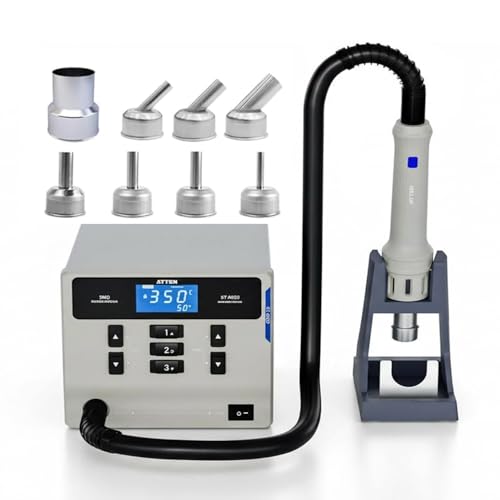
The ATTEN ST-862D 1000W Station separates itself with 1000W power and a nozzle holder designed for quick changes without tweezers or other tools. Its digital interface offers three fast-access temperature and air-volume settings, and the station has an automatic sleep function when the handle returns to its bracket. Those controls may suit repeat board-rework tasks that call for switching among saved common settings.
Bottom line: Pick this for a dedicated station with 1000W power and quick nozzle changes.
Beaiguna 2-in-1 Soldering Station

The Beaiguna 2-in-1 Soldering Station is another integrated iron-and-hot air option, distinguished by separate switches for independent control of the two systems. Its features specify up to 700W power for heating the soldering iron, a pure-copper-wound transformer and an upgraded dual-system design. That combination fits a bench where both tools are needed but separate operation is useful. The specifications do not include temperature or air-volume ranges, limiting comparison for repairs that require a particular heat setting; confirm those ranges before committing to this station.
Bottom line: Choose this if independent operation of the iron and hot air is your priority.
YIHUA 959D Digital Hot Air Station

The YIHUA 959D Digital Hot Air Station is the dedicated hot air choice with the highest temperature ceiling in this group: 932°F. Its brushed aluminum panel and automatic heat-up behavior when the gun is lifted from its holder add practical bench features. This is a fit for users who want presets rather than an integrated soldering iron; the package features do not describe included nozzles.
Bottom line: Pick this for a dedicated hot air station with three stored setting channels.
How to choose a hot air gun for soldering
Choose by the workpiece, control needs and whether you need an iron built in. Hot air rework warms a component and its solder broadly, while a soldering iron applies heat through a tip at a smaller contact area. For surface-mount parts, select a station with adjustable temperature and airflow so heat delivery can be adapted to component size and board layout. A combined station saves bench space when both tools are needed; a dedicated station avoids paying for a second iron function you already own. Hot air can also disturb nearby components or damage plastics, so use heat-resistant shielding and keep airflow aimed at the target rather than across the board.
Temperature and airflow for board rework
Temperature settings alone do not determine how quickly a joint heats; nozzle size, airflow, distance and board thermal mass all affect heat transfer. A small nozzle concentrates air around a small component, while a wider nozzle warms a broader area; use the narrowest nozzle that covers the target without blowing adjacent parts away. Keep the gun moving rather than holding it stationary, and raise heat gradually if solder does not reflow. Lead-free solder typically melts at a higher temperature than common leaded solder, so match the process to the solder alloy and component limits rather than assuming one setting works for every repair. The table shows which capability differentiates these choices.
| Need | Useful station capability |
|---|---|
| Iron and hot air together | Integrated 2-in-1 station |
| Limited bench storage | Compact body with integrated holders |
| Repeat setting changes | Preset channels or fast-access keys |
Nozzle fit and safe handling
Nozzle diameter should match the component footprint: a nozzle that is too wide can heat neighboring parts, while one that is too narrow may concentrate heat unevenly. Keep the hot nozzle away from cables, plastic housings and skin; hot air stations can exceed 900°F, enough to cause severe burns and ignite nearby materials. Use a stable holder whenever the gun is not in hand, and let the nozzle cool before changing it unless the station is specifically designed for hot changes. Work with ventilation because soldering flux fumes can irritate airways, and avoid breathing directly over the board. A heat-resistant work surface and eye protection help manage splashes and displaced solder.
Common hot air soldering mistakes
Excessive airflow is a common cause of displaced small components, so start with controlled flow and increase only as needed. Heating one spot for too long can lift board pads or overheat nearby components; sweeping the nozzle around the joint spreads heat more evenly. A board with large copper planes absorbs heat faster than a small isolated pad, so the same setting and dwell time may not work across both. Secure loose parts before applying air and use tweezers only after solder has softened. Return the gun to its holder after use, and keep children and pets away until the nozzle has cooled fully.
Frequently Asked Questions
Can a hot air gun replace a soldering iron?
No, hot air and an iron serve different jobs: hot air heats a component and surrounding solder broadly, while an iron applies heat through a small tip. A combined station supplies both tools, but a dedicated hot air unit does not replace an iron for ordinary point-to-point joints.
What temperature should I use for hot air soldering?
There is no single setting for every repair; solder alloy, nozzle, airflow and board mass all affect the required heat. Common lead-free solder melts around 217°C (423°F), while common leaded solder melts around 183°C (361°F), but the station setting must be higher to transfer heat into the joint.
How close should the hot air nozzle be to a circuit board?
Keep the nozzle close enough to heat the target efficiently but far enough to avoid touching components or concentrating heat in one spot. A few millimeters is a typical starting distance, then adjust based on nozzle size, airflow and how quickly the solder responds.
Do I need different nozzles for different components?
Yes, nozzle size affects the area receiving heat. A narrow nozzle is generally suited to a small target, while a wider nozzle spreads heat over larger packages; too much width can disturb neighboring components.
How can I protect nearby components during rework?
Use heat-resistant tape or a metal shield to cover sensitive neighboring parts, and direct the airflow away from them. Keep airflow controlled because high flow can move small components, and allow the board to cool before handling it.