
Best Portable Deer Blind: 5 Pop-Up Models Compared

For most hunters, 360-Degree Blind with Mud Flap is the best portable deer blind because it combines 360-degree see-through panels with a 12-pound weight and mud flap. Choose a different model if you need a removable floor, a larger 3–4-person interior or a compact solo blind.
Pop-up ground blinds are portable fabric shelters that conceal hunters while providing windows for observation and shooting.
We earn a commission if you buy through links on this page. As an Amazon Associate I earn from qualifying purchases. Products are compared on manufacturer specifications, not hands-on testing.
- Best overall: 360-Degree Blind with Mud Flap – 360-degree viewing, a mud flap and 12-pound weight make it a practical balance of visibility and portability.
- Best for group space: FUNHORUN Blind with Floor Mat – The 70-by-70-inch floor area and detachable waterproof floor mat suit larger groups.
- Best for solo hunts: Lenotos 360-Degree Blind – Its 55-by-55-inch base and 1–2-person capacity use less ground space.
| Product | Best for | Capacity | Footprint | Weight | Shop |
|---|---|---|---|---|---|
| 360-Degree Blind with Mud Flap | All-around use | 2–3 people | 58 × 58 in | 12 lb | Check Price on Amazon |
| FUNHORUN Blind with Floor Mat | Roomy groups | 3–4 people | 70 × 70 in | 23.1 lb | Check Price on Amazon |
| Lenotos 360-Degree Blind | Solo setups | 1–2 people | 55 × 55 in | — | Check Price on Amazon |
| FUNHORUN 360-Degree Blind | Easy entry | 2–3 people | 58 × 58 in | 15 lb | Check Price on Amazon |
| THUNDERBAY SPUR Collector | Quick setup | 2 people | 55 × 55 in | 11.8 lb | Check Price on Amazon |
Portable Deer Blinds Compared
Compare capacity, footprint and visibility to match a blind to your hunting location and group size.
360-Degree Blind with Mud Flap
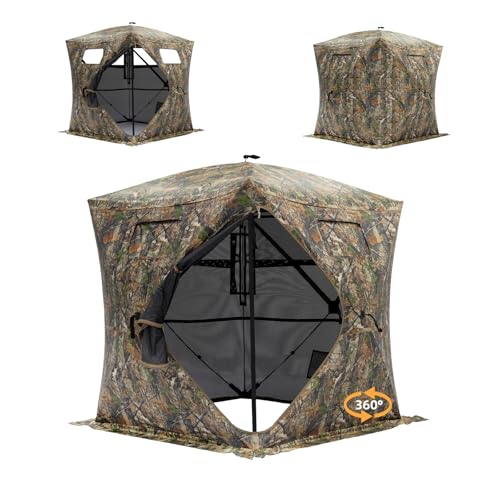
360-Degree Blind with Mud Flap pairs a 360-degree see-through design with a mud flap that blocks light and mud, making it the most balanced option here for portability and concealment. Its 58-by-58-inch footprint suits a small hunting party, while the diamond-shaped door is designed for easier entry. The maker describes the fabric as tear-resistant. At 67 inches tall, it offers less headroom than the tallest option in this group, so taller hunters should compare interior height with their sitting and shooting position before choosing.
Bottom line: Choose this if you want broad visibility and a mud flap without carrying the heaviest blind.
FUNHORUN Blind with Floor Mat

FUNHORUN Blind with Floor Mat is the largest option by footprint, with a 70-by-70-inch base and an 80-inch height for hunters who need more room to sit or move. Its zip-in floor mat has a waterproof layer and can be removed for washing, a useful feature for damp or muddy ground. Four see-through panels support views in every direction. The tradeoff is its 23.1-pound weight, nearly twice that of the lightest blind, so it is better suited to a shorter carry or a group that can share the load.
Bottom line: Pick this for extra interior space and a removable floor, if the heavier carry is acceptable.
Lenotos 360-Degree Blind

Lenotos 360-Degree Blind has the smallest footprint, 55 by 55 inches, and is sized for one or two people. Four see-through mesh panels provide 360-degree views, while four quiet shooting windows and a fully open door support different shooting angles and entry. The center height is 65 inches, lower than the other blinds with height figures here; check whether that suits your seated or standing position. Weight is not provided in the specifications, so hunters who prioritize a light carry should compare the packed weight before choosing.
Bottom line: Choose this compact footprint for a solo or paired setup where space is limited.
FUNHORUN 360-Degree Blind

FUNHORUN 360-Degree Blind uses four one-way see-through panels and a full-open door, a distinct advantage for hunters who need a wide entrance or use a cart or wheelchair. At 58 by 58 inches and 66 inches tall, it occupies the same footprint as the smaller 360-degree blind but weighs 15 pounds. The maker includes stakes and ropes and describes the frame as using solid fiber support rods.
Bottom line: Pick this for a generous entryway and an accessible route into the blind.
THUNDERBAY SPUR Collector

THUNDERBAY SPUR Collector stands out for its five-hub frame, which the maker says sets up and comes down in less than two minutes. Its 55-by-55-inch footprint is compact, and the 66-inch height accommodates a two-person setup. The 270-degree windows use a silent sliding system with shoot-through mesh covers, unlike the full 360-degree viewing panels on several alternatives. A fiberglass frame and 210D polyester with a black interior PU coating round out the construction. Choose another blind if viewing behind the shelter is essential to your setup.
Bottom line: Choose this for a compact two-person blind and a maker-claimed fast setup.
How to Choose a Portable Deer Blind
Start with capacity and footprint: the choices range from 55-by-55-inch bases for one or two hunters to a 70-by-70-inch base for three or four. Add space for chairs, bows or packs rather than sizing only for the number of people; a blind that fits bodies tightly can restrict movement and shooting positions. Viewing design is another key choice: 360-degree panels provide visibility around the shelter, while a 270-degree window layout leaves a more limited viewing arc. If you carry gear far, compare packed weight as well as floor area. A measurable rule of thumb is to allow about 2 feet of width per seated hunter, then add room for equipment.
Blind Footprint, Height and Hunter Fit
Footprint determines how much level ground a blind needs, while height affects sitting and standing comfort. These options list footprints from 55 to 70 inches and heights from 65 to 80 inches; check both against the site and the posture you plan to use. A larger footprint can make room for extra hunters, but it needs a wider, flatter placement area. Measure the ground at the intended location, including nearby branches or brush that could interfere with the frame. For a tight site under 60 inches wide, choose one of the 55- or 58-inch bases; allow clearance around the perimeter for stakes and tie-down ropes.
360-Degree Panels Versus Sliding Windows
See-through panels and adjustable windows solve different visibility needs. Full-panel designs offer a broad view around the shelter, while sliding or hook-style windows let a hunter open selected shooting lanes. Mesh coverings can help break up the opening, but shooting through any mesh changes the arrow or bullet path; practice with the same equipment and setup before hunting, and never shoot unless the target and what lies beyond it are clearly identified. Check whether the window arrangement opens toward the expected approach and shooting lanes. A 270-degree layout can work when the blind is placed against a boundary; open terrain favors visibility on more sides.
Anchoring and Weather Safety
Secure a pop-up blind with its stakes and guy lines whenever conditions allow; a lightweight fabric shelter can catch wind like a sail. Ground conditions change how well stakes hold, so use suitable anchors for soft soil and avoid relying on a loose stake in wet ground. Clear snow, standing water and loose branches from the footprint before setup, and do not use a blind during thunderstorms or when high winds make the frame unstable. Fiberglass poles can splinter if damaged, so inspect them before each outing and keep broken sections away from hands and eyes. Do not use a portable hunting blind with a flame or fuel-burning heater because enclosed shelters can accumulate carbon monoxide.
Frequently Asked Questions
How many hunters fit inside a portable deer blind?
Capacity in these options ranges from one or two people to three or four. Allow additional room for bulky clothing, chairs and equipment, since stated headcount does not ensure comfortable movement.
What size footprint should a deer blind have?
The compared footprints range from 55 to 70 inches per side. Measure the cleared ground and leave room around the base for stakes and guy lines before selecting a size.
Are see-through panels safe to shoot through?
Mesh can change an arrow or bullet’s path, so practice with the exact equipment and window configuration before hunting. Never take a shot unless the target and the area beyond it are clearly visible.
How should I anchor a pop-up hunting blind?
Use stakes and guy lines to secure the frame, with anchors suited to the soil and wind conditions. Check each pole and tie-down before use, and take the blind down if gusts make it unstable.
Can I use a heater inside a hunting blind?
Do not use a fuel-burning heater or open flame in an enclosed blind because carbon monoxide can build up. For warmth, use clothing and gear intended for outdoor conditions and keep exits clear.