
Paver Molds for Concrete: 4 Options Compared by Size

SvitMolds S34 6-Piece Set is the named paver mold set for concrete, and its six reusable ABS molds cover 0.37 square meters together. Choose a single larger form instead if you want a continuous paving pattern in fewer placements, or a 20-inch form for a larger grid.
We earn a commission if you buy through links on this page. As an Amazon Associate I earn from qualifying purchases. Products are compared on manufacturer specifications, not hands-on testing.
- Best overall: SvitMolds S34 6-Piece Set – Six different reusable ABS molds cover a combined 0.37 square meters.
- Best for large squares: 15.7-Inch Patio Paver Molds, 2-Pack – Two 15.7-inch square ABS molds make a 2-inch-thick pattern.
- Best for broad layouts: CJGQ 20-Inch 8-Grid Walk Maker – The 20-inch, 8-grid mold forms eight stone patterns in one placement.
| Product | Best for | Mold size | Material | Pattern / set | Shop |
|---|---|---|---|---|---|
| SvitMolds S34 6-Piece Set | Varied flagstone paths | — | ABS, 1.9–2 mm | 6 textures; 0.37 m² | Check Price on Amazon |
| 15.7-Inch Patio Paver Molds, 2-Pack | Square path sections | 15.7 × 15.7 × 2 in | ABS, 2–3 mm | Parquet pattern; 2 molds | Check Price on Amazon |
| CJGQ 20-Inch 8-Grid Walk Maker | Broad grid paths | 20 × 20 × 1.8 in | Polypropylene | 8-grid; 1 mold | Check Price on Amazon |
| Betonex 6-Piece Flagstone Molds | Textured flagstone paths | — | ABS, 1.9–2 mm | 6 textures; 0.37 m² | Check Price on Amazon |
Paver Molds for Concrete Compared
Compare the form dimensions and layouts to match the mold to your path or patio plan.
SvitMolds S34 6-Piece Set
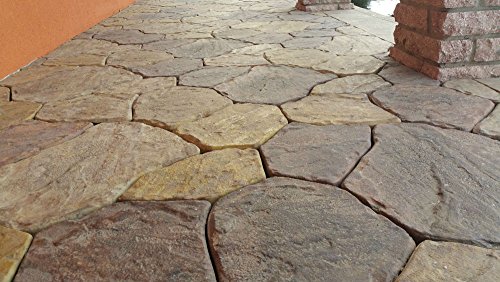
The six-piece S34 set differs from the single-form options by offering multiple textures across a combined casting area of 0.37 square meters. The reusable ABS molds have 1.5-inch depth, suitable for making textured paving stones for a yard path or patio. Use separate molds to vary the appearance of adjoining castings, and paint the cured stones if you want color.
The set’s total coverage is given, but individual mold dimensions are not; measure your planned layout before deciding how many placements it will take.
Bottom line: Choose this set for several flagstone textures and a combined coverage area.
15.7-Inch Patio Paver Molds, 2-Pack

Two 15.7-inch square forms distinguish this set, giving you matching units for a repeated parquet-style path pattern. Each mold is 2 inches deep and made from thickened ABS plastic, so the resulting format is deeper than the 1.5-inch S34 mold. The manufacturer says each form can be reused for more than 500 pours; treat that as a maker claim rather than a guaranteed service life.
The square footprint may be less suitable for a meandering path where irregular stone outlines are the priority.
Bottom line: Pick these for repeated square sections and a 2-inch casting depth.
CJGQ 20-Inch 8-Grid Walk Maker

The CJGQ form has the largest square footprint here at 20 inches by 20 inches, with an 8-grid layout that creates eight stone shapes per casting. Polypropylene construction makes this a different material choice from the ABS forms. It is reusable and intended for paths, patios, or larger paved areas; its 1.8-inch depth is also a middle ground between the 1.5-inch and 2-inch forms.
One form is included, so a wide project still requires repeated placements as the concrete sets and the mold moves along.
Bottom line: Choose this for a broad square form with eight stone shapes in one pour.
Betonex 6-Piece Flagstone Molds
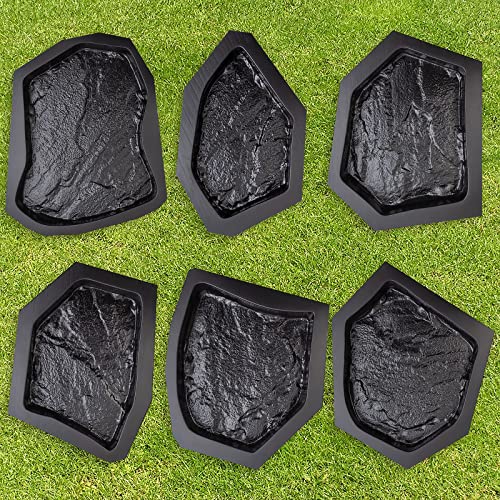
Betonex pairs six different textures with ABS construction, making it a close alternative to the SvitMolds set for a varied flagstone appearance. The set covers 0.37 square meters, and the manufacturer says it can produce more than 50 tiles. That output estimate is useful for rough planning, but actual yield depends on your placement and finished layout.
Individual mold dimensions are not provided, so this set is less convenient to plan against a measured path width than options with a square footprint.
Bottom line: Choose this for six ABS textures and a claimed output above 50 tiles.
How to choose paver molds for concrete
Choose by finished layout first: individual square forms suit repeatable grids, while several textured molds help vary the look of flagstone paths. Compare both mold depth and footprint, because a wider form covers more ground per placement but may be harder to fit into a narrow route. The options range from 1.5 to 2 inches deep and 15.7 to 20 inches across when dimensions are supplied.
A practical decision rule is to measure the narrowest path width: for a path under 20 inches wide, a 20-inch mold cannot sit wholly within the route, so choose a smaller footprint or a multi-piece set with confirmed individual dimensions. Leave enough space around the path for mold placement and movement between pours.
Concrete paver mold size and coverage
A mold’s footprint determines the area it can shape per placement, while its depth determines the stone’s thickness. The square forms here span 15.7 to 20 inches on each side, and listed depths range from 1.5 to 2 inches. A bigger footprint can reduce how many separate placements you need, but irregular edges and turning paths may call for smaller shapes or several molds.
Coverage figures should be compared only on the same basis. The SvitMolds and Betonex sets give combined coverage of 0.37 square meters, while other options give individual mold dimensions. For a straight path, measure its length and width and sketch the mold footprint; for bends, mark each turn because a square form may leave gaps or extend beyond the planned edge.
Single forms and multi-mold sets
Single forms are moved from one section to the next, whereas a multi-mold set can shape several distinct stones in one work session. The 8-grid form creates eight shapes in a single casting, while the two-piece set supplies two matching square forms and the six-piece sets supply six varied textures. Decide whether your priority is a continuous repeat pattern or variation between stones.
The comparison below maps layout needs to the relevant mold style. Reusable plastic forms need to be lifted and repositioned without disturbing fresh concrete; avoid assuming that a claimed reuse count or output applies to every mix and handling method.
| Layout need | Mold style | Tradeoff |
|---|---|---|
| Repeated square path | Single square form | Consistent outline, repeated placements |
| Several stone shapes per casting | Grid form | Multiple shapes, fixed pattern |
| Varied flagstone look | Multi-mold texture set | Different textures, individual sizes to plan around |
Using reusable concrete paver molds
Reusable molds need a level, prepared base so stones sit evenly and do not rock after curing. Remove loose soil, compact the path bed, and use a stable, well-draining base; a common walkway base uses several inches of compacted gravel, with depth adjusted for soil and expected foot traffic. Keep the mold level while filling to avoid uneven stone thickness.
Concrete dust and wet cement can irritate skin and eyes, so wear gloves and eye protection, and avoid skin contact with fresh concrete. Clean the plastic form promptly after lifting it, before residue hardens. For structural loads, such as vehicles, a garden stepping-stone mold is not a substitute for a pavement design rated for that use.
Frequently Asked Questions
How much concrete does a paver mold need?
Concrete volume is the mold’s footprint multiplied by its depth, with extra material allowed for spillage. For example, a 15.7-inch square mold that is 2 inches deep holds about 0.28 cubic feet before allowing for its internal pattern and fill level.
How thick should concrete path pavers be?
A typical garden stepping stone is about 1.5 to 2 inches thick, while slabs carrying heavier loads need a design suited to the load and base. For vehicle traffic, do not rely on a thin garden mold; use a pavement specification designed for vehicles.
Should concrete pavers have a gravel base?
A compacted gravel base helps support walkway stones and drain water; several inches is a common starting point for a foot-traffic path. Soft or wet soil can require a deeper base, and the surface should be leveled before casting.
When can a concrete mold be lifted?
Lift a reusable mold once the concrete holds its shape without slumping, often within minutes, but temperature, mix stiffness, and water content change timing. Test an edge gently and avoid pulling the form if the pattern starts to deform.
Can concrete paver molds be reused?
Plastic molds can be reused when they remain intact and are cleaned before concrete hardens. Follow any mold-specific reuse claim cautiously, since rough handling, freezing conditions, or prying against thin edges can shorten service life.