
Best Gas Cans for Boats: 5 Options Compared

Scepter 12-Gallon Marine Tank suits most boaters who need more portable fuel, with a 12-gallon capacity and built-in gauge. Choose Scepter 6-Gallon Underseat Marine Tank instead when an underseat profile matters more than capacity; the wheeled caddies and steel safety can serve different transfer or storage needs.
Marine portable tanks hold fuel for outboard motors and connect through a fuel line; a gas caddy or safety can is not necessarily a direct replacement tank.
We earn a commission if you buy through links on this page. As an Amazon Associate I earn from qualifying purchases. Products are compared on manufacturer specifications, not hands-on testing.
- Best overall: Scepter 12-Gallon Marine Tank – Its 12-gallon capacity is the largest among the purpose-built marine tanks.
- Best for underseat storage: Scepter 6-Gallon Underseat Marine Tank – The 6-gallon tank measures 19.3 by 12.2 by 10.2 inches.
- Best for wheeled transfer: 15-Gallon Wheeled Fuel Caddy – Its 15-gallon caddy includes a 10-foot hose and manual siphon pump.
- Best for steel storage: Eagle 5-Gallon Type I Steel Safety Can – The 5-gallon steel can has a flame arrester and self-closing lid.
| Product | Best for | Capacity | Dimensions | Construction | Shop |
|---|---|---|---|---|---|
| Scepter 12-Gallon Marine Tank | Longer outings | 12 gallons | 22.9 × 14.3 × 13.9 in. | — | Check Price on Amazon |
| Scepter 6-Gallon Underseat Marine Tank | Low-clearance storage | 6 gallons | 19.3 × 12.2 × 10.2 in. | UV-stabilized HDPE | Check Price on Amazon |
| 15-Gallon Wheeled Fuel Caddy | Shore-side transfer | 15 gallons | 16.14 × 16.14 × 34 in. | HDPE tank and nozzle | Check Price on Amazon |
| Garvee 15-Gallon Fuel Caddy | Large fuel transfers | 15 gallons | 14 × 14 × 35 in. | Industrial-grade HDPE | Check Price on Amazon |
| Eagle 5-Gallon Type I Steel Safety Can | Steel fuel storage | 5 gallons | 12.5 × 12.5 × 13.5 in. | Galvanized steel | Check Price on Amazon |
Best Gas Cans for Boats
Match the container to your boat’s storage space and whether you need a connected marine tank or fuel for transfer.
Scepter 12-Gallon Marine Tank

For boaters who prioritize fuel capacity, this portable marine tank holds 12 gallons, twice the capacity of the 6-gallon marine tank here. Its 2-way vented cap and built-in fuel pick-up/sight gauge distinguish it from the other boat tank. Scepter says the cap releases pressure above 5 PSI and the tank works with gasoline and ethanol-blended fuels. A fuel line is sold separately, so this tank suits buyers who already have a compatible line or plan to source one. Its tall profile may be harder to fit beneath a low seat.
Bottom line: Choose this tank when capacity matters more than underseat clearance.
Scepter 6-Gallon Underseat Marine Tank

The 6-gallon underseat shape is the compact choice for boats where a taller tank will not fit. Its molded top handle makes it easier to carry between boat and dock, and its combination fuel pick-up/sight gauge accepts standard 1/4 NPT marine tank fittings. The polyethylene shell is UV-stabilized, and the tank works with gasoline and ethanol-blended fuels. Scepter says its one-piece construction is designed to reduce fuel evaporation. Its smaller capacity means more frequent refueling than the 12-gallon tank, so it is a better fit for limited space than long runs between refills.
Bottom line: Pick this for underseat storage and shorter fuel needs.
15-Gallon Wheeled Fuel Caddy
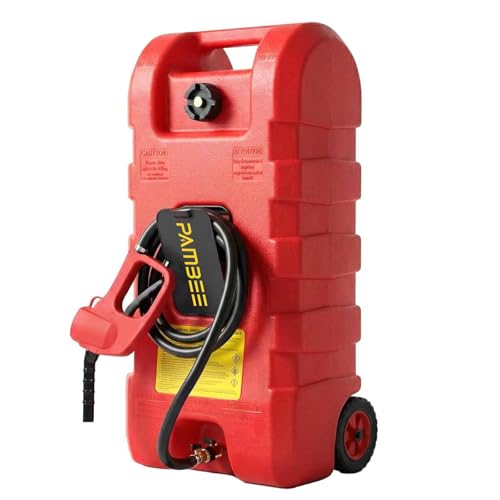
Unlike the marine tanks, this 15-gallon container is a wheeled caddy with a manual siphon pump and 10-foot hose, making it suited to moving fuel from storage toward equipment. Its uses include boats, but the features do not establish a marine tank fitting or boat-mount design. The tank and nozzle are high-density polyethylene, and the hose is automotive-grade rubber. The maker says siphon mode can reach 3 gallons per minute, with speed dependent on pumping. This is a transfer tool, not the most direct choice when you need a portable tank that connects to an outboard fuel line.
Bottom line: Choose it for wheeled fuel transfer rather than a connected boat tank.
Garvee 15-Gallon Fuel Caddy

This yellow 15-gallon caddy offers a large wheeled-container format for moving fuel, rather than a marine tank profile for fitting aboard. Its industrial-grade HDPE construction and manual fuel transfer pump suit buyers who need a portable supply for several kinds of equipment, including boats. The maker describes dual shut-off valves, vapor-tight seals, a child-resistant cap, and anti-static grounding. The features do not establish a compatible marine fuel-line fitting, so verify the transfer connection before relying on it for a particular boat. Its 35-inch height also calls for storage space well beyond the footprint of a compact tank.
Bottom line: Pick it for sizable wheeled transfers, not underseat boat storage.
Eagle 5-Gallon Type I Steel Safety Can

This is the only steel container in the group: a 5-gallon Type I safety can with one opening for filling and pouring. Its funnel, gasketed spout cap, and non-sparking flame arrester make it a different choice from the portable marine tanks, which have fuel pick-ups and sight gauges. Eagle says the can meets OSHA Standard 1910.106 and NFPA Code 30 requirements and is FM, UL, and ULC approved. It suits shore-side storage or transfer where a safety can is wanted, but it is not presented as a boat-mounted tank or as having a marine fuel-line fitting.
Bottom line: Choose this for steel safety-can storage, not a connected outboard tank.
How to choose a boat fuel container
Start with the container’s job: an outboard’s portable tank, a wheeled transfer caddy, or a shore-side safety can. A marine tank with a fuel pick-up is the direct choice for an outboard connection; a long hose and pump identify a transfer caddy instead. For volume, 1 US gallon of gasoline weighs roughly 6 pounds, so a full 6-gallon tank adds about 36 pounds of fuel and a full 12-gallon tank about 72 pounds, before container weight. Choose the 6-gallon tank if the available space is shorter than the 12-gallon tank’s 13.9-inch height; choose the larger tank only when its footprint and loaded weight can be safely secured. Check the fuel-line fitting and tank placement against the boat and motor requirements before use.
Marine tank size and fit
Measure the storage opening in three dimensions, including the route through which the tank must pass; a tank that fits under a seat may not fit through a hatch. The compact marine tank measures 19.3 by 12.2 by 10.2 inches, while the tall tank is 22.9 by 14.3 by 13.9 inches. Keep enough room to reach the cap, gauge, and fuel connection without forcing or bending the hose. A marine tank’s gauge can help monitor remaining fuel, but capacity alone cannot predict range: engine consumption, boat load, speed, and conditions change how long fuel lasts. Secure a portable tank so it cannot slide or tip as the boat moves, and confirm the fuel-line connector matches the outboard before setting off.
Gasoline handling on a boat
Gasoline vapors can ignite, so refuel portable tanks away from ignition sources and never smoke while handling fuel. Shut off the engine and allow hot components to cool before refueling; close doors, hatches, and ports during fueling, then ventilate enclosed spaces before starting the engine. Gasoline vapor can collect low in a boat, including in the bilge, so use the installed ventilation system and check for fuel odors before restarting. Keep containers upright and closed when not dispensing, and do not overfill: leave room for fuel expansion rather than filling to the brim. Use only a container intended for the fuel and task, and clean spills promptly with safe handling that keeps fuel out of the water.
Marine tanks, caddies, and safety cans compared
Container type matters more than capacity when deciding how fuel reaches the engine. A portable marine tank has a fuel pick-up intended for a compatible marine line; a wheeled caddy transfers fuel through a hose or pump, while a Type I safety can is designed for filling and pouring. The table separates these use cases so capacity is not mistaken for compatibility.
| Container type | Typical use | What to verify |
|---|---|---|
| Portable marine tank | Fuel supply to an outboard | Line fitting, tank restraint, available space |
| Wheeled caddy | Moving fuel to equipment | Hose reach and transfer connection |
| Type I safety can | Shore-side filling and pouring | Spout suitability and secure transport |
A transfer hose is not automatically an outboard connector, and a safety can does not become a marine tank simply because it holds gasoline. For direct outboard use, select a marine tank and verify the matching fuel-line fittings; for dock-side replenishment, a caddy or safety can may suit the transfer task without being mounted aboard.
Frequently Asked Questions
How much does a full boat gas tank weigh?
Gasoline weighs roughly 6 pounds per US gallon, so fuel alone adds about 36 pounds to a full 6-gallon tank and 72 pounds to a full 12-gallon tank. Include the container’s weight when planning how to carry or secure it.
Can I use a gas caddy with an outboard motor?
A caddy can transfer gasoline, but its hose or pump is not automatically compatible with an outboard. Verify the motor’s fuel-line connection and the caddy’s transfer method before relying on it.
Should I fill a portable tank on the boat?
Refuel portable tanks away from ignition sources, with the engine off and hot components cooled; shore-side fueling is the safer practical choice. Close openings during fueling, avoid overfilling, and ventilate enclosed spaces before starting the engine.
How do I keep a portable tank from shifting?
Restrain the tank upright with a purpose-made holder or secure tie-down so it cannot slide or tip as the boat moves. Leave access to the cap and fuel connection, and keep the hose from being pinched.
Why does gasoline smell collect in a boat bilge?
Gasoline vapor can settle in low spaces such as the bilge, where an ignition source can make it dangerous. Do not start the engine when fuel odor is present; ventilate and locate the source before operating the boat.