
Best Tuff Shed Locking Door Handles Compared by Fit

StartFine 6½-Inch T-Handle Lock is the closest match for a Tuff Shed locking door handle because it is identified for Tuff Shed use and fits doors up to 6 inches thick. Measure your door and confirm its lock-hole layout before ordering, since compatibility with a particular Tuff Shed model is not established here.
Choose a different stem length if your door thickness falls outside that range or if the existing opening and hardware require a different handle style.
We earn a commission if you buy through links on this page. As an Amazon Associate I earn from qualifying purchases. Products are compared on manufacturer specifications, not hands-on testing.
- Best overall: StartFine 6½-Inch T-Handle Lock – Identified for Tuff Shed use and fits doors up to 6 inches thick.
- Best for thinner doors: 4½-Inch Stem L-Handle Lock Kit – Its 4½-inch stem is specified for doors 3½ inches thick or less.
- Best for longer stem reach: 7½-Inch Stem L-Handle Lock Kit – A 7½-inch stem and five keys suit buyers seeking a longer stem.
| Product | Best for | Stem length | Maximum door thickness | Keys included | Shop |
|---|---|---|---|---|---|
| StartFine 6½-Inch T-Handle Lock | Tuff Shed doors | 6½ in | 6 in | 4 | Check Price on Amazon |
| 4½-Inch Stem L-Handle Lock Kit | Thinner shed doors | 4½ in | 3½ in | 2 | Check Price on Amazon |
| QANVEE T-Handle Lock Kit | Four-key sets | 4½ in | 3½ in | 4 | Check Price on Amazon |
| 7½-Inch Stem L-Handle Lock Kit | Long stem reach | 7½ in | — | 5 | Check Price on Amazon |
Tuff Shed Locking Door Handles
Compare stem length and stated door-thickness fit before matching a handle to your shed’s existing opening.
StartFine 6½-Inch T-Handle Lock

For a Tuff Shed handle with a longer stated door reach, this StartFine kit has a 6½-inch zinc-plated spindle and is specified for doors up to 6 inches thick. The set includes an outside locking T-handle, inside D-handle, keys, screws and a hex key; its finish is black powder coating. The maker also identifies use on barns, playhouses and chicken coops. The thickness range is the key limitation: measure the door first, and confirm the existing hole and mounting arrangement match before choosing this handle.
Bottom line: Choose this if your door is no more than 6 inches thick and you want the Tuff Shed-named option.
4½-Inch Stem L-Handle Lock Kit

Unlike the longer-stem options, this L-handle kit is explicitly sized for shed doors 3½ inches thick or less. It has a chrome-plated zinc-alloy construction with a black powder-coated finish, an adjustable rear D-handle, and two keys. Installation calls for a ⅜-inch drive bit, and the inner handle’s set screw is adjusted with an Allen key. Its thickness limit makes it a poor match for a door thicker than 3½ inches, even if the handle style appeals to you.
Bottom line: Choose this for a shed door at or below 3½ inches thick when an L-handle is suitable.
QANVEE T-Handle Lock Kit

For buyers preferring a T-handle rather than an L-handle, this QANVEE set pairs a 4½-inch stem with a door limit of 3½ inches. It includes an adjustable back D-handle, four keys, two Phillips-head screws and an Allen wrench, with a black powder-coated finish. The maker says sets are keyed alike in batches of 200 and different for the next batch, so separate purchases may not share a key. Its short stem and thickness ceiling rule it out for thicker doors.
Bottom line: Choose this for a door up to 3½ inches thick if you want a T-handle and four keys.
7½-Inch Stem L-Handle Lock Kit
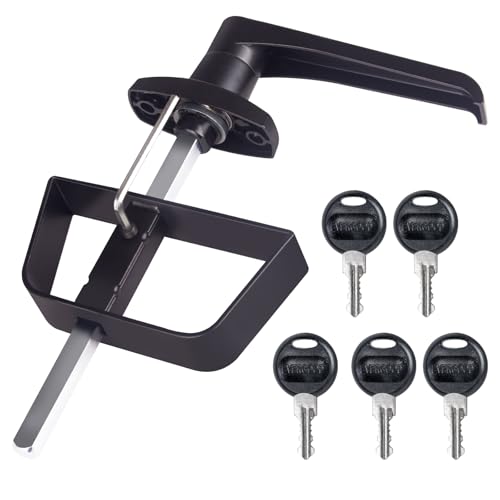
The standout distinction here is its 7½-inch stem, the longest among these choices, plus five keys. This black metal L-handle lock kit is described for sheds, playhouses, chicken coops and campers. The longer stem may be relevant when the door or mounting arrangement calls for more reach, but a stem length alone does not establish the maximum door thickness it can secure. Measure the door and verify the stem and mounting layout before selecting it; this kit is a less certain fit when you need a thickness limit.
Bottom line: Choose this when a 7½-inch stem and five keys matter, after confirming fit for your door.
How to match a shed lock stem to door thickness
Match the lock’s usable stem reach to the full door thickness, including any trim or spacers that the handle must pass through. Among these choices, the 4½-inch kits are specified for doors up to 3½ inches, while the 6½-inch kit is specified for doors up to 6 inches; the 7½-inch kit has no stated thickness limit. Measure the door at the lock location rather than relying on a nominal shed-wall thickness. If the handle reaches through too little material, its inside hardware may not seat correctly; excess stem can also interfere with mounting. Confirm the opening and fastener positions against the existing door before drilling.
Choose between T-handles and L-handles
A T-handle turns from the outside and is commonly used on shed doors, while an L-handle turns from an offset grip; either style needs an inside component that engages the latch or locking mechanism. The kits differ in handle form: QANVEE T-Handle Lock Kit and StartFine 6½-Inch T-Handle Lock are T-handle sets, while 4½-Inch Stem L-Handle Lock Kit and 7½-Inch Stem L-Handle Lock Kit are L-handle kits. Use the existing handle shape and hole layout as a starting point, but do not assume that matching the outside shape guarantees matching the spindle or latch. A lock can deter casual entry, but a handle alone is not a security rating for the door, frame or shed. For valuable contents, consider the whole door-and-frame assembly.
Use this fit guide to narrow the options by door thickness:
| Door thickness | Candidate stem | Fit note |
|---|---|---|
| Up to 3½ in | 4½ in | Two kits specify this limit |
| Over 3½ in through 6 in | 6½ in | One kit specifies this limit |
| Over 6 in | 7½ in | Verify usable reach and fit first |
Check the hole and installation before replacing a handle
Existing hole diameter and spacing matter as much as stem length: a replacement with a different spindle layout may require new drilling or may not cover the old opening. Measure the current hole and compare the inside and outside handle positions before buying. One kit specifies a ⅜-inch drive bit for installation, but that drilling size should not be assumed for the other kits or for your shed. Protect the door surface from splintering when drilling, and keep fingers clear of the latch mechanism while aligning parts. Tighten the set screw or fasteners securely, then operate the lock from both sides with the door open before closing it.
What key count and finish mean for shed use
Key counts range from two to five across these kits, so choose enough copies for the people who need access and store a spare separately. Key count does not tell you whether locks purchased later will use the same key; QANVEE T-Handle Lock Kit and StartFine 6½-Inch T-Handle Lock state batch-based keying, and separate sets may differ. All four options are black, with powder-coated finishes specified for 4½-Inch Stem L-Handle Lock Kit, QANVEE T-Handle Lock Kit and StartFine 6½-Inch T-Handle Lock. Outdoor exposure can wear coatings and expose metal to moisture, so inspect the handle and fasteners periodically for looseness, corrosion or binding. Keep the lock cylinder clean and use a lubricant intended for locks rather than thick grease that can collect grit.
Frequently Asked Questions
How do I measure a shed door for a replacement handle?
Measure the door thickness at the handle opening, including any cladding or trim the stem must cross. Then compare it with the kit’s maximum door thickness and check the existing hole layout.
Can I use a T-handle in place of an L-handle?
Only if the spindle, latch engagement and mounting layout are compatible. T- and L-handles describe different outside grips, not a guaranteed interchangeable mechanism.
Do matching shed locks use the same key?
Not necessarily. The QANVEE and StartFine kits say their keying is alike within batches of 200 and different for the next batch, so separate purchases may not match.
How often should I check an outdoor shed lock?
Inspect the handle, fasteners and key operation at least seasonally and after severe weather. Address looseness, corrosion or binding before the lock becomes difficult to operate.