
Jafanda Air Purifiers: 5 Models Compared by Coverage

For most rooms, the Jafanda JA280 is the clearest starting point because its AHAM-rated CADR values show how quickly it cleans smoke, dust and pollen. Choose a different model if you need app control for a large space, a smaller bedroom unit or a ultra-quiet sleep mode.
Air purifiers pull room air through filters; compare clean-air delivery and air changes per hour rather than relying on a square-foot figure alone.
We earn a commission if you buy through links on this page. As an Amazon Associate I earn from qualifying purchases. Products are compared on manufacturer specifications, not hands-on testing.
- Best overall: Jafanda JA280 – AHAM-certified CADR ratings make its smoke, dust and pollen delivery straightforward to compare.
- Best for very large rooms: Jafanda JF888 – Its 488 CFM CADR and coverage up to 3,800 square feet at one air change per hour suit expansive spaces.
- Best for small rooms: Jafanda JF100 – The compact JF100 is rated for 450 square feet at one air change per hour and has a 22 dB sleep mode.
| Product | Best for | Coverage rate | Sleep-mode noise | CADR | Shop |
|---|---|---|---|---|---|
| Jafanda JA280 | Everyday room sizing | 209 sq ft at 4.8x/hour; 1 | — | 135 smoke / 143 dust / 164 pollen CFM | Check Price on Amazon |
| Jafanda JF888 | Expansive open rooms | 3,800 sq ft at 1x/hour; 760 sq ft at 5x/hour | 22 dB | 488 CFM | Check Price on Amazon |
| Jafanda JF260 | Flexible room coverage | 1,190 sq ft at 1x/hour; 595 at 2x; 238 at 5x | 23 dB | 153 CFM | Check Price on Amazon |
| Jafanda JF100 | Small bedrooms | 450 sq ft at 1x/hour | 22 dB | — | Check Price on Amazon |
| Jafanda JF068 | Quiet sleep use | 1,076 sq ft at 1x/hour | 20 dB | — | Check Price on Amazon |
Jafanda air purifiers compared
Match the coverage rate and clean-air delivery to your room before weighing extras such as controls or a night light.
Jafanda JA280
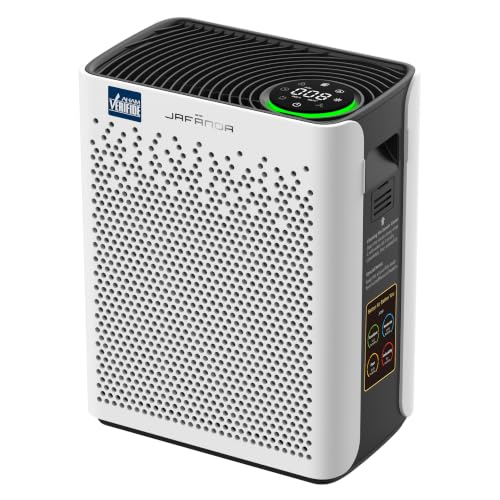
The JA280 stands apart with AHAM-certified CADR figures, giving buyers a more useful sizing basis than a square-foot maximum alone. Its smoke, dust and pollen CADR ratings are 135, 143 and 164 CFM, respectively; the manufacturer says it cleans up to 4.8 times per hour in 209 square feet and covers 1,015 square feet at one air change per hour. It also has dual-sided intake, washable pre-filters and three-stage HEPA filtration. It suits buyers who prioritize measurable delivery; its larger-area figure means only one air change hourly.
Bottom line: Choose this model when CADR-backed sizing matters more than a high one-change coverage figure.
Jafanda JF888
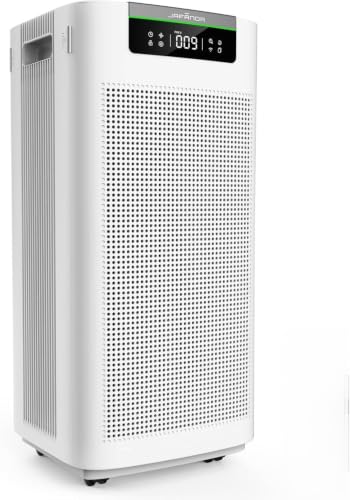
The JF888 has the highest clean-air delivery and room coverage in this group, with a 488 CFM CADR and dual-in, dual-out airflow. The manufacturer gives coverage at three rates: 3,800 square feet for one air change hourly, 1,900 square feet for two and 760 square feet for five. App and Alexa control, an auto mode and a PM display add monitoring and control options. Its size—about 25.9 inches wide—makes it a better fit for a large floor area than a crowded bedside table. The one-change figure is not equivalent to frequent room cleaning.
Bottom line: Pick it for a broad room where app control and high airflow are priorities.
Jafanda JF260

The JF260 gives three coverage rates, so buyers can choose between a large footprint and more frequent air turnover. Its CADR is 153 CFM; the manufacturer says it covers 1,190 square feet at one air change per hour, 595 at two and 238 at five. The three-in-one filter uses true HEPA and 300 grams of activated carbon, while auto mode adjusts fan power based on surrounding air quality. A 23 dB sleep mode and night light make it a bedroom candidate. Its five-change coverage is much smaller than its headline one-change area.
Bottom line: Choose it when you want auto mode and a clearly stated five-change room size.
Jafanda JF100

The JF100 is the smallest option here by physical dimensions, at about 7.1 inches wide and 11.3 inches tall, and its coverage is 450 square feet at one air change per hour. The manufacturer says its filter captures 99.97% of particles as small as 0.01 microns, including dust, pollen, smoke, odors and pet dander. It also offers three fan speeds, a child lock, scheduled startup and a 22 dB sleep mode. This compact model fits a small bedroom or office; the coverage figure describes only one hourly air change, so it is not a high-turnover rating.
Bottom line: Pick it for a smaller space where a compact footprint and child lock help.
Jafanda JF068

The JF068 is distinguished by its 20 dB sleep-mode claim, the lowest sleep-noise figure among the models with a value. The manufacturer says it completes one filtration cycle per hour in rooms up to 1,076 square feet and describes its filter as a three-in-one HEPA system. That combination makes it a reasonable bedroom or office choice for shoppers focused on sleep-mode noise. The broad coverage is based on one hourly cycle, however, so buyers who need several air changes an hour should choose by CADR or a higher-turnover coverage figure instead.
Bottom line: Choose it for sleep-mode quiet when one hourly filtration cycle meets your room needs.
How to choose a Jafanda air purifier by room size
Start with CADR and the air-change rate, not the largest square-foot claim. For a standard 8-foot ceiling, a common AHAM sizing rule is a smoke CADR of at least two-thirds of the room’s area in square feet: a 300-square-foot room calls for about 200 CFM. That targets roughly five air changes per hour. Higher ceilings or open layouts need more clean-air delivery, and smoke CADR is the cautious value to use when comparing mixed pollutants. A purifier rated for 1,000 square feet at one air change per hour is not equivalent to one sized for the same area at five changes. Choose the coverage figure closest to your desired turnover rate.
What the coverage numbers mean
Coverage describes a room area paired with an air-change rate; the rate is essential to interpreting the figure. Air changes per hour count how many room volumes pass through the cleaner each hour, so five changes provide more frequent filtration than one. The JA280 and JF260 give more than one rate, while some other models show only a one-change maximum. Use this table as a rate-first comparison, not as a guarantee for every floor plan. For a bedroom under 250 square feet where you want roughly five changes hourly, favor a model with a coverage near that size rather than extrapolating from a much larger one-change figure.
| Model | Coverage at stated rate | Decision cue |
|---|---|---|
| JA280 | 209 sq ft at 4.8x/hour | Use its CADR ratings for sizing |
| JF260 | 238 sq ft at 5x/hour | Useful for a defined smaller-room rate |
| JF888 | 760 sq ft at 5x/hour | For large rooms needing frequent turnover |
| JF100 | 450 sq ft at 1x/hour | Compact unit; allow for lower turnover |
| JF068 | 1,076 sq ft at 1x/hour | Quiet-mode priority at low turnover |
How HEPA and carbon filters differ
HEPA-style media capture airborne particles, while activated carbon adsorbs some gases and odors; neither filter does the other’s job. Particle efficiency claims depend on the test conditions and filter setup, and a tight seal matters because air can bypass a filter through gaps. Carbon performance also depends on the amount of carbon and the gas involved, so do not treat an odor claim as universal gas removal. A purifier is not a substitute for source control or ventilation: address smoke, cooking emissions or moisture at their source when possible. Avoid ozone-generating air cleaners, particularly in occupied rooms, because ozone irritates lungs.
Where to place and maintain an air purifier
Leave open space around the intake and outlet so furniture, curtains or bedding do not obstruct airflow. Keep the unit on a stable, dry surface and avoid placing it where spills or bathroom humidity can reach electrical parts. Washable pre-filters can catch larger debris, but they need to dry completely before reuse; a damp filter can encourage unwanted growth and restrict airflow. Replace the main filter on the manufacturer’s schedule, with earlier replacement potentially needed in smoky or dusty conditions. A clogged filter reduces airflow, so persistent dust buildup or a weaker air stream is a cue to inspect the filters rather than simply raising fan speed.
Frequently Asked Questions
How many air changes per hour should a bedroom purifier provide?
About five air changes per hour is a common sizing target for portable air cleaners. For an 8-foot-ceiling room, use a smoke CADR near two-thirds of the floor area in square feet as a starting point.
Does a larger square-foot rating mean stronger cleaning?
Not by itself: coverage must be compared at the same air-change rate. A 1,000-square-foot rating at one change per hour delivers less frequent turnover than that same area rated at five changes per hour.
Where should I place an air purifier in a bedroom?
Keep the intake and outlet unobstructed, ideally with several inches of open space around the unit. Avoid placing it behind curtains, beside bedding that blocks the airflow, or where water can reach its electrical components.
Can an air purifier remove cooking odors and gases?
Activated carbon can adsorb some gases and odors, but performance depends on carbon quantity and the specific gas. HEPA media captures particles rather than gases, so ventilation and source control remain important for cooking emissions.
How often should I replace an air purifier filter?
Many portable purifier filters are replaced about every 6 to 12 months, but smoke and heavy dust can shorten that interval. Check the filter condition and airflow regularly, and use the model’s recommended replacement schedule.