
Car Subwoofers With Built-In Amps: 4 Compared

For most buyers, Rockville RWS12CA 12-inch Slim Powered Subwoofer is the best fit because its built-in amp is rated at 300W RMS and it offers high- and low-level inputs plus adjustable crossover control. Choose LUVUMVLT 10-inch Slim Under-Seat Subwoofer instead if its 3.54-inch profile better suits the space under your seat.
A powered car subwoofer combines a subwoofer enclosure and amplifier in one unit. Separate-amp packages such as Skar Audio SDR Single 12-inch Bass Package may suit buyers who can accommodate a larger enclosure and additional components.
We earn a commission if you buy through links on this page. As an Amazon Associate I earn from qualifying purchases. Products are compared on manufacturer specifications, not hands-on testing.
- Best overall: Rockville RWS12CA 12-inch Slim Powered Subwoofer – Its built-in 300W RMS amp, high- and low-level inputs, and adjustable crossover offer useful setup flexibility.
- Best for shallow spaces: LUVUMVLT 10-inch Slim Under-Seat Subwoofer – Its 3.54-inch profile is the shallowest measurement among the built-in-amp options.
| Product | Best for | RMS power | Profile or enclosure | Shop |
|---|---|---|---|---|
| Rockville RWS12CA 12-inch Slim Powered Subwoofer | Flexible connections | 300W | 24 × 15 × 4.37–6.65 in. (feature dimensions) | Check Price on Amazon |
| LUVUMVLT 10-inch Slim Under-Seat Subwoofer | Shallow mounting | 220W | 13.58 × 10.25 × 3.54 in. | Check Price on Amazon |
| Skar Audio SDR Single 12-inch Bass Package | Separate amp setup | 600W | 22 × 23.25 × 21 in. | Check Price on Amazon |
| MTX Terminator Dual 12-inch Sealed Bundle | Dual sealed drivers | — | Dual 12-inch sealed enclosure | Check Price on Amazon |
Car Subwoofers With Built-In Amps
Compare integrated-amp options by continuous power, fit, and connection features before choosing a setup.
Rockville RWS12CA 12-inch Slim Powered Subwoofer
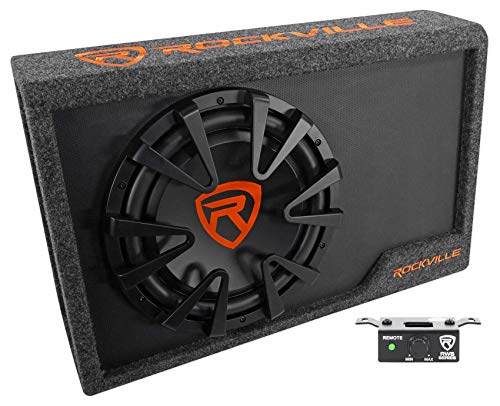
Unlike the 220W RMS option, this 12-inch powered subwoofer pairs a built-in 300W RMS mono amp with high- and low-level inputs, making it adaptable to factory or aftermarket audio systems. The maker specifies an adjustable 50–250 Hz low-pass crossover, +12 dB bass boost, and a dash bass remote. Its enclosure measurements are 24 × 15 × 4.37–6.65 inches, so measure the intended space carefully before choosing it. The profile may be a drawback where seat clearance is especially tight, and the two sets of dimensions in the specifications do not agree; verify the enclosure measurements before ordering.
Bottom line: Choose this if you want integrated amplification with multiple input types and adjustable crossover control.
LUVUMVLT 10-inch Slim Under-Seat Subwoofer

The 3.54-inch thickness is the key distinction here: this 10-inch subwoofer-and-amp combination is designed for a shallow under-seat location. The maker gives its power as 220W RMS and 1,200W peak, and the dimensions are 13.58 × 10.25 × 3.54 inches. An aluminum alloy grille and blue LED halo add visual features, while the cast aluminum housing is intended to dissipate heat. Its lower RMS rating than Rockville RWS12CA 12-inch Slim Powered Subwoofer may matter to buyers prioritizing higher continuous power. Check seat movement and clearance before installation, since a slim profile alone cannot establish fit in every vehicle.
Bottom line: Pick this when a shallow under-seat profile is more important than higher stated RMS power.
Skar Audio SDR Single 12-inch Bass Package
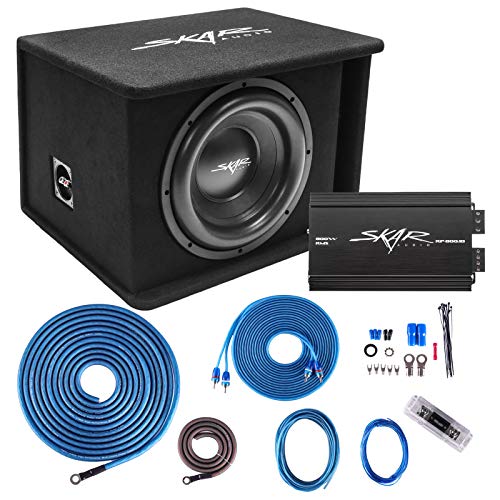
Unlike the integrated-amp choices, this package has a separate RP-800.1D Class D monoblock amplifier, a loaded vented enclosure, and a 4-gauge wiring kit. The package is rated at 600W RMS and 1,200W peak, with a single 12-inch SDR subwoofer in a D2 enclosure. Its enclosure dimensions are 22 × 23.25 × 21 inches and its weight is 71 pounds, so it calls for substantially more cargo space than a slim powered unit. Choose it only if a separate amplifier and larger enclosure suit the installation; it is not a subwoofer with a built-in amp.
Bottom line: Choose this if you want a separate amplifier and can accommodate a large vented enclosure.
MTX Terminator Dual 12-inch Sealed Bundle

This bundle differs from powered subwoofers because it combines a dual 12-inch sealed enclosure with a mono amp and 4-gauge wiring kit rather than placing the amplifier inside the subwoofer enclosure. The sealed box uses a 5/8-inch MDF body with carpet wrap, and its two-driver layout is intended for trunk or cargo-area installation. The specifications do not give a reliable enclosure footprint or an RMS power figure, so those are important to confirm for a planned installation. It may suit buyers seeking two sealed drivers, but it is not the integrated, compact format implied by a built-in-amp search.
Bottom line: Consider this if you specifically want a dual-driver sealed enclosure with a separate amp.
How to Choose a Powered Car Subwoofer
Start with RMS power, enclosure dimensions, and the signal connections your stereo supports. RMS is the continuous-power figure to compare; peak power describes short bursts and should not be used as the main match point. A powered subwoofer has its amplifier integrated into the enclosure, while a bass package with a separate amp needs space and wiring for both components. Factory stereos commonly provide speaker-level outputs, while aftermarket receivers often offer RCA preamp outputs; check which connection type your system has before selecting inputs. If you need factory-radio compatibility, choose a unit with high-level inputs. Treat controls such as crossover and bass boost as tuning options, not substitutes for matching the subwoofer to the space and system.
How to Measure Under-Seat Fit
Measure the usable width, depth, and height under the seat at its lowest position, then repeat with the seat moved through its full travel. Leave room for power and signal cables, ventilation, and access to controls; an enclosure that fits only when the seat is raised is a poor match. Subwoofer enclosures can be deeper at one end or have protruding connectors, so a single height measurement may miss an obstruction. With less than 4 inches of usable height, prioritize a product whose thickness is below that limit and verify clearance at the thickest point. Keep the unit clear of seat tracks, moving mechanisms, and airbag deployment areas, and never route wiring where a seat can pinch it.
Built-In Amp Versus Separate Amp Packages
An integrated amplifier keeps the amp and subwoofer together, reducing the number of separate components to place in a vehicle. A separate-amp package can use a larger enclosure and gives the installer a distinct amplifier to position, but it requires space for both pieces and their wiring. Sealed enclosures use an enclosed air volume and are commonly chosen for controlled bass; vented enclosures use a port and need the port opening unobstructed. Use this distinction as a planning aid, not a guarantee of sound quality, because driver, enclosure, and tuning all affect output. If cargo space is tight or you want fewer components, start with powered models; if you have room for a dedicated amp and box, compare complete packages.
Safe Wiring and Setup Checks
Car audio amplifiers draw power from the vehicle electrical system, so use the correct wire gauge and an inline fuse close to the battery on the positive power lead. The fuse protects the cable if it shorts; do not bypass it or replace it with a larger rating to stop nuisance blows without checking the system requirements. Secure wiring away from sharp metal edges, pedals, hot surfaces, and seat tracks, and protect any pass-through with a grommet. Set the subwoofer gain as an input match rather than using it as a volume control, and begin with bass boost and crossover settings conservatively. Confirm polarity and turn-on behavior before reinstalling trim, then check that the unit and wiring stay clear of airbags and moving parts.
Frequently Asked Questions
What does RMS power mean on a car subwoofer?
RMS is the continuous power rating used to compare subwoofers and amplifiers. Compare RMS figures rather than peak numbers, and match the amp and subwoofer ratings according to their specifications.
Can a powered subwoofer connect to a factory stereo?
Yes, if the powered subwoofer accepts speaker-level inputs and the factory stereo provides speaker outputs. Check the input types before buying; RCA low-level inputs alone may not connect directly to a factory receiver.
How much space should I leave around an under-seat subwoofer?
Leave enough clearance for seat travel, cables, ventilation, and access to controls. Measure the available space with the seat moved through its full range, and keep the enclosure and wires clear of tracks and airbag areas.
Where should the amplifier fuse go in a car?
Install an inline fuse on the positive power cable close to the battery. The fuse protects the cable from a short, so do not omit it or route unfused power wire through the vehicle.
What is the difference between sealed and vented subwoofer boxes?
A sealed enclosure is closed around the driver, while a vented enclosure has a port that must remain unobstructed. The enclosure type affects installation space and tuning, so account for the box and port when measuring cargo room.