
One Question a Day Five-Year Journals Compared

One Question a Day: A Five-Year Journal is the closest match for a one question-a-day five-year journal because its title identifies a question-and-answer time capsule. Choose a one line journal instead if you prefer to write your own thought rather than answer a prompt; the other Q&A format is a related alternative.
We earn a commission if you buy through links on this page. As an Amazon Associate I earn from qualifying purchases. Products are compared on manufacturer specifications, not hands-on testing.
- Best overall: One Question a Day: A Five-Year Journal – Its title specifies a five-year journal built around questions and answers.
- Best for compact Q&A: Q&A a Day: 5-Year Journal – It is a compact 5-year Q&A journal measuring about 4.4 by 6.3 inches.
- Best for dated entries: Nouveau One Line a Day – It specifies dated pages and a five-year memory book format.
| Product | Best for | Format | Dimensions (in.) | Shop |
|---|---|---|---|---|
| One Question a Day: A Five-Year Journal | Daily prompts | Question-and-answer | 5.15 × 7.70 × 1.05 | Check Price on Amazon |
| Q&A a Day: 5-Year Journal | Compact Q&A | Question-and-answer | 4.41 × 6.26 × 1.30 | Check Price on Amazon |
| Nouveau One Line a Day | Dated one line entries | One-line memory book | 4 × 6.5 × 1.13 | Check Price on Amazon |
| One Line a Day: A Five-Year Memory Book | Free-form notes | One-line memory book | 4 × 6.5 × 1.33 | Check Price on Amazon |
One question a day five-year journals
Compare prompted Q&A journals with one line formats by entry style and physical size.
One Question a Day: A Five-Year Journal

One Question a Day: A Five-Year Journal is the direct choice for a reader who wants a question-and-answer format rather than a blank line to fill. Its title frames the journal as a five-year time capsule, and its dimensions are about 5.15 by 7.70 by 1.05 inches. The journal is identified as English-language with an “other” binding. A prompt-led format can make daily writing easier when you want a specific starting point, but it offers less freedom than a journal where you choose the subject. Check that the question format suits the kind of reflection you want to keep.
Bottom line: Choose this if you want a five-year journal centered on questions and answers.
Q&A a Day: 5-Year Journal

Q&A a Day: 5-Year Journal offers the same broad Q&A approach in a compact format, measuring about 4.41 by 6.26 inches. Its specifications identify it as a 5-year journal and call it compact for traveling, making it a related option for readers who want brief prompted entries. The maker does not identify a specific one question-per-day structure, so choose it for its Q&A format rather than assuming its prompts match another journal’s. A small footprint is convenient to carry, though readers who want room for longer reflections may prefer a larger journal.
Bottom line: Pick this if a compact Q&A journal matters more than a confirmed one question-per-day format.
Nouveau One Line a Day
Nouveau One Line a Day differs from a question-led journal by using a one line-a-day memory book format, with 372 dated pages. That structure suits someone who wants a short record in their own words instead of responding to a daily question. Its dimensions are 4 by 1.13 by 6.5 inches, and the color is Onyx Black. The dated-page design gives each entry a calendar anchor, but it is not the best fit if having a prompt is the main reason for choosing a journal. Choose it for concise, self-directed notes.
Bottom line: Choose this if dated one line memories fit better than prompted answers.
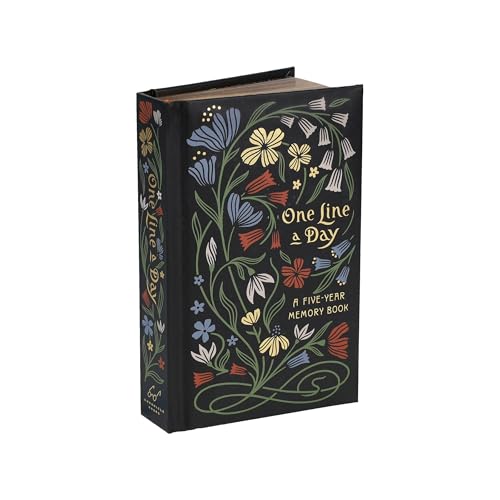
One Line a Day: A Five-Year Memory Book

One Line a Day: A Five-Year Memory Book is another one line memory book option, rather than a question-and-answer journal. Its compact dimensions are 4 by 6.5 by 1.325 inches, making it close in footprint to the dated one line alternative. The title identifies a five-year format, which lets a reader keep short memories in a recurring journal structure without relying on a prompt. That flexibility also means you must decide what to write each day. It suits people who prefer their own topics, while readers seeking a guided question each day should favor a Q&A format.
Bottom line: Pick this if you want a compact, self-directed one line journal.
How to choose a five-year journal format
Choose a question-and-answer journal for guided reflection and a one line format for free-form notes. A five-year journal revisits a calendar date across successive years, so a short entry can show how a thought or routine changes over time. Question-led books supply a starting point; one line books leave the subject to you. If you want to write more than a sentence or two, look for a larger page format rather than assuming a five-year layout offers room for long entries. The useful decision rule is simple: choose Q&A when you want a prompt to remove the daily blank-page decision, and choose one line when control over the subject matters more.
What five-year journal dimensions mean
Compare height, width and thickness separately because a book that is easy to carry may have less room for handwriting. These options are roughly 4 to 5.15 inches wide and 6.26 to 7.70 inches tall, with thicknesses around 1.05 to 1.33 inches where dimensions are supplied. Measure the space where you plan to store the journal and consider whether you write with large lettering. Compact formats work well for brief entries, while a taller or wider page can be easier for larger handwriting. Dimensions are exterior measurements, not a guarantee of writing area, so choose based on the amount of text you expect to enter.
Question prompts versus one line entries
Question prompts guide what to record, while a one line journal expects you to choose the subject. A prompted entry is useful when you want a repeatable reflection routine; a free-form line works when your daily memory may be unrelated to a fixed question. Use this comparison to match the format to your writing habit.
| Writing need | Format to choose | Tradeoff |
|---|---|---|
| A daily starting point | Question-and-answer | Less control over the topic |
| Own topic, brief note | One line memory book | You supply the subject |
| Long reflections | Larger writing format | May be less portable |
How to build a daily journal habit
Keep the journal where you already pause each day, such as beside a reading chair or on a nightstand, and write a phrase rather than waiting for the perfect entry. A consistent cue is more dependable than relying on memory, especially when the journal is meant for daily use. For a five-year format, briefly check the date before writing so entries land under the intended day. If you miss a day, resume at the current date rather than trying to reconstruct several entries from memory. A one line record can be enough to preserve a detail, while a prompt can help when nothing immediately comes to mind.
Frequently Asked Questions
What is the difference between a one line and Q&A journal?
A one line journal leaves the topic to you, while a Q&A journal uses questions to guide entries. Choose Q&A if deciding what to write is the main obstacle; choose one line for more freedom.
How much should I write in a five-year journal?
A short phrase or sentence is enough for a one line format. If you regularly want to write several paragraphs, select a journal with more page space rather than relying on a compact daily layout.
How do I keep a daily journal habit?
Attach writing to an existing daily routine and keep the journal within reach. A fixed cue, such as writing before bed, is easier to repeat than waiting for inspiration.
What should I do after missing a journal day?
Resume with the current date instead of filling several missed entries from memory. A brief, accurate record is more useful than guessing what happened on earlier days.
Are five-year journals good for long entries?
Five-year journals are generally designed for concise daily records, not long-form writing. If you need more than a sentence or two per entry, choose a larger format with more writing room.