
Best Solar Fence Charger for Cattle: 4 Compared

For most cattle setups, Zareba 5-Mile Solar Energizer is the clearest fit because its low-impedance design is intended for livestock and its maker says it can power up to 5 miles in ideal conditions.
Choose a different unit if your priority is a specified joule rating, a longer backup claim, or a solar-and-AC power option; fence length alone does not determine whether a charger can keep a cattle fence effective.
We earn a commission if you buy through links on this page. As an Amazon Associate I earn from qualifying purchases. Products are compared on manufacturer specifications, not hands-on testing.
- Best overall: Zareba 5-Mile Solar Energizer – Low-impedance design for livestock, with a maker-claimed 5-mile reach in ideal conditions.
- Best for higher energy: Epoify 1.2J Solar/AC Charger – Its 1.2J stored energy and included AC adapter suit buyers prioritizing a stronger energy rating and backup power.
- Best for battery capacity: PLOWIC 0.20J Solar Charger – A 10,400mAh battery and IP55 rating are specified for outdoor use.
| Product | Best for | Energy | Fence reach | Backup power | Shop |
|---|---|---|---|---|---|
| Zareba 5-Mile Solar Energizer | Livestock fencing | — | 5 miles | Up to 2 weeks | Check Price on Amazon |
| Epoify 1.2J Solar/AC Charger | Higher energy rating | 1.2J stored | 45 miles | — | Check Price on Amazon |
| PLOWIC 0.20J Solar Charger | Battery capacity | 0.20J output | 10 miles | 10,400mAh | Check Price on Amazon |
| 0.11J Solar Charger | Small farm fencing | 0.11J | 10 miles | Up to 30 days | Check Price on Amazon |
Solar Fence Chargers for Cattle
Compare energy ratings and power backups first, then match the charger to the fence load and site conditions.
Zareba 5-Mile Solar Energizer
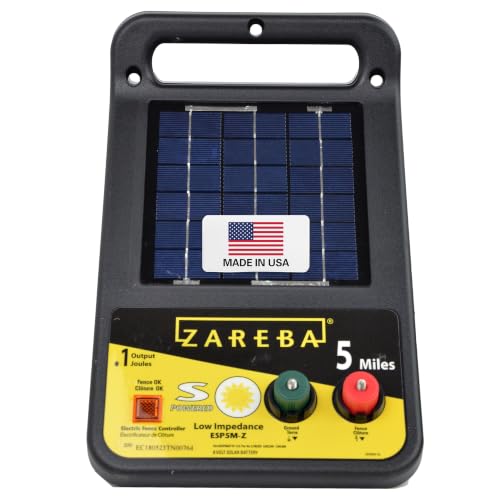
For cattle and other livestock, this charger stands out for its low-impedance design and post-mounting flexibility. The maker says it can energize up to 5 miles of fence in ideal conditions and operate for up to 2 weeks without sunlight. Its bracket fits T-posts, Y-posts and round-wood posts, and the charger rotates 360 degrees to help orient it toward the sun. That combination suits rotational grazing and remote paddocks. The reach figure is not a guarantee for every fence: wire condition, vegetation touching the line and grounding all affect performance, so plan for the actual fence load.
Bottom line: Choose this for cattle fencing when flexible post mounting and a low-impedance design matter.
Epoify 1.2J Solar/AC Charger

This unit is the energy-focused alternative, with 1.2 joules of stored energy, an 8W solar panel and an included AC adapter. The maker gives a 7–11kV pulse-output range and says the charger can cover up to 45 miles; those figures make it worth considering for a larger or more demanding fence, but a reach claim is not a substitute for checking the fence load. The use includes cattle along with other livestock. A short-circuit alarm and sealed magnetic switch are also named features. Choose it if you want solar plus AC backup; the maker does not establish how long it runs without either power source.
Bottom line: Pick this if the 1.2J energy rating and AC backup matter more than a no-sun runtime.
PLOWIC 0.20J Solar Charger

Battery capacity is the differentiator here: this charger pairs a 10,400mAh rechargeable battery with a 3W solar panel. The maker says it outputs up to 0.20 joule and 8kV, and powers up to 10 miles of fence. Its IP55 waterproof rating and stated operating range of -4°F to 122°F add useful outdoor-use specifications. The maker describes it for cattle, poultry, pets and gardens, so it is a more general-purpose choice than a cattle-specific energizer. Its lower stated output energy than Epoify 1.2J Solar/AC Charger may matter on a longer or heavier fence; compare the joule rating against the fence load rather than relying on advertised miles.
Bottom line: Choose this for a general-purpose setup where battery capacity and an IP55 rating are priorities.
0.11J Solar Charger

This charger emphasizes a long backup claim and a small 5W monocrystalline panel: its maker says it recharges in 6 sunny days and provides up to 30 days of backup. The 0.11J rating and adjustable 8,100V pulse are specified, along with waterproof construction and low-temperature operation. The maker positions it for gardens, small livestock farms and pet farms, making it a less clearly cattle-focused option than a low-impedance livestock energizer. Its 10-mile reach claim should not be read as guaranteed working length; vegetation, wire layout and grounding change the load substantially. It may suit modest fencing where the joule rating fits the system.
Bottom line: Consider this for smaller farm fencing when its backup-time claim is the deciding factor.
How to choose a solar fence charger for cattle
Choose by stored energy and fence load before comparing advertised miles. Joule ratings describe energy available for each pulse; output voltage is the brief pulse level, not a continuous shock. A longer fence, multiple wires, wet vegetation and poor connections all increase the load, so two chargers with the same reach claim can perform differently. Low-impedance energizers are designed to maintain a pulse on heavier or partially grounded fence systems, while smaller outputs suit lighter loads. A practical rule: if cattle share a long perimeter with weeds contacting the wire, favor a higher joule rating or low-impedance design over a higher mileage number alone. Plan an adequate ground system and use a fence voltmeter to check voltage at the far end.
What fence miles mean in real cattle pastures
Fence-mile claims generally describe ideal conditions, not a guaranteed working distance in a pasture. Wire count, wire material, line length, insulators, vegetation and ground quality change the electrical load; a charger may energize fewer miles when weeds touch the wire or connections corrode. A single clean strand is a lighter load than several long wires, and wet grass can drain pulses into the soil. Before buying, map the total energized wire length, including every strand, rather than measuring only the perimeter. For example, four strands around a 1-mile perimeter represent about 4 wire-miles. Keep the line clear and use a voltmeter at the farthest point to confirm that the fence holds a useful pulse.
Solar panel and battery backup for pasture use
Solar charger runtime depends on daily sunlight, panel orientation and the energy demanded by the fence. Aim the panel toward the equator—south in the United States—and keep it clear of shade and dirt; even partial shading can reduce charging. Battery capacity in milliamp-hours cannot be directly compared across products without battery voltage, while a number of backup days is a maker claim rather than a universal runtime. Choose a 360-degree mount if the post position makes sun alignment difficult, and favor AC backup when the site has accessible power and cloudy periods are a concern. Set the unit where livestock cannot rub against the panel, wiring or exposed terminals.
Grounding and cattle fence safety
A fence charger delivers short pulses, but the grounding system is essential: current must travel through the animal and soil back to the energizer for an effective circuit. Use galvanized ground rods and place them in moist soil when possible; dry, rocky ground may require additional rods or a different layout. Keep the energizer and connections away from flammable material, and never connect an electric fence to household wiring. Check local rules before placing a fence near roads or public access. A digital fence voltmeter helps identify drops caused by broken wires, weeds or loose connections; inspect the line regularly, especially after storms or grazing changes.
Comparing charger types by cattle-fence need
The right type depends on the fence load and available power, not a single mileage figure. A low-impedance livestock energizer is meant for a tougher line, while a small-output solar unit is better suited to lighter fence loads. Solar-only models rely on stored energy through cloudy stretches; a solar model with AC backup offers another power source where an outlet is available. Use the table to narrow the type, then verify the charger’s joule rating and mounting fit against the actual fence.
| Fence need | Useful deciding feature | Tradeoff to consider |
|---|---|---|
| Long or weed-prone livestock line | Low impedance or higher joule rating | Keep wire clear and confirm voltage at the far end |
| Remote pasture with no outlet | Solar panel and stated no-sun backup | Shade and poor sun exposure reduce recharge |
| Site with cloudy periods and power access | Solar plus AC adapter | Requires a usable power source at the site |
| Light garden or small paddock fence | Lower output unit matched to load | Do not assume advertised miles apply to multi-wire fencing |
Frequently Asked Questions
How many joules does a cattle fence charger need?
There is no single joule value for every cattle fence; longer lines, multiple strands and vegetation raise the load. Compare stored or output joules as labeled and favor a low-impedance model for a heavier fence.
Do solar fence chargers work on cloudy days?
They can continue running from stored battery power, but available runtime depends on sun exposure and fence demand. One product here claims up to 2 weeks without sunlight, while another claims up to 30 days; treat those as maker estimates, not guarantees.
How do I calculate fence miles for a charger?
Count every energized wire strand, not just the enclosure perimeter. A 1-mile perimeter with four energized strands is about 4 wire-miles before adding lead-out wire or separate paddocks.
Where should I aim a solar fence charger panel?
In the United States, aim a fixed panel generally south and keep it unshaded through the day. A rotating mount can help when the post location does not face the sun well.
How often should I check a cattle electric fence?
Check voltage with a fence voltmeter during routine fence walks and after storms, repairs or a change in grazing layout. Vegetation touching the wire and loose connections can quickly reduce the pulse at the far end.