
Sandblasting Media for Rust Removal: 4 Abrasives Compared

For most metal rust-removal jobs, Premium Garnet 30/60 Mesh, 80 lb is the strongest starting point because its 30/60 mesh garnet comes in an 80-pound package. Choose a different abrasive when you need a smaller amount, a finer size, or silicon carbide; abrasive size and your blaster’s requirements decide the fit.
We earn a commission if you buy through links on this page. As an Amazon Associate I earn from qualifying purchases. Products are compared on manufacturer specifications, not hands-on testing.
- Best overall: Premium Garnet 30/60 Mesh, 80 lb – 30/60 mesh garnet in an 80-pound package suits larger rust-removal jobs.
- Best for reusable grit: TITGGI Aluminum Oxide 80 Grit, 19 lb – 80-grit aluminum oxide is offered in a 19-pound package.
- Best for small projects: Aluminum Oxide 80 Grit, 1 lb – The 1-pound package is a manageable amount for limited work.
- Best for coarse cutting: LE LEMATEC Silicon Carbide 60 Grit – 60-grit silicon carbide is the coarsest labeled size among these options.
| Product | Best for | Abrasive | Size | Package weight | Shop |
|---|---|---|---|---|---|
| Premium Garnet 30/60 Mesh, 80 lb | Larger rust jobs | Garnet | 30/60 mesh | 80 lb | Check Price on Amazon |
| TITGGI Aluminum Oxide 80 Grit, 19 lb | Reusable abrasive | Aluminum oxide | 80 grit | 19 lb | Check Price on Amazon |
| Aluminum Oxide 80 Grit, 1 lb | Small metal projects | Aluminum oxide | 80 grit | 1 lb | Check Price on Amazon |
| LE LEMATEC Silicon Carbide 60 Grit | Coarse cutting jobs | Silicon carbide | 60 grit | 2.2 lb | Check Price on Amazon |
Sandblasting Media for Rust Removal
Match abrasive type and size to the metal surface, blaster, and amount of work you plan to tackle.
Premium Garnet 30/60 Mesh, 80 lb

Unlike the smaller packages here, this garnet abrasive comes in an 80-pound amount for larger rust-removal projects. The maker says its 30/60 mesh natural garnet cuts rust, oxidation, paint, and mill scale, and can be recovered for reuse. That size and quantity may suit metal preparation before painting when your equipment can handle the abrasive. The package is a drawback for spot repairs or occasional small parts: the other options come in packages from 1 to 19 pounds, which may be easier to manage for limited work.
Bottom line: Choose this for substantial rust-removal work when your blaster accepts 30/60 mesh.
TITGGI Aluminum Oxide 80 Grit, 19 lb

This 80-grit aluminum oxide option pairs a medium-sized package with an abrasive the maker says is reusable and suitable for wet or dry blasting. The maker identifies the material as brown fused aluminum oxide and says it has a Mohs hardness of 9; its applications include rust and paint removal and metal preparation. At 19 pounds, it is a middle ground between the 1-pound option and the 80-pound garnet package. Its labeled size differs from the garnet’s mesh rating, so verify that the grit is compatible with your blaster and workpiece.
Bottom line: Pick this when you want an 80-grit aluminum oxide abrasive in a mid-sized package.
Aluminum Oxide 80 Grit, 1 lb

The 1-pound package makes this aluminum oxide the smallest quantity among the four choices, useful when a project needs only a limited amount of abrasive. Its maker says the #80 angular grains are intended for rust removal, paint stripping, and matte finishing on metal, with applications such as auto and motorcycle frame cleanup. The small package is less suited to extended blasting, where frequent replenishment can interrupt work. This product also carries a #80 grit label, not the 30/60 mesh rating used for the garnet, so compare the sizing convention with your equipment guidance.
Bottom line: Choose this for a small rust-removal task or to keep abrasive quantity limited.
LE LEMATEC Silicon Carbide 60 Grit
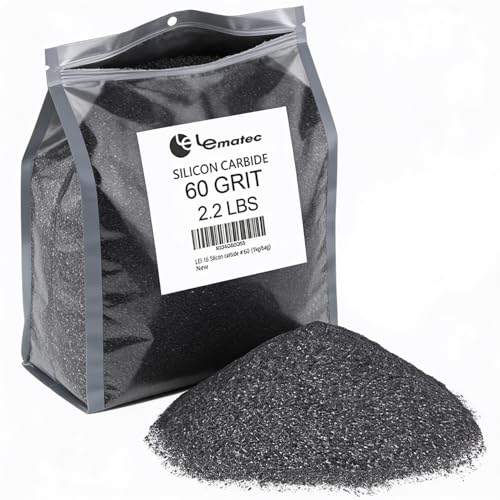
Silicon carbide distinguishes this option from the garnet and aluminum oxide abrasives, and the 60-grit size gives it a coarser label than the two 80-grit choices. The maker says it is intended for fast cutting and rust removal on metal, and also identifies rock polishing and glass or stone work as uses. Its 2.2-pound package fits modest tasks better than the large garnet quantity, but may run short on broad or heavily rusted surfaces. Check the blaster’s abrasive compatibility before use, especially when switching from another media type.
Bottom line: Pick this for a coarse silicon carbide abrasive in a small package.
How to choose sandblasting media for rust removal
Choose media by the metal, desired surface profile, and your blaster’s supported abrasive size. Aluminum oxide, garnet, and silicon carbide are hard mineral abrasives; the products here offer grit labels of 60 or 80 and a 30/60 mesh garnet. Those labels are not interchangeable by number alone: mesh describes a particle-size range, while grit labels can follow different grading conventions. As a practical rule, start with the equipment maker’s permitted media range, then test a small inconspicuous area before treating a visible surface. A finer abrasive generally removes material more gradually than a coarse abrasive, but the result also changes with nozzle size, pressure, distance, and angle.
Abrasive blasting removes rust by directing particles at the surface; the impact strips corrosion but can also damage thin metal or alter its finish. Keep the nozzle moving and use the least aggressive setting that clears the rust.
Grit size, mesh, and surface finish
Media size affects both cleaning speed and the finish left behind. A 60-grit abrasive is coarser-labeled than an 80-grit abrasive, while 30/60 mesh garnet identifies a range rather than a single grit number; do not treat those labels as direct equivalents. Coarser particles can cut aggressively and leave a more pronounced profile, whereas finer particles are generally chosen when a less aggressive finish is needed. Actual results depend on the substrate and operating setup, so test a small area before blasting an entire part.
Use a decision rule: for thin sheet metal or a finish-sensitive part, begin with a finer compatible abrasive and low pressure; for thick rusted steel, a coarser compatible abrasive can reduce the passes needed. Blasting can warp thin panels through heat and impact, so keep the nozzle moving and pause if the panel warms.
Blasting safety and cleanup
Abrasive blasting creates airborne dust and can propel particles back toward the operator. Use a purpose-built blasting cabinet or an enclosed blasting area, suitable eye and respiratory protection, gloves, and protective clothing; ordinary safety glasses do not protect the whole face. Keep bystanders out of the work zone and avoid blasting near people, pets, or open windows. Never use sand that contains crystalline silica for abrasive blasting: inhaled respirable crystalline silica can cause silicosis and other serious lung disease.
Contain spent abrasive and rust debris, and clean the work area without dry sweeping or compressed-air blowdown, which can put dust back into the air. Reuse media only when the equipment and abrasive permit it, and discard contaminated or degraded material according to local waste rules.
Match package size to the project
Package weight affects how much work the abrasive can support before replenishment, but it does not predict coverage by itself. Surface area, rust thickness, blast pressure, nozzle, and media reuse all change consumption. The 1-pound package is suited to limited tasks; larger projects may call for a larger quantity. Garnet, aluminum oxide, and silicon carbide also differ in hardness and particle shape, so a pound of one type need not cover the same area as a pound of another.
The table compares the choices by material and labeled size. Use it as a shortlist, then confirm that the abrasive type and size are approved for your equipment.
| Need | Choice | Reason |
|---|---|---|
| Large quantity | Garnet, 30/60 mesh | 80-pound package |
| Mid-sized supply | Aluminum oxide, 80 grit | 19-pound package |
| Limited amount | Aluminum oxide, 80 grit | 1-pound package |
| Coarse-labeled abrasive | Silicon carbide, 60 grit | 60-grit label |
Frequently Asked Questions
Can I use sand for removing rust by blasting?
Do not use silica-containing sand for abrasive blasting; inhaling respirable crystalline silica can cause silicosis and other serious lung disease. Use a compatible non-silica abrasive and contain the dust.
What grit should I use on rusty steel?
Choose a grit compatible with your blaster and the steel’s thickness; 60 grit is coarser-labeled than 80 grit. Test a small area first because pressure, nozzle distance, and exposure time also affect the finish.
Can blasting warp thin sheet metal?
Yes, abrasive impact and heat can warp thin panels. Keep the nozzle moving, use a conservative compatible setting, and pause if the metal warms.
How do I keep rust from returning after blasting?
Apply a suitable primer or protective coating soon after blasting, because clean steel can flash-rust when exposed to moisture. Keep the surface dry and follow the coating maker’s preparation window.