
Sage Green Food Colouring: 3 Types Compared

For sage green food colouring across buttercream, chocolate and cake batter, Colour Mill Sage Oil Blend is the most versatile match because its oil blend is specified for all three.
We earn a commission if you buy through links on this page. As an Amazon Associate I earn from qualifying purchases. Products are compared on manufacturer specifications, not hands-on testing.
- Best overall: Colour Mill Sage Oil Blend – Oil blend is intended for buttercream, chocolate, cake batter, ganache and fondant.
- Best for icing: AmeriColor Sage Soft Gel Paste – Soft gel paste is formulated for royal icing, buttercream, fondant and dough.
- Best for chocolate: Sage Green Oil-Based Dye, 30 mL – Oil-soluble liquid is designed to blend into oils, fats and confectionery.
| Product | Best for | Formula | Size | Suitable uses | Shop |
|---|---|---|---|---|---|
| Colour Mill Sage Oil Blend | Mixed baking projects | Oil blend | 20 mL | Buttercream, chocolate, batter | Check Price on Amazon |
| AmeriColor Sage Soft Gel Paste | Icing and dough | Soft gel paste | 0.75 oz | Icing, fondant, dough | Check Price on Amazon |
| Sage Green Oil-Based Dye, 30 mL | Chocolate and candy | Oil-based liquid | 30 mL | Chocolate, oils, fats | Check Price on Amazon |
Sage Green Food Colouring Options
Match the coloring’s formula to the fat, water and texture in your recipe.
Colour Mill Sage Oil Blend

Colour Mill Sage Oil Blend stands out for covering both fat-rich and standard baking mixtures: its oil-dispersed color is intended for buttercream, Swiss meringue, chocolate, cake batter, ganache and fondant. The 20 mL bottle is allergen-free and vegan. That breadth makes it a sensible option when one sage color needs to work across several recipes rather than only candy or icing. Its oil-based formula is the limitation for recipes built around a water-based medium; choose a gel paste for royal icing or dough instead.
Bottom line: Pick this for sage coloring across buttercream, chocolate and cake batter.
AmeriColor Sage Soft Gel Paste
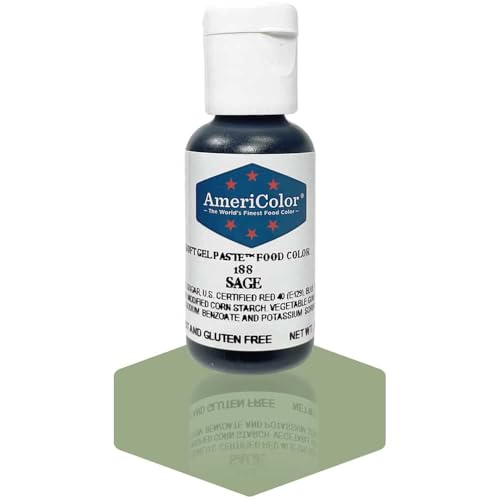
AmeriColor Sage Soft Gel Paste is the icing-focused choice: the soft gel paste is made for royal icing, buttercream, rolled fondant, macarons, cookie dough and bread dough. The single bottle holds 0.75 oz, and the formula is peanut-, tree nut-, soy- and gluten-free; it is also Kosher certified. This range suits decorators coloring several non-oil-based mixtures. It is not the oil-soluble choice for chocolate or other fat-heavy candy work, so select an oil formula when that is the main task.
Bottom line: Choose this for sage shades in icing, fondant and dough.
Sage Green Oil-Based Dye, 30 mL

Sage Green Oil-Based Dye, 30 mL is the explicitly oil-soluble liquid option, making it the closest fit here for chocolate melts and candy work. Its 30 mL bottle is described as suitable for oils, fats, batters and confectionery, and the maker says the dye is concentrated and tasteless. It also mentions soap and candle crafts, but keep edible coloring and craft use separate to avoid cross-contamination. The limitation is breadth: it is aimed at oil-compatible applications, while a soft gel paste is a more direct match for royal icing and fondant.
Bottom line: Pick this for sage coloring in chocolate melts and oil-based candy.
How to choose sage green food colouring
Match the coloring base to the recipe before choosing a shade: oil-based colors are intended for chocolate and fats, while gel pastes are commonly used in icing and dough. Standard water-based liquid color can thin icing or chocolate, so a concentrated gel or fat-compatible formula is a better starting point for those uses. Begin with a small amount and increase gradually; concentrated color can deepen as it is mixed and allowed to settle. For a sage target, start from a product actually labeled sage, since olive and sage are related but distinct greens. A small test batch helps reveal whether the finished color shifts in a pale or yellow-tinted base.
Gel, oil blend and oil-soluble dye compared
Gel paste, oil blends and oil-soluble liquid behave differently because recipes contain different amounts of water and fat. Use this guide to choose the formula by the ingredient it must color, rather than by package size alone.
| Recipe target | Formula to consider | Why it fits |
|---|---|---|
| Royal icing or fondant | Soft gel paste | Designed for icing and sugar-paste mixtures |
| Buttercream plus cake batter | Oil blend or gel paste | Both can be matched to these baking uses |
| Chocolate melts or candy | Oil-soluble color | Compatible with fats and oils |
Use the table as a starting point, not a guarantee for every recipe: chocolate coatings and emulsions can respond differently. Keep craft-dedicated coloring away from food tools and ingredients.
Getting a consistent sage shade
Build sage gradually because a muted green is easier to adjust before a large batch is colored. Add a tiny amount, mix fully, then compare a dab against the intended shade in the same lighting where the food will be served. Buttercream and batter can look different in the bowl than after spreading or baking, so check a small sample first. Avoid adding extra liquid to correct color in a delicate icing; use a compatible concentrated formula and increase in small increments. If a formula is designed for fats, use it in the fat-containing part of the recipe as appropriate, rather than assuming it will disperse evenly in every water-based mixture.
Food coloring safety and storage habits
Use only coloring labeled for food in edible recipes, and keep craft materials such as soap or candle supplies separate from kitchen utensils. Food dyes do not replace safe food handling: wash hands and tools, prevent raw ingredients from contacting finished icing, and refrigerate perishable frosting promptly. Keep caps closed and store coloring away from heat, sunlight and moisture to reduce drying or contamination. For dietary restrictions, read the package ingredient and allergen label each time, since allergen claims and certifications apply to a specific formula and can change between products.
Frequently Asked Questions
Can oil-based food coloring color chocolate melts?
Oil-soluble coloring is designed to mix with fats, making it the appropriate type to consider for chocolate melts. Add it in very small increments and stir thoroughly, since excess liquid can affect a chocolate coating’s texture.
Is sage green food coloring the same as olive?
No, sage and olive are different green shades; olive commonly reads deeper or more yellow-brown. Choose a product labeled sage when that muted sage target matters.
Which food coloring formula suits royal icing?
Soft gel paste is a common choice for royal icing because it adds color without relying on an oil-based formula. Add a small amount, mix completely and assess the shade before coloring the full batch.
How can I keep sage icing from getting too dark?
Add concentrated coloring in tiny increments and mix before adding more. A test portion is useful because the shade can look stronger after it is spread across a larger surface.
Can one food coloring work in buttercream and chocolate?
Some oil blends are intended for both buttercream and chocolate, while a gel paste may better suit icing and fondant. Check that the formula is compatible with both recipe bases before using it for both.