
Gasoline Bicycle Conversion Kits: 4 Options Compared

For a gasoline bicycle conversion kit, the IMAYCC 100cc kit stands out for its 6,500 rpm speed and stated 2–4-hour installation estimate. Choose another option if you want a 4-stroke engine or a kit with a horsepower and torque figure.
These kits add a gasoline engine to a bicycle; wheel size alone does not confirm that the engine mount will fit your frame.
We earn a commission if you buy through links on this page. As an Amazon Associate I earn from qualifying purchases. Products are compared on manufacturer specifications, not hands-on testing.
- Best overall: IMAYCC 100cc 2-Stroke Kit – The 100cc two-stroke lists 6,500 rpm and gives an installation-time estimate.
- Best for 4-stroke power: 100cc 4-Stroke 3 HP Kit – The 100cc four-stroke lists 3 HP, 4.5 N·m torque, and a recoil start.
- Best for V-frame fit: 110cc 2-Stroke V-Frame Kit – It is designed for V-shaped frames with ample triangular space.
| Product | Best for | Engine | Listed speed | Weight | Shop |
|---|---|---|---|---|---|
| IMAYCC 100cc 2-Stroke Kit | DIY installation | 100cc, 2-stroke | 6,500 rpm | 26.46 lb | Check Price on Amazon |
| 110cc 2-Stroke V-Frame Kit | V-frame bicycles | 110cc, 2-stroke | 6,000 rpm | — | Check Price on Amazon |
| 110cc 2-Stroke Air-Cooled Kit | 26–28-inch bikes | 110cc, 2-stroke | 6,000 rpm | 24.69 lb | Check Price on Amazon |
| 100cc 4-Stroke 3 HP Kit | Four-stroke setups | 100cc, 4-stroke | 3,600 rpm | 44 lb | Check Price on Amazon |
Gasoline Bicycle Conversion Kits
Compare engine type, listed speed, and other fit or installation details before choosing a kit.
IMAYCC 100cc 2-Stroke Kit

The IMAYCC kit is the only option here that gives an installation-time estimate: the maker says to allow about 2–4 hours for installation and fine-tuning. It includes a single-cylinder, air-cooled 100cc gasoline engine and is intended for 26- to 28-inch bikes. The speed is 6,500 rpm.
This kit suits a buyer prepared to work with basic tools and hardware skills. The time estimate is not a guarantee; first-time installers should allow for additional setup, and the wheel-size range does not establish frame or mount compatibility.
Bottom line: Choose this if you have basic mechanical skills and want the highest engine speed.
110cc 2-Stroke V-Frame Kit
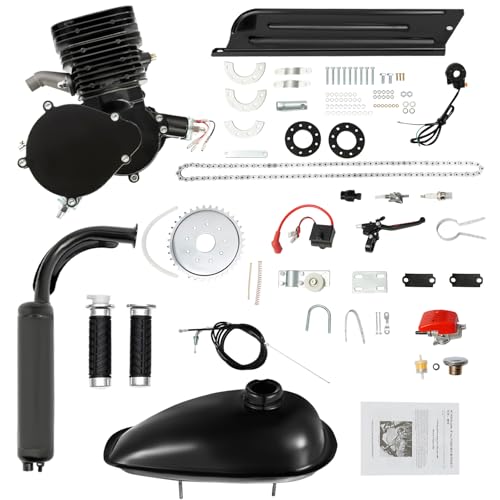
The 110cc kit makes frame shape its clearest fit criterion: it is designed for bicycles with a V-shaped frame and ample triangular space. The maker lists a maximum speed of 6,000 rpm and describes the set as including the parts and accessories for a gasoline conversion.
This option suits a bicycle whose frame has enough room in that triangle. The compatibility is broad rather than a frame measurement, so it is not a fit guarantee; buyers should compare the engine mount and available clearance with their bicycle before committing.
Bottom line: Choose this for a V-shaped frame with adequate triangle clearance.
110cc 2-Stroke Air-Cooled Kit

The 110cc kit is distinct from the other 110cc option because its weight is 24.69 pounds and its features name air cooling and a CDI system. The maker says the engine reaches 6,000 rpm, and the kit is intended for 26- or 28-inch bikes.
This kit suits a buyer comparing stated weight and included engine components. Its wheel-size range does not establish that the engine mount fits a particular frame, so confirm frame clearance and mounting compatibility before installation.
Bottom line: Choose this if the weight and CDI system suit your build.
100cc 4-Stroke 3 HP Kit

The 100cc four-stroke is the only four-stroke in this group, and it has the most detailed output figures: 3 HP, 2 kW at 3,600 rpm, and 4.5 N·m at 2,500 rpm. It uses a single-cylinder, air-cooled OHV engine with recoil start and a 1.6-liter fuel tank; the kit weighs 44 pounds.
This suits a buyer specifically seeking a four-stroke with a recoil starter. At 44 pounds, it is substantially heavier than the other kits with weights, so frame capacity and dependable braking matter especially before adding an engine.
Bottom line: Choose this if you specifically want a four-stroke and can accommodate its 44-pound weight.
How to choose a gasoline bicycle conversion kit
Choose by engine type, frame fit, and added weight; rpm alone does not predict road speed. The options here include three two-strokes and one four-stroke, while engine rpm measures revolutions per minute rather than bicycle speed. Gear ratio, wheel diameter, and total load also affect road speed. A kit weighing 44 pounds adds that much before fuel and rider weight, so check the bicycle’s frame, wheels, and brakes for the added load. A conversion also creates exhaust: operate a gasoline engine outdoors, never in an enclosed room or garage.
Use the engine type and fit criteria as starting points, not guarantees. A 26- or 28-inch wheel match does not confirm that the frame has the right mounting space.
| Need | Compare |
|---|---|
| Four-stroke design | 100cc four-stroke kit |
| Higher listed engine speed | 100cc kit at 6,500 rpm |
| Frame-shape guidance | 110cc kit designed for a V-shaped frame |
Check bicycle frame and mount fit
Frame clearance and mounting points matter more than wheel diameter when fitting a gasoline bicycle engine. A 26-inch wheel can be paired with many different frame geometries, and a motor must fit inside the frame triangle without interfering with pedals, cables, or the rider’s legs. Measure the open triangle and compare it with the engine and mount dimensions before assembly; the maker gives no universal triangle measurement. Also inspect the frame for cracks, corrosion, or loose joints before adding a motor and fuel tank.
Brake capacity is another practical fit check: motor assistance adds mass and can raise riding speed, so worn pads, cables, or rims should be addressed before conversion. Local motorized-bicycle rules vary, including engine and equipment limits, so confirm the requirements for the roads where you plan to ride.
Two-stroke and four-stroke engine differences
Two-stroke and four-stroke describe how the engine completes its power cycle, not how quickly a bicycle travels. These options include 100cc and 110cc two-strokes, plus one 100cc four-stroke; the four-stroke option lists 3 HP and 4.5 N·m of torque. The two-stroke options list engine speeds from 6,000 to 6,500 rpm, but those figures cannot be compared directly with horsepower or torque as a measure of road performance.
Choose the engine format that matches the build you want, then compare fuel-system layout, mount clearance, and kit weight. Do not assume that a larger displacement or higher rpm figure automatically means a better fit or safer conversion.
Installation and safe operation
Plan for mechanical setup and outdoor engine operation before starting a gasoline bicycle conversion. One kit gives an installation estimate of about 2–4 hours and says basic hardware skills and tools are needed; first-time installers should allow additional time for alignment and fine-tuning. A typical bicycle engine conversion also requires checking chain alignment and fastener tightness after assembly, since vibration can loosen hardware.
Gasoline engines produce carbon monoxide, an odorless gas that can be deadly, so never start or tune the engine in a home, shed, or closed garage. Keep fuel away from ignition sources and let hot engine and exhaust parts cool before handling. Before riding, test braking and steering at low speed in a clear outdoor area and check that no cables or moving parts bind.
Frequently Asked Questions
Does a 26-inch kit fit every 26-inch bicycle?
No; wheel diameter alone does not establish engine-mount fit. Compare the frame triangle, mount points, and clearance around the engine with the kit before installation.
Is engine rpm the same as bicycle speed?
No; rpm measures engine revolutions per minute, not road speed. Gearing, wheel size, load, and setup affect the bicycle’s speed.
Are gasoline bicycle conversions legal on public roads?
Rules vary by state and locality, and may depend on engine capacity, speed, and required equipment. Check the rules where you plan to ride before converting; gasoline engines also produce exhaust, so never run one indoors.
What should I check before installing a bicycle engine kit?
Confirm frame clearance and mount compatibility, then check that the bicycle’s brakes and wheels are appropriate for the added engine and weight. A wheel-size match by itself does not establish a safe installation.