
Helavo All Terrain Walker: Models Compared by Fit

The Helavo All Terrain Walker with pneumatic tires suits most outdoor users who want air-filled wheels and a 300-pound capacity; its 12-inch front tires are the deciding difference. Choose another model if you need flat-free tires, a wider frame, upright armrests, or a seat that converts to transport-chair use.
We earn a commission if you buy through links on this page. As an Amazon Associate I earn from qualifying purchases. Products are compared on manufacturer specifications, not hands-on testing.
- Best overall: Helavo All Terrain Walker, Pneumatic Tires – Its pneumatic 12-inch front and 10-inch rear tires are designed to cushion rough outdoor routes.
- Best for flat-free use: Helavo All Terrain Walker, Solid Rubber Tires – Its solid rubber tires avoid the risk of a flat while retaining the 12-inch front and 10-inch rear setup.
- Best for higher capacity: Helavo Extra Wide Bariatric Rollator – Its 550-pound capacity and 28.3-inch width distinguish it from the other options.
| Product | Best for | Tire type and size | Capacity | Overall width | Shop |
|---|---|---|---|---|---|
| Helavo All Terrain Walker, Pneumatic Tires | Outdoor cushioning | Pneumatic, 12-in front / 10-in rear | 300 lb | 26.0 in | Check Price on Amazon |
| Helavo All Terrain Walker, Solid Rubber Tires | Flat-free tires | Solid rubber, 12-in front / 10-in rear | 300 lb | 26.0 in | Check Price on Amazon |
| Helavo Extra Wide Bariatric Rollator | Higher weight capacity | Rubber, 8-in | 550 lb | 28.3 in | Check Price on Amazon |
| Helavo Upright Walker with Seat | Upright arm support | Rubber, 10-in front | 300 lb | 26.4 in | Check Price on Amazon |
| Helavo Wide 2-in-1 Walker Wheelchair Combo | Walking and transport | EVA, 8-in front / 10-in rear | 300 lb | 27.6 in | Check Price on Amazon |
Helavo All Terrain Walkers and Related Models
Compare tire construction, capacity, and frame width to match the rollator to your routes and fit needs.
Helavo All Terrain Walker, Pneumatic Tires
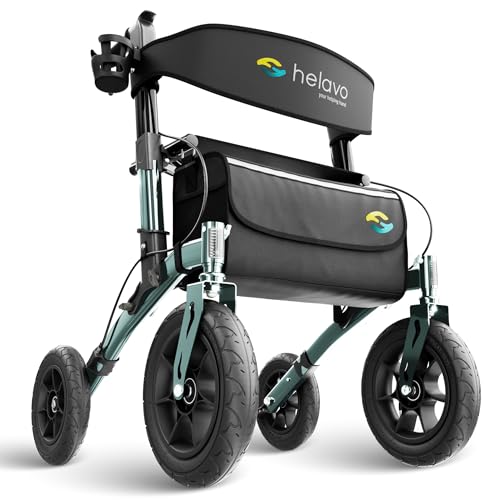
The pneumatic-tire version is the direct match for an outdoor rollator with air-filled wheels: it pairs 12-inch front and 10-inch rear tires with an aluminum frame. The maker says the tires absorb shock on grass, gravel, dirt trails, and uneven sidewalks, and the walker folds for storage. At 26 inches wide and 20.9 pounds, it suits people who prioritize a cushioned ride over avoiding tire maintenance. Air-filled tires can puncture, so this choice matters less to buyers who want flat-free wheels.
Bottom line: Choose this if cushioning on rough outdoor surfaces matters more than puncture resistance.
Helavo All Terrain Walker, Solid Rubber Tires

Unlike the pneumatic version, this all-terrain rollator uses solid rubber tires, so a puncture is not a concern. Its 12-inch front and 10-inch rear wheels, 300-pound capacity, 26-inch width, and 20.9-pound weight closely match the air-tire model; tire construction is the key choice between them. The maker says the wheels provide cushioning across varied surfaces, while the aluminum frame folds down. Buyers who want an air-filled tire’s shock absorption should choose the other tire setup instead.
Bottom line: Pick this when avoiding flat tires is more important than choosing air-filled wheels.
Helavo Extra Wide Bariatric Rollator

The extra-wide bariatric model differs from the two all-terrain versions with a 550-pound capacity and 28.3-inch overall width. Its aluminum frame has 22.4 inches between the handles, and the seat adjusts from 20.9 to 22.8 inches; handles adjust from 33.1 to 39.0 inches. An adjustable backrest adds another fit option for seated breaks. It uses 8-inch rubber tires rather than the larger 12-inch front wheels of the all-terrain models, so buyers focused on rougher routes may prefer those larger-wheel designs.
Bottom line: Choose this for its higher capacity and wider seating area, not for the largest wheels.
Helavo Upright Walker with Seat

The upright design sets this model apart: padded armrests and height-adjustable handles are intended to support a more upright walking position, unlike the standard all-terrain rollators. It has 10-inch rubber front wheels, a 300-pound capacity, and an overall width of 26.4 inches; its height range is 40.9 to 46.9 inches. The maker says the rubber tires cushion outdoor movement without flat risk. The taller frame and armrest posture are a different fit, so choose a standard rollator if you do not want upright support.
Bottom line: Pick this if padded armrests and upright positioning are your priority.
Helavo Wide 2-in-1 Walker Wheelchair Combo

This model is the only option that converts from a rollator into a transport chair, with footrests for seated assistance. Its EVA tires measure 8 inches in front and 10 inches in back, and the frame is 27.6 inches wide with a 300-pound load capacity. The maker says the tires are suited to grass, gravel, pavement, and uneven surfaces. The wider frame and chair-conversion design matter most when a companion may need to push; buyers seeking a conventional all-terrain walker may prefer a simpler rollator.
Bottom line: Choose this when chair conversion and footrests are useful for outings.
How to choose Helavo all-terrain tires
Choose pneumatic tires for air-filled cushioning, or solid rubber when avoiding punctures is the priority. The two standard all-terrain models have the same 12-inch front and 10-inch rear wheel sizes, 26-inch width, and 300-pound capacity, so tire construction is the meaningful difference between them. Air tires can lose pressure or puncture; solid tires remove that upkeep but do not offer an air chamber. For rough routes such as gravel or grass, larger wheels generally roll over obstacles more easily than small wheels. Confirm the tire type before choosing: both options look similar in overall dimensions, but one uses air-filled tires and the other solid rubber.
Fit the rollator to your doorway and body
Measure the narrowest doorway and walking path before choosing a frame; allow at least 2 inches of extra width beyond the walker for steering clearance. A 26-inch frame therefore needs a path roughly 28 inches wide for comfortable passage. Handle height and seat height also affect posture and safe transfers: the upright model adjusts from 40.9 to 46.9 inches, while the bariatric model’s handle range is 33.1 to 39 inches. Those ranges are not interchangeable. Set handles near wrist height while standing upright, with relaxed shoulders and slightly bent elbows, and confirm the lift range before ordering if the user’s height falls outside the adjustment range.
Compare Helavo walker types by need
Standard rollators, upright walkers, bariatric rollators, and transport-chair combos solve different mobility needs rather than representing one universal upgrade. A standard rollator supports walking and seated breaks; an upright design adds padded armrests, while a bariatric frame increases capacity and width. A combo adds footrests and chair conversion for assisted transport. The table is a quick way to narrow the type before measuring the frame.
| Need | Type to consider |
|---|---|
| Air-filled outdoor wheels | Standard pneumatic all-terrain rollator |
| Flat-free outdoor wheels | Standard solid rubber all-terrain rollator |
| Higher capacity and wider seat | Bariatric rollator |
| Upright arm support | Upright walker |
| Seated transport with footrests | Walker-chair combo |
Use and maintain a rollator safely
Keep the brakes engaged before sitting, standing, or transferring; an unlocked rollator can roll away under body weight. A seated rollator is a rest seat, not a substitute for a wheelchair unless it is designed for transport and includes the needed footrests and pushing arrangement. Check tire condition and brake response regularly, and inspect pneumatic tires for low pressure or damage before outdoor trips. On slopes, wet pavement, or loose gravel, slow down and avoid sharp turns because small front wheels can deflect. Never exceed the model’s weight capacity, and practice folding and unfolding the frame on level ground before taking it out.
Frequently Asked Questions
Do pneumatic rollator tires need air checks?
Yes, air-filled tires need periodic pressure checks and inspection for punctures. Check them before longer outdoor trips, especially after rolling over sharp gravel or debris.
Can a rollator be used as a wheelchair?
Only a walker designed to convert for transport should be used that way. A transport-chair combo includes footrests; a standard rollator seat is intended for resting rather than being pushed.
How wide should a doorway be for a rollator?
Measure the walker’s full width and add about 2 inches for steering clearance. A 26-inch-wide frame is more manageable through a path around 28 inches or wider.
What is the difference between pneumatic and solid tires?
Pneumatic tires contain air and can cushion impacts, but they can puncture and need pressure checks. Solid rubber tires cannot go flat, though tire design and size affect how they roll over rough ground.
When should rollator brakes be locked?
Lock the brakes before sitting, standing, or transferring to the seat. Test that both sides hold the frame stationary on level ground before putting weight on it.