
Markers for Black Paper: 5 Sets Compared by Tip

For black paper, Sunshilor 12 Metallic Fine-Point Markers is the most direct fit because its metallic ink is intended for dark surfaces and its 1 mm tip suits controlled writing. Choose 30-Color Dual-Tip Metallic Markers instead if you want a brush tip and a wider color selection; the acrylic sets are better suited to projects that also use other surfaces.
We earn a commission if you buy through links on this page. As an Amazon Associate I earn from qualifying purchases. Products are compared on manufacturer specifications, not hands-on testing.
- Best overall: Sunshilor 12 Metallic Fine-Point Markers – Its metallic finish is described for light and dark surfaces, and the fine point makes controlled 1 mm lines.
- Best for varied strokes: 30-Color Dual-Tip Metallic Markers – It pairs a 1 mm fine tip with a 0.5–5 mm brush tip across 30 metallic colors.
- Best for dual-tip acrylic: KEVIN&SASA 24-Color Acrylic Markers – It offers round and brush nibs for fine lines and filling larger areas.
| Product | Best for | Ink type | Tip size | Color count | Shop |
|---|---|---|---|---|---|
| Sunshilor 12 Metallic Fine-Point Markers | Fine metallic writing | Metallic | 1 mm | 12 | Check Price on Amazon |
| 30-Color Dual-Tip Metallic Markers | Metallic mixed strokes | Metallic | 1 mm; 0.5–5 mm | 30 | Check Price on Amazon |
| KEVIN&SASA 24-Color Acrylic Markers | Acrylic brush work | Acrylic | Round and brush nibs | 24 | Check Price on Amazon |
| ARTISTRO 36-Color Dot-Tip Acrylic Markers | Dot patterns | Water-based acrylic | 1 mm; 1–5 mm dot tip | 36 | Check Price on Amazon |
| ARTISTRO 36-Color Brush-Tip Acrylic Markers | Acrylic brush lettering | Water-based acrylic | 1 mm; 1–5 mm brush tip | 36 | Check Price on Amazon |
Markers for Black Paper Compared
Compare ink type, point size and stroke options to match the paper and the marks you want to make.
Sunshilor 12 Metallic Fine-Point Markers

For a fine metallic line on dark paper, this set has a 1.0 mm point and 12 colors. The maker says the bright metallic finish marks light and dark surfaces and suits writing, decorating, doodling and drawing. The fine point is a better match for lettering and outlines than filling broad shapes. The maker cautions that the point is not for very small details, so choose a finer tool if your work needs tiny marks. Its single fine-point format also lacks a brush option for broad, expressive strokes.
Bottom line: Choose this set for visible metallic writing and outlines on black paper.
30-Color Dual-Tip Metallic Markers

This set stands out for combining a 1 mm fine tip with a 0.5–5 mm brush tip, giving black-paper projects both narrow outlines and broader strokes. Its 30 metallic colors also offer more color choices than the 12-color fine-point set. The maker says the markers work on black paper and a range of other craft surfaces, and that shaking is not needed during use. The brush width varies across its 0.5–5 mm range, so it may be less suited than a single fine point for consistently precise, tiny lettering.
Bottom line: Pick this set when you want metallic color choices plus both fine and brush strokes.
KEVIN&SASA 24-Color Acrylic Markers
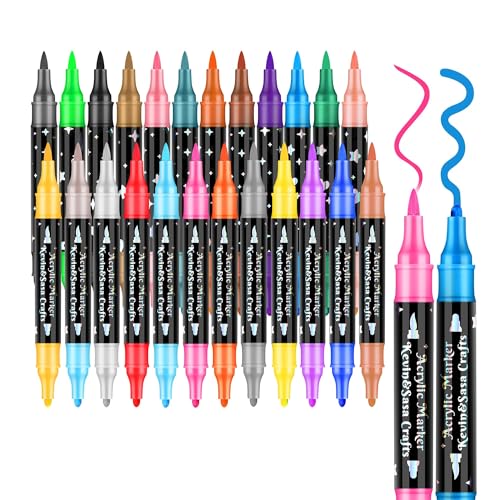
Unlike the metallic sets, these are acrylic markers with a round nib and a brush nib in each pen. The 24-color assortment is positioned for varied painting projects, with the two nib styles intended for fine lines and larger-area filling. That combination is useful when a black-paper project also includes wood, canvas, rock or glass. The maker does not specifically identify black paper as a target surface, so do a small test mark on the same paper before committing to a finished design. These are not a single-width fine-point set.
Bottom line: Choose these for acrylic projects spanning black paper and other craft surfaces.
ARTISTRO 36-Color Dot-Tip Acrylic Markers

These acrylic markers use a 1 mm fine tip alongside a 1–5 mm dot tip, making them distinct from brush-tip sets when dotted patterns and decorative accents matter. The maker says the water-based paint is ready to use without pressing and recommends gently shaking before first use. The pair of tip styles suits work that mixes writing or outlines with dots, and the 36-color set serves projects across several listed surfaces. Black paper is not named among those surfaces, so verify the color contrast on a paper offcut first. A dot tip is not a substitute for a flexible brush stroke.
Bottom line: Pick these for dot accents and fine lines in an acrylic marker set.
ARTISTRO 36-Color Brush-Tip Acrylic Markers

This ARTISTRO set pairs a 1 mm fine point with a flexible 1–5 mm brush tip, unlike the companion set’s dot tip. That makes it the more natural acrylic option for lettering and strokes that change width. The maker says its water-based acrylic paint is richly pigmented and suitable for paper and several craft materials, while noting that coverage can vary with surface color and material. Since black paper is not named directly, test a mark on the same stock and allow it to dry before judging the result. The brush point is less suited to perfectly uniform line width.
Bottom line: Choose these for variable-width acrylic lettering and strokes.
How to Choose Markers for Black Paper
For legible marks on black paper, start with an ink explicitly described for dark surfaces or a visibly contrasting metallic finish. The Sunshilor set is the clearest match for controlled writing, while the 30-color metallic set adds a brush option. For a lettering line under 1 mm, neither listed metallic fine tip is a match; select a genuinely finer point. For strokes wider than 1 mm, a brush tip gives more range than a fixed fine point. Make a short swatch on a scrap of the same paper before lettering: paper color and surface can change how opaque or bright a mark appears.
Metallic and Acrylic Markers Compared
Metallic markers emphasize reflective-looking color, while acrylic markers use paint-based ink and come with round, dot or brush nibs in these choices. The distinction matters more than color count: a fine point controls small writing, while a brush or dot point favors broader marks or accents. Choose metallic ink when the visible finish is the priority; choose acrylic when the project also needs the nib style or other craft surfaces. Product claims about surfaces differ, so do not assume every marker works equally on every paper.
Use this quick match to connect a project goal with the available marker style.
| Project need | Marker style | Useful constraint |
|---|---|---|
| Fine metallic lettering | Metallic fine point | 1 mm lines are not for tiny details |
| Variable-width metallic marks | Metallic brush and fine tips | Brush width spans 0.5–5 mm |
| Dots or acrylic strokes | Acrylic dot or brush tip | Test contrast on the paper stock |
Testing Ink on Black Paper
A scrap test is the most reliable way to judge contrast before writing a finished card or illustration. Draw a short line, a filled-in patch and a letter on the same paper stock; a narrow line can look different from a covered area. Let the marks dry fully before deciding whether the color reads clearly, since wet and dry appearances may differ. If the paper is textured, test across both a smooth area and a rough area where possible. Avoid assuming a surface claim for glass, wood or rock guarantees the same result on every black paper.
Choosing a Tip for Lettering and Details
Tip width sets a practical lower limit on detail: a 1 mm point is suited to ordinary lettering and outlines, not miniature strokes. For details that must be finer than 1 mm, use a finer-point marker rather than pressing harder, which can produce uneven lines. Brush tips cover a broader 0.5–5 mm range, making them useful for changing stroke widths, while the dot tip makes rounded accents rather than continuous brush strokes. Plan the mark size before choosing a nib; for words with small characters, test the smallest letter at actual size on a paper scrap.
Frequently Asked Questions
Will metallic markers show on black paper?
Metallic markers are a sensible choice for contrast, and the Sunshilor set is described for light and dark surfaces. Test a short line on the exact paper because stock and mark width affect how visible the result looks.
What does a 1 mm marker tip suit?
A 1 mm point suits ordinary lettering, outlines and controlled line work. The Sunshilor maker says its tip is not for very small details, so choose a finer point when the marks must be smaller.
Are acrylic markers different from metallic markers?
Yes; the acrylic sets use water-based acrylic paint, while the two black-paper-specific choices are metallic marker sets. Choose based on the desired ink type and nib format, then test contrast on the paper.
How can I make brush strokes wider or narrower?
A brush tip in these choices spans 0.5–5 mm, so pressure and angle can create different stroke widths. If a project needs a consistently narrow line, use the 1 mm fine tip instead.
Should I test a marker before lettering a card?
Yes; make a line, a filled patch and a small letter on a scrap from the same paper. Let the marks dry before judging contrast, especially when switching between fine and broad tips.