
48V to 12V DC Converter: 5 Models by Capacity

For loads that may draw up to 30A, Nilight 30A 360W Converter is the strongest match because it is rated for 360W at 12V; choose a 20A model if your combined load stays within 240W. A DC-DC converter reduces a higher-voltage DC supply to a lower, fixed DC output.
Buyers with a 36V pack or a specific golf cart connector should compare the input range and included wiring, while anyone using a 48V battery should verify the pack’s maximum charging voltage remains within the converter’s input limit.
We earn a commission if you buy through links on this page. As an Amazon Associate I earn from qualifying purchases. Products are compared on manufacturer specifications, not hands-on testing.
- Best overall: Nilight 30A 360W Converter – Its 30A, 360W rating provides more 12V output capacity than the 20A models.
- Best for broad input range: KInuoxj 20A 240W Converter – The 20V–60V input range covers a wide range of DC supply voltages.
- Best for included wiring: Pro Chaser 36V/48V Converter – It includes a matched connector harness and butt connectors for connection and disconnection.
- Best for efficiency: dkplnt 20A 240W Converter – The maker claims conversion efficiency of up to 97%.
| Product | Best for | Input range | Protection / housing | Shop |
|---|---|---|---|---|
| Nilight 30A 360W Converter | Higher accessory load | 18V–60V DC | Waterproof, anti-shock housing | Check Price on Amazon |
| KInuoxj 20A 240W Converter | Wide input range | 20V–60V DC | Waterproof, dustproof, shockproof housing | Check Price on Amazon |
| dkplnt 20A 240W Converter | Efficiency claim | 30V–60V DC | Aluminum shell, silicone sealed | Check Price on Amazon |
| Pro Chaser 36V/48V Converter | Connector harness | 36V or 48V systems | Water-resistant sealed case | Check Price on Amazon |
| 36V/48V 20A 240W Converter | Rugged enclosure | 20V–60V DC | Aluminum housing | Check Price on Amazon |
48V to 12V DC Converters
Compare input limits and output capacity against your battery pack and the combined draw of the 12V accessories you plan to power.
Nilight 30A 360W Converter

Nilight 30A 360W Converter stands apart with a 30A output rating, giving it more capacity than the 20A, 240W converters here. It accepts 18V–60V DC input and provides fixed 12V output, making it a fit when the 12V equipment’s combined maximum draw is above 20A but no more than 30A. The maker claims 96% conversion efficiency and describes the aluminum-shell, silicone-sealed housing as waterproof and shock-resistant. Its 60V input ceiling still matters: verify that the supply never exceeds it, including during battery charging.
Bottom line: Choose this if your 12V load needs more than 20A and stays within 30A.
KInuoxj 20A 240W Converter

KInuoxj 20A 240W Converter combines a 20A, 240W output with a 20V–60V input range, a broader low-end reach than the other models with explicit ranges. Its fixed 12V output suits a load whose total draw remains within 20A. The maker says its sealed aluminum shell is waterproof, dustproof and shockproof, and it lists input undervoltage plus overload, overcurrent, overheat and output short-circuit protection. The 20A ceiling is the key limitation for accessory groups with higher startup or continuous draw; add the loads before choosing it.
Bottom line: Choose this for a 12V load within 20A when the wider low-end input range is useful.
dkplnt 20A 240W Converter
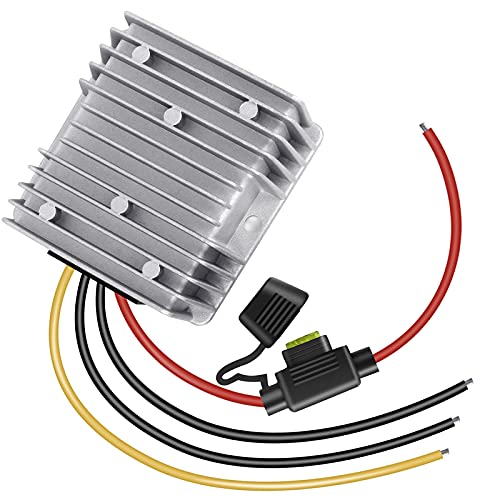
dkplnt 20A 240W Converter has a 30V–60V input range and a 20A, 240W fixed 12V output, so it targets 36V and 48V systems rather than lower-voltage supplies. The maker claims conversion efficiency of up to 97% and describes the aluminum shell as silicone-sealed. It also lists overload, overcurrent, overtemperature and short-circuit protection. The 30V minimum excludes supplies below that level, and its 20A output limit may not suit several high-draw accessories running together. Check the combined load, including any motor or lighting startup draw.
Bottom line: Choose this for a 36V or 48V supply with a load capped at 20A.
Pro Chaser 36V/48V Converter

Pro Chaser 36V/48V Converter is differentiated by its included matched male-and-female connector harness and butt connectors, which support an installation that needs a disconnectable connection. It is intended for golf carts and RVs with 36V or 48V battery systems and is sized at 20A, 240W. The maker describes its cast-aluminum case as sealed and water-resistant and says the ventilation design supports airflow. This option is less broadly specified for other input voltages than converters with a numeric input range, so it best fits buyers whose system is specifically 36V or 48V and whose load stays under 20A.
Bottom line: Choose this for a 36V or 48V cart or RV setup where the connector harness helps.
36V/48V 20A 240W Converter
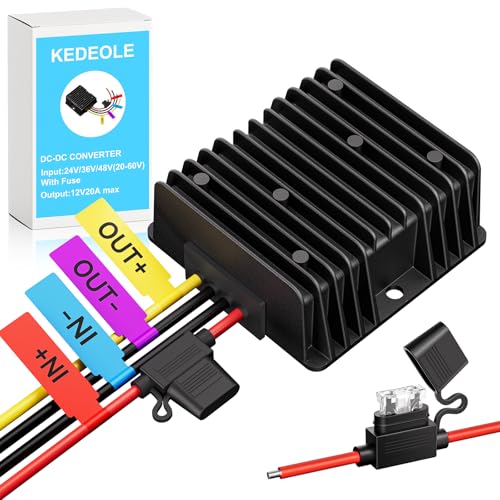
36V/48V 20A 240W Converter pairs a 20V–60V input range with a 20A, 240W fixed 12V output, making it another option for a modest accessory load across a broad supply range. Its features describe an aluminum enclosure and layered cutoff protection for overload, short circuit, overcurrent and overtemperature. The product also describes its thermal management as fanless. These claims do not change the practical 20A output limit: calculate the draw of the accessories first, and leave room for any startup current. It is a match for buyers who prioritize the enclosure and protection features over a higher output rating.
Bottom line: Choose this for a 12V load within 20A when a fanless design is preferred.
How to size a 48V to 12V converter
Size a 12V converter by adding the maximum current draw of every accessory that may run at once. At 12V, 20A equals 240W and 30A equals 360W; use watts divided by 12 to estimate current when an accessory is rated in watts. For example, a 120W load draws about 10A at 12V. Include startup demand for motors, pumps and some lighting drivers, which can exceed steady draw. As a practical selection rule, if the combined continuous load is above 20A, the 20A models here are undersized; if it exceeds 30A, none of these ratings is enough. A margin between expected load and converter rating helps avoid operating at the limit continuously.
Check 48V battery voltage before connecting
A converter’s input ceiling must cover the battery pack’s actual voltage, not just its nominal 48V label. A 48V lead-acid battery bank can approach the high-50V range while charging, so a converter capped at 60V leaves only a modest margin; verify the charger’s maximum voltage and any voltage spikes against the converter’s permitted input. Also confirm that the converter accepts the battery chemistry and system configuration you use. Connect the input to the battery side, not a 12V accessory circuit, and observe DC polarity: reversing positive and negative can damage equipment. For a 36V system, check its maximum charging voltage the same way rather than assuming nominal voltage is the peak.
Compare converter capacity and input fit
Choose by the limiting condition first: supply voltage range, then 12V current demand, then installation needs. A higher current rating does not make a converter compatible with a supply outside its input range. This table links typical use needs to the relevant rating in this group.
| Need | Rating to consider | Key check |
|---|---|---|
| Up to 20A at 12V | 20A / 240W | Input range includes the full supply range |
| Above 20A, up to 30A | 30A / 360W | Load stays within 30A |
| 36V or 48V cart wiring | System-specific model | Harness, polarity and charging voltage |
Do not treat a converter’s efficiency as extra output capacity: output current and wattage ratings remain the constraints for accessory selection.
Install and protect the 12V circuit
Use wiring and a fuse sized for the converter’s maximum output current, with the fuse placed close to the power source to protect the wire if it shorts. At 20A or 30A, a long or undersized cable can cause voltage drop and heat, so cable gauge must account for current and run length rather than current alone. Keep connections dry unless the installation and connectors are protected for the environment; water-resistant housing does not make exposed terminals waterproof. Secure the unit away from moving parts and allow heat to escape, especially when mounting it inside an enclosed compartment. Disconnect the battery before wiring and check output polarity and voltage with a meter before attaching sensitive 12V electronics.
Frequently Asked Questions
Can a 48V converter work with a 36V battery pack?
Only if the converter’s allowed input range includes the pack’s operating voltage. For instance, a 30V minimum excludes a 36V pack if its voltage falls below that threshold during use.
How many watts does a 20A 12V converter provide?
A 20A output at 12V equals 240W, using watts = volts × amps. Keep the combined accessory demand below the converter’s current and wattage limits.
Can I power several 12V accessories at once?
Yes, if their combined current draw stays within the converter’s rating. Add the simultaneous loads and account for higher startup draw from motors, pumps or some electronic drivers.
Does a waterproof converter make the wiring waterproof?
No; a sealed housing does not protect exposed terminals, splices or connectors. Protect each connection from water and corrosion, and use cable routing that avoids standing water.
What should I check before using a converter with a 48V battery?
Check the battery’s maximum charging voltage against the converter’s maximum input voltage. A 48V lead-acid system can reach the high-50V range while charging, which is close to a 60V input ceiling.