
Dual AC Machines for R134a and 1234yf Compared

For most shops, VEVOR Fully Automatic 10-Inch Dual is the strongest fit because its maker claims a recovery rate of at least 98.5% and it has a 10-inch touchscreen with a vehicle database. Shops prioritizing a 10-minute refrigerant changeover can choose Airtek AC-Dual or Tektino RCC-6S-Dual instead.
A dual-refrigerant automotive AC machine recovers and recharges systems using R134a and R1234yf; it is distinct from equipment that handles only one refrigerant at a time.
We earn a commission if you buy through links on this page. As an Amazon Associate I earn from qualifying purchases. Products are compared on manufacturer specifications, not hands-on testing.
- Best overall: VEVOR Fully Automatic 10-Inch Dual – The maker claims a recovery rate of at least 98.5%, and the machine includes a 10-inch touchscreen and vehicle database.
- Best for support: Airtek AC-Dual – It has two attached tanks, a 10-minute changeover, and local professional support by phone or live chat.
- Best for dual tanks: Tektino RCC-6S-Dual – It includes two empty tanks and two sets of quick couplers, with a maker-claimed 10-minute changeover.
| Product | Best for | Recovery rate | Changeover time | Weight | Shop |
|---|---|---|---|---|---|
| VEVOR Fully Automatic 10-Inch Dual | High recovery claim | ≥98.5% (maker claim) | — | 251.55 lb | Check Price on Amazon |
| Airtek AC-Dual | Local support | 95% (maker claim) | 10 min | 275 lb | Check Price on Amazon |
| Tektino RCC-6S-Dual | Couplers included | 96% (maker claim) | 10 min | 273 lb | Check Price on Amazon |
| VEVOR 7-Inch Dual Cylinder | Database workflow | — | — | 275 lb | Check Price on Amazon |
Dual AC Machines for R134a and 1234yf
Compare these dual-refrigerant machines by recovery claim, changeover approach, and workshop features.
VEVOR Fully Automatic 10-Inch Dual

For shops that prioritize a high recovery claim and a large interface, this VEVOR pairs a 10-inch touchscreen with a vehicle database that matches recovery and recharge amounts. Its maker claims a recovery rate of at least 98.5%. The automatic system combines recovery, vacuum, filtration, recharging, and oil replacement, and is intended for standard and high-voltage automotive AC systems. At 251.55 lb, it is lighter than the other models here with weights. The feature set is useful for varied service work, but the maker does not describe a refrigerant changeover time, so confirm that workflow before choosing it.
Bottom line: Pick this for the largest screen and the strongest recovery claim.
Airtek AC-Dual
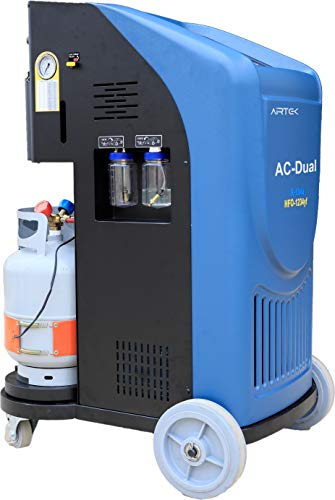
Airtek stands out for local professional support by phone or live chat seven days a week, alongside a 10-minute switch between refrigerants. It has two empty refrigerant tanks attached, so the machine is set up for both R134a and HFO1234yf service. Its maker claims a 95% recovery rate and says software controls prevent wrong-oil injection; oil injection is specified for non-EV and hybrid vehicles. Airtek says the machine serves domestic and foreign vehicles, including electric and hybrid models. The 275 lb weight is worth considering if the machine needs to be moved often.
Bottom line: Choose this if support access and a 10-minute changeover are priorities.
Tektino RCC-6S-Dual

Tektino distinguishes itself with two sets of quick couplers as well as two empty refrigerant tanks, reducing the need to swap tanks when changing refrigerant types. Its maker says the changeover takes 10 minutes and claims a 96% recovery rate. The built-in vehicle database and fully automatic operation suit workshops that service fuel-powered vehicles, EVs, and hybrids. At 273 lb, it is slightly lighter than the Airtek model. Buyers who need a larger screen or a high-voltage-system capability should compare those specific requirements, since the Tektino features do not give those particulars.
Bottom line: Choose this when paired couplers and tanks simplify refrigerant changes.
VEVOR 7-Inch Dual Cylinder

This VEVOR model emphasizes an automated workflow and a built-in vehicle database on a 7-inch color display. It combines recovery, vacuum pumping, filtration, cleaning, charging, and refrigeration-oil charging, with automatic operation intended to run without supervision. The machine is described as a dual-cylinder unit for R134a and R1234yf, and its dimensions are 58.3 inches high, 27.8 inches long, and 33.9 inches wide. Compared with the 10-inch VEVOR, the screen is smaller; buyers who need a specific recovery-rate claim or changeover time should verify those operating specifications before selecting it.
Bottom line: Pick this for an automated, database-centered workflow with a 7-inch display.
How to choose a dual refrigerant AC machine
Start by confirming the machine is designed to service both R134a and R1234yf, not merely to use one refrigerant selected at setup. Then compare the workflow: automatic recovery, evacuation, filtration, charging, oil handling, vehicle database, and refrigerant changeover are separate capabilities. Recovery-rate figures are maker claims, not a guarantee of the amount recovered in every service; system condition and procedure matter. For a busy shop, a database and automatic cycle can reduce manual entry, while quick couplers and separate tanks can make refrigerant changes simpler. Choose by the functions your technicians actually need, rather than screen size alone.
Refrigerant separation and shop safety
R134a and R1234yf must stay separated: mixing refrigerants can contaminate a vehicle system and complicate recovery and service. R1234yf is classified A2L, meaning mildly flammable, so avoid ignition sources and use equipment and procedures designed for that refrigerant. In the United States, technicians servicing motor vehicle air conditioning need EPA Section 609 certification, and refrigerant must be recovered rather than vented. Confirm the machine’s refrigerant-specific connections, tanks, and service workflow before use; never rely on a generic coupler to identify refrigerant. Ventilation and correct labeling help prevent accidental cross-contamination.
Dual machines compared by workflow
The main difference is how the machine separates and transitions between the two refrigerants. A machine with attached dedicated tanks and couplers can avoid repeatedly replacing core hardware, while an automatic database can simplify vehicle-specific charge selection. A changeover time is useful for planning, but it does not replace careful refrigerant separation and correct setup.
| Shop need | Feature to prioritize | Why it matters |
|---|---|---|
| Frequent refrigerant changes | Dedicated tanks and couplers | Reduces tank and connection swapping |
| Many vehicle variants | Built-in vehicle database | Helps match service amounts to vehicle |
| Higher recovery emphasis | Compare maker-claimed recovery rates | Clarifies each maker’s target |
| Moving equipment in a shop | Weight and dimensions | Helps plan placement and handling |
Setup and handling mistakes to avoid
Keep refrigerant identity, tank, and connections aligned from setup through recharge; a mistaken connection can contaminate recovered refrigerant. Check shop space before delivery: machines in this group weigh about 252 to 275 lb where weight is supplied, and one listed model is nearly 59 inches tall. Plan a stable position with room to access hoses and controls, rather than moving the unit during a service cycle. Also distinguish an automatic cycle from unattended risk-free operation: confirm the procedure, vehicle charge amount, and oil requirements for the vehicle, especially when servicing electric or hybrid systems.
Frequently Asked Questions
Can one machine service both R134a and R1234yf?
Yes, a true dual-refrigerant machine is designed to service both refrigerants while keeping them separate. Use the correct tank, hose, and connection setup for each refrigerant to avoid cross-contamination.
Why should R134a and R1234yf stay separate?
Mixing them can contaminate a vehicle’s AC system and the refrigerant recovered from it. R1234yf is mildly flammable, so use refrigerant-specific equipment and keep ignition sources away during service.
What does a recovery rate percentage mean?
A recovery rate is the maker’s share of refrigerant recovered from a system during a service procedure. The percentages in machine specifications are claims, not a promise of identical results on every vehicle.
Do automotive AC technicians need certification?
In the United States, technicians servicing motor vehicle air conditioning systems need EPA Section 609 certification. Refrigerant must be recovered with approved practices rather than vented.
How much room does a dual AC machine need?
Check the machine’s full height, length, and width before assigning a bay; one model here is 58.3 inches tall. Leave access for hoses and controls, and account for handling equipment weighing roughly 252 to 275 lb when a weight is provided.