
Bicycle Rear Blue Red Lights: 3 Options Compared

For a bicycle rear blue red light, YUERWOVER Red + Blue Tail Light, 2-Pack is the closest match for riders who want a two-pack with red and blue lights and five modes.
Blue lighting rules vary by location, so confirm that a blue bicycle light is permitted where you ride before using one on public roads.
We earn a commission if you buy through links on this page. As an Amazon Associate I earn from qualifying purchases. Products are compared on manufacturer specifications, not hands-on testing.
- Best overall: YUERWOVER Red + Blue Tail Light, 2-Pack – A two-pack with red and blue lighting, five modes and a 500 mAh battery.
- Best for strap mounting: Dual-Color Red-Blue LED Tail Light – Its silicone strap is identified for attachment to a bike frame, helmet or backpack.
- Best for a third color: Red + Blue + White USB Tail Light – The product name specifies red, blue and white lighting.
| Product | Best for | Color setup | Modes | Power | Shop |
|---|---|---|---|---|---|
| YUERWOVER Red + Blue Tail Light, 2-Pack | Two-light setup | Red and blue | 5 | USB, 500 mAh | Check Price on Amazon |
| Dual-Color Red-Blue LED Tail Light | Strap mounting | Red and blue | 5 | USB rechargeable | Check Price on Amazon |
| Red + Blue + White USB Tail Light | Three-color choice | Red, blue and white | 5 or 6 | USB rechargeable | Check Price on Amazon |
Bicycle Rear Blue Red Lights Compared
Compare the color options, modes and power details to find a rear light that suits your setup.
YUERWOVER Red + Blue Tail Light, 2-Pack

YUERWOVER Red + Blue Tail Light, 2-Pack stands out as a two-pack with both red and blue COB LEDs and a 240-degree viewing angle. The maker says its output reaches 100 lumens; a 500 mAh battery charges by USB in 1–2 hours and provides 2–6 hours of working time. The compact lights measure 3.15 by 0.79 inches. This option suits riders who want two lamps and several color or flashing choices.
Bottom line: Pick this if a two-pack, USB charging and red-and-blue modes are your priorities.
Dual-Color Red-Blue LED Tail Light
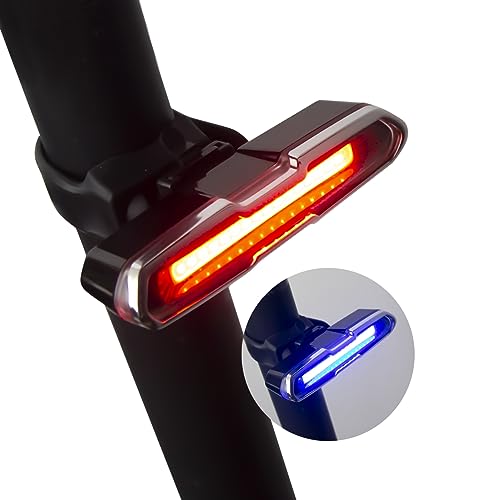
Dual-Color Red-Blue LED Tail Light differs with a silicone strap and is described for use on a bike frame, helmet or backpack. The maker states a 168-lumen output and five modes, including steady red, steady blue, alternating red-blue and two flashing patterns. Its COB LED design is described for both front and rear use, so placement and direction matter if using it away from the rear of a bicycle. This suits riders who value a flexible strap mount and named mode choices. The product name calls it waterproof, but gives no water-resistance rating for comparison.
Bottom line: Choose this when the silicone strap and explicitly named light patterns fit your setup.
Red + Blue + White USB Tail Light

Red + Blue + White USB Tail Light is the only option whose name adds white to the red-and-blue combination. The maker describes a PC shell, a rubber-band fixing mount and USB charging, and says five or six modes are available. Its features also identify IP43, but do not clarify whether that rating applies to the entire assembled light, so riders planning wet-weather use should verify the rating and mounting arrangement. Dimensions are 3.94 inches long and 1.97 inches wide and high. This suits buyers who specifically want a third color; the mode count is presented as a range rather than a single fixed number.
Bottom line: Pick this if white alongside red and blue is an important requirement.
How to Choose a Red and Blue Rear Light
Choose a rear light by its red mode, mounting position and visibility pattern before comparing extra colors. Red is the conventional rear-facing signal color; blue is restricted in some jurisdictions because it can be associated with emergency vehicles, so check local traffic rules before riding with a blue mode active. A wider viewing angle can help visibility from the sides, but it does not replace a lamp aimed toward approaching traffic. For night riding, pair a rear light with a front-facing white light and reflectors; a rear lamp alone does not illuminate the road ahead. If you need a specific flash pattern, verify that the controls include it rather than relying on a total mode count.
Mounting and Aiming a Bicycle Tail Light
Mount the rear light where bags, clothing and seat posts do not block it, and aim it level or slightly downward so it does not shine directly into another rider’s eyes. Seat-post straps are common, while silicone or rubber bands can also fit a frame, helmet or backpack; fit varies with the strap length and mounting surface. Before every ride, tug the mount gently and confirm the lamp stays fixed while the bike is moved. A loose strap can let a light rotate or fall off over bumps. If mounting on a backpack, keep the lamp visible from behind and avoid placing it where a jacket or pack flap covers it.
What Light Modes and Battery Runtime Mean
Steady light and flashing modes serve different visibility needs: a steady beam makes a cyclist’s position easier to judge, while a flash can draw attention in daylight. For night riding, avoid relying on a very fast flash as the only rear signal because it can make distance and motion harder to judge. Battery runtime changes with brightness and mode, so a maximum may not describe every setting. Charge a rechargeable light before a long ride and check that its charging port is fully closed before wet-weather use. USB charging does not establish a battery-life standard, and rechargeable runtime figures are product-specific rather than interchangeable.
Water Resistance and Care for Bike Lights
Water-resistance labels use an IP code with two digits: the first addresses solids and the second water ingress, so IP43 indicates limited splash protection rather than suitability for immersion. A waterproof claim without an IP rating does not give the same measurable comparison. Keep charging ports sealed when riding in rain, and dry the lamp before connecting a USB cable; moisture at an electrical connection can cause corrosion. Check the mount and lens for cracks or looseness regularly, especially after a fall or a rough ride. Clean the lens with a soft damp cloth rather than an abrasive pad that could scratch or haze the cover.
Frequently Asked Questions
Are blue bicycle lights legal on public roads?
Blue bicycle lights may be restricted because blue lighting is commonly associated with emergency vehicles. Rules differ by location, so check your state and local traffic requirements before using a blue mode on public roads.
Should a rear bicycle light be steady or flashing?
Either mode can improve visibility, but steady rear lighting helps others judge position and movement while flashing can attract attention. For night rides, use a pattern that remains easy to see and does not obscure your position.
Where should I mount a bicycle rear light?
Mount it at the rear where bags and clothing cannot block it, and aim it toward traffic behind you. Check the strap before each ride; a loose mount can rotate or drop on rough pavement.
What does an IP43 rating mean for a bike light?
IP43 indicates protection against objects larger than 1 mm and water spray up to 60 degrees from vertical, not immersion. Close charging-port covers before riding in wet conditions and dry the light before charging.
How often should I charge a USB bike tail light?
Charge it before a long ride and whenever its indicator or reduced brightness signals a low battery. Runtime depends on the selected brightness and mode, so do not assume a maximum-hour claim applies to every setting.