
Wire Connectors for Car Stereo: 5 Types Compared

For most car stereo wiring, AIRIC Insulated Butt Splices, 200-Piece is the most versatile pick because its butt splices cover 22–10 AWG wires in three color-coded sizes. Choose woshilaoDS Closed-End Crimp Caps, 250-Piece for closed-end crimp caps or Feggizuli Mixed Spade and Terminal Kit, 280-Piece when you need varied spade, ring, and fork terminals instead of inline splices.
Car stereo wire connectors join the radio harness to vehicle wiring; match the connector to both wire gauge and the connection style your installation requires.
We earn a commission if you buy through links on this page. As an Amazon Associate I earn from qualifying purchases. Products are compared on manufacturer specifications, not hands-on testing.
- Best overall: AIRIC Insulated Butt Splices, 200-Piece – Three butt-splice sizes cover 22–10 AWG wire.
- Best for closed-end caps: woshilaoDS Closed-End Crimp Caps, 250-Piece – The kit includes crimp caps with ranges spanning 22–10 AWG.
- Best for mixed terminals: Feggizuli Mixed Spade and Terminal Kit, 280-Piece – The assortment combines male and female spades with ring and fork terminals.
| Product | Best for | Connector style | Wire range | Count | Shop |
|---|---|---|---|---|---|
| AIRIC Insulated Butt Splices, 200-Piece | Mixed wire gauges | Butt splice | 22–10 AWG | 200 pieces | Check Price on Amazon |
| woshilaoDS Closed-End Crimp Caps, 250-Piece | Closed-end splices | Closed-end cap | 22–10 AWG | 250 pieces | Check Price on Amazon |
| Kuject Solder-Seal Connectors, 120-Piece | Heat-sealed splices | Solder-seal butt splice | 26–10 AWG | 120 pieces | Check Price on Amazon |
| Feggizuli Mixed Spade and Terminal Kit, 280-Piece | Mixed terminal shapes | Spade, ring, fork | 22–10 AWG | 280 pieces | Check Price on Amazon |
| TICONN Heat-Shrink Butt Connectors, 100-Piece | Sealed crimp splices | Heat-shrink butt splice | — | 100 pieces | Check Price on Amazon |
Wire Connectors for Car Stereo Wiring
Match the connector shape to the harness connection and the wire gauge before choosing a kit.
AIRIC Insulated Butt Splices, 200-Piece

AIRIC Insulated Butt Splices, 200-Piece stands out for its three-size butt-splice assortment, which covers thin signal wires through larger leads. The kit has 90 red connectors for 22–16 AWG, 80 blue for 16–14 AWG, and 30 yellow for 12–10 AWG. A wire-stop structure helps position conductors, while flared insulation eases insertion. The maker says the terminals suit car stereo and other wiring projects. These are insulated crimp connectors, not heat-shrink seals, so choose another style if moisture sealing is a priority.
Bottom line: Choose this kit when your installation uses several wire gauges and standard crimped inline splices.
woshilaoDS Closed-End Crimp Caps, 250-Piece

Unlike inline butt splices, woshilaoDS Closed-End Crimp Caps, 250-Piece uses closed-end caps to join wires within a single insulated terminal. The kit lists CE1, CE2, and CE5 sizes and ranges of 22–16, 16–14, and 12–10 AWG. Its nylon insulation surrounds an aluminum conductor; the maker says the connectors are suitable for car stereos and help protect against shorts. Installation requires stripping the wires and crimping the cap with pliers. A cap is not a substitute for a vehicle-specific harness adapter when the radio connection requires a plug.
Bottom line: Pick these when a closed-end crimp cap matches the connection you need to make.
Kuject Solder-Seal Connectors, 120-Piece

Kuject Solder-Seal Connectors, 120-Piece differs from ordinary crimp terminals by combining a solder ring with heat-shrink tubing, so it is intended to make a sealed inline splice rather than a removable terminal connection. The kit covers 26–10 AWG and uses a heat gun for installation, without a crimping step. The maker says adhesive rings help resist moisture and the tubing tolerates brief high heat during joining. This format needs heat and careful control, so it is less suitable when working near heat-sensitive trim or where a heat gun cannot be used safely.
Bottom line: Choose these for a heat-applied splice where moisture resistance matters more than quick removal.
Feggizuli Mixed Spade and Terminal Kit, 280-Piece
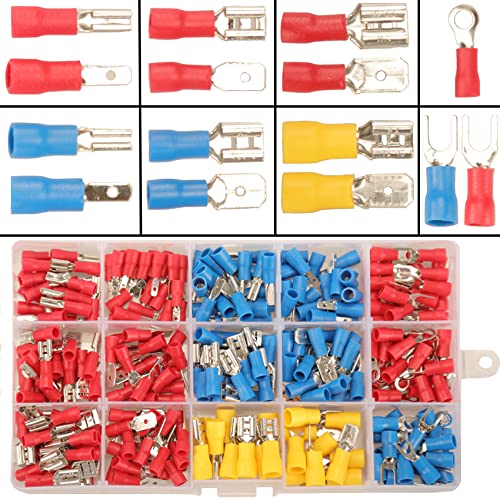
Feggizuli Mixed Spade and Terminal Kit, 280-Piece is the option for installations that call for terminal shapes beyond a simple wire-to-wire splice. Its 280-piece kit includes male and female spades in 2.8, 4.8, and 6.3 mm sizes, plus ring and fork connectors. Red, blue, and yellow identify ranges of 22–16, 16–14, and 12–10 AWG. The maker identifies the terminals as tinned copper with PVC insulation. You will need a crimper, and these terminals do not provide the same inline splice format as butt connectors.
Bottom line: Choose this assortment when the stereo or vehicle connection calls for spades, rings, or forks.
TICONN Heat-Shrink Butt Connectors, 100-Piece

TICONN Heat-Shrink Butt Connectors, 100-Piece pairs a crimped butt splice with adhesive-lined, dual-wall heat-shrink tubing, distinguishing it from unsealed insulated terminals. The kit contains 100 connectors in three sizes, with a 3:1 shrink ratio. Its maker says the tinned-copper barrel and adhesive lining help create a moisture-resistant seal after crimping and heating. Heat is also required to finish the seal.
Bottom line: Pick these if you want heat-shrink protection and can confirm the size suits your wire gauge.
How to Choose Car Stereo Wire Connectors
Choose the connector by wire gauge and joint shape first; color alone is useful only when you know the kit’s gauge key. A butt splice joins two wire ends in line, while a closed-end cap gathers wires into one insulated termination. Spade, ring, and fork terminals connect a wire to a tab or screw terminal rather than directly joining two wire ends. Strip only enough insulation for the conductor to reach the terminal’s barrel, and use a crimper sized to the connector. For a typical stereo harness, a crimp connector is usually more practical than a solder-seal connector when access to a heat gun is limited.
Match Connector Size to Wire Gauge
Wire gauge numbers run in reverse: 10 AWG is thicker than 22 AWG, so a connector’s range must include the wire size being joined. Where two wires differ in gauge, confirm that the connector is rated for both; do not force a thick conductor into a small barrel or leave a thin wire loose. A color code is not universal across every kit, so use the manufacturer’s gauge range rather than assuming red, blue, or yellow means the same thing. When the stereo harness has more than one wire size, choose a kit spanning those gauges or keep separate, clearly sorted connectors for each size.
Butt Splices, Caps, and Terminals Compared
Connector shape determines how a stereo wire can attach: butt splices join wire ends, closed-end caps join wires inside a capped terminal, and spade, ring, or fork terminals attach to a tab or fastener. A heat-shrink version adds tubing that contracts when heated, while a standard insulated crimp terminal does not form that heat-activated seal. Use this quick guide to narrow the connector style before matching gauge.
| Connection need | Connector style | What to confirm |
|---|---|---|
| Join two wire ends inline | Butt splice | Gauge range and crimp fit |
| Join wires into a capped end | Closed-end cap | Wire count and gauge range |
| Attach to a tab or fastener | Spade, ring, or fork | Terminal shape and size |
| Seal a crimped inline splice | Heat-shrink butt splice | Gauge range and heat access |
Crimping and Heat-Shrink Safety
A sound crimp grips bare conductor without cutting strands or trapping insulation under the metal barrel. Use the crimper slot that matches the terminal, then pull the joined wires gently to check retention before insulating or reinstalling the radio. Heat-shrink connectors need a heat gun and space to direct hot air; keep heat away from plastic trim, wiring insulation, and other heat-sensitive parts. Never work on wiring with the vehicle powered, and isolate the circuit before cutting or joining conductors. A connector’s moisture-resistant design does not remove the need for a correctly sized crimp.
Frequently Asked Questions
Can I use butt connectors for car stereo wires?
Yes, butt connectors can join two stereo wire ends inline when the connector range matches both wires. Crimp the barrel with a suitable tool and check that neither wire pulls out.
What does the color on a wire connector mean?
Color commonly marks a connector’s wire-gauge range, but the mapping can differ by kit. For example, one assortment assigns red to 22–16 AWG, blue to 16–14 AWG, and yellow to 12–10 AWG.
Are heat-shrink connectors better for a car stereo?
Heat-shrink connectors add tubing that contracts when heated, and adhesive-lined versions can seal around a crimp. Choose them when that seal is useful and you have safe access for a heat gun; a standard insulated crimp may be simpler for a dry interior splice.
Do I need a special crimper for stereo wire connectors?
A crimp connector needs a crimping tool matched to its terminal size; ordinary pliers may not compress the barrel evenly. Heat-seal solder connectors instead require a heat gun, not a crimp step.
How do I connect different gauge stereo wires?
Use a connector whose approved range covers each wire’s gauge, and ensure both conductors sit securely in the barrel. AWG numbers decrease as wire gets thicker, so 10 AWG is larger than 22 AWG.