
Carbon Air Filter Car Options by Vehicle Fit

For a carbon air filter car replacement, choose the option whose vehicle fitment and dimensions match your cabin filter; Tesla Model 3 / Model Y Carbon Filter is the Tesla-specific choice for Model 3 and Model Y. The other options cover different vehicle families, so choose them only if their fitment matches your car.
These are cabin air filters, installed in the ventilation system to filter air entering the passenger compartment; activated carbon is included in each product name.
We earn a commission if you buy through links on this page. As an Amazon Associate I earn from qualifying purchases. Products are compared on manufacturer specifications, not hands-on testing.
- Best overall: Tesla Model 3 / Model Y Carbon Filter – It covers Tesla Model 3 and Model Y, and its 5.6-by-9.4-inch dimensions distinguish it from the other options.
- Best for Hyundai and Kia: Hyundai / Kia / Genesis Carbon Filter – Its vehicle fitment spans Hyundai, Kia, and Genesis models.
- Best for Toyota and Lexus: Puroma Toyota / Lexus Carbon Filter – Its Toyota and Lexus fitment includes a broad range of model families.
| Product | Best for | Vehicle coverage | Filter dimensions | Pack count | Shop |
|---|---|---|---|---|---|
| Tesla Model 3 / Model Y Carbon Filter | Tesla vehicles | Model 3 2017–2026; Model Y 2020–2026 | 5.6 × 9.4 × 1.2 in | 2 filters | Check Price on Amazon |
| Hyundai / Kia / Genesis Carbon Filter | Hyundai Kia Genesis | Selected Hyundai, Kia, Genesis models | 8.3 × 8.9 × 1.2 in | — | Check Price on Amazon |
| Puroma Toyota / Lexus Carbon Filter | Toyota and Lexus | Selected Toyota, Lexus models | 7.6 × 8.4 × 1.2 in | 1 filter | Check Price on Amazon |
| Honda / Acura CF182 Carbon Filter | Honda and Acura | Selected Honda, Acura models | 8.1 × 8.3 × 1.2 in | — | Check Price on Amazon |
| EPAuto CP134 / CF10134 Carbon Filter | Older Honda Acura | Selected Honda, Acura models | 9.3 × 9.0 × 1.2 in | 1 filter | Check Price on Amazon |
Carbon Air Filters for Cars
Match the vehicle and model year first, then compare dimensions and pack count where provided.
Tesla Model 3 / Model Y Carbon Filter
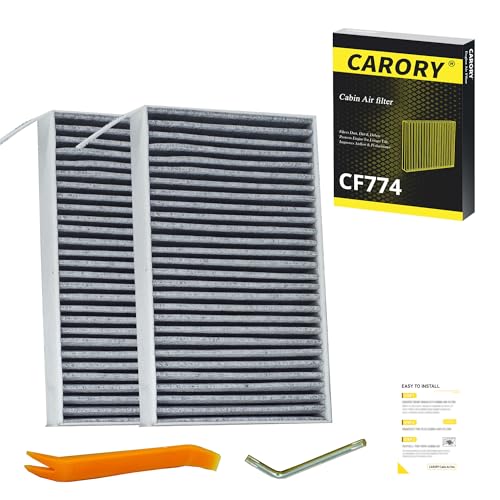
For Tesla Model 3 and Model Y owners, this option is the only one here specifically identified for those vehicles. It comes as a two-filter set and measures about 5.6 × 9.4 × 1.2 inches. The fitment spans Model 3 years 2017–2026 and Model Y years 2020–2026. Its dimensions and vehicle coverage make it distinct from the broader multi-brand replacements. The limitation is narrow vehicle coverage: it is not a fit choice for the Hyundai, Toyota, Honda, or Acura applications covered by the other options, so confirm your exact model-year fit before ordering.
Bottom line: Choose this if your Tesla model and year match the fitment.
Hyundai / Kia / Genesis Carbon Filter

The cross-brand fitment is what separates this filter: it covers selected Hyundai, Kia, and Genesis vehicles, including models such as Tucson, Sportage, Sorento, EV6, and GV60. Its dimensions are about 8.3 × 8.9 × 1.2 inches, larger in width than the Tesla filter here. The model-year ranges vary by vehicle; for example, Tucson coverage begins in 2022, while Sonata begins in 2020. That breadth does not make it universal: owners of other brands or unlisted model years should select a different fitment rather than rely on the shared cabin-filter format.
Bottom line: Pick this for a Hyundai, Kia, or Genesis model and year.
Puroma Toyota / Lexus Carbon Filter

This Puroma option targets a large selection of Toyota and Lexus vehicles, rather than the Tesla and Korean-brand applications in the other filters. The Toyota coverage includes older Camry, Corolla, Highlander, and RAV4 years, among many others; Lexus fitment includes several CT, ES, and GS models. It measures about 7.6 × 8.4 × 1.2 inches and is a single filter. The tradeoff is that the coverage spans many distinct generations, so a familiar model name alone is not enough—match the exact vehicle year against the fitment before choosing.
Bottom line: Choose this for a Toyota or Lexus that falls within its years.
Honda / Acura CF182 Carbon Filter

For newer Honda and Acura fitments, this filter covers vehicles including Civic, CR-V, HR-V, Odyssey, Integra, MDX, and RDX. The years reach 2025 for several models, with coverage varying across the range. At about 8.1 × 8.3 × 1.2 inches, it differs in footprint from the Toyota/Lexus and Hyundai/Kia options. Its broad brand coverage is useful only when the year and model match: Honda and Acura have multiple cabin-filter shapes, so this is not interchangeable with every vehicle from either marque.
Bottom line: Select this for a Honda or Acura model and year in its fitment range.
EPAuto CP134 / CF10134 Carbon Filter

The EPAuto CP134 / CF10134 is a distinct choice for a number of older Honda and Acura applications, with coverage including Accord years back to 2003, Civic from 2006, and several Acura lines. It measures about 9.3 × 9.0 × 1.2 inches and comes as one filter. Its fitment overlaps with some vehicles covered by Honda / Acura CF182 Carbon Filter, but the year spans differ—for example, its Accord range begins well before the other Honda/Acura option. The limitation is that a matching brand is not enough; check the exact vehicle generation and year to avoid selecting the wrong filter shape.
Bottom line: Choose this when your Honda or Acura matches its older model-year coverage.
How to Choose a Carbon Cabin Air Filter
Start with the exact vehicle, model year, and filter dimensions; activated carbon alone does not establish that a replacement fits. Cabin filters are commonly replaced about every 12,000 to 15,000 miles or once a year, with dusty driving often calling for earlier replacement. Carbon media can adsorb some gases and odors, while the filter also captures airborne particles; effectiveness depends on its design and fit. If your vehicle year is outside the range, do not assume that a similar model or adjacent year uses the same filter.
Vehicle Fit and Filter Dimensions
Choose by vehicle application before comparing the inch measurements, because cabin filter housings are not a universal size. Measure the old filter’s length, width, and depth, or check the vehicle’s owner documentation for the correct replacement dimensions; use the same orientation when comparing measurements. A difference of even a small fraction of an inch can keep a filter from seating flat, leaving gaps around its edge. Use the exact model-year fitment as the deciding condition: for example, a Honda owner should distinguish Honda / Acura CF182 Carbon Filter from EPAuto CP134 / CF10134 Carbon Filter by model year and application, not by brand alone. If you cannot confirm the matching fitment, verify the precise replacement number before ordering.
What Activated Carbon Does in a Cabin Filter
Activated carbon has a porous structure that can adsorb some gaseous compounds and odors as cabin air passes through the filter. It complements particle-filtering media; the carbon layer does not mean every gas or smell will be removed. Performance depends on carbon quantity, filter construction, airflow, and how much material the media has already captured. Cabin filters are not the same as engine air filters: the cabin filter serves the passenger ventilation system, while the engine filter protects the intake side of the powertrain. Select the right component for the job, and replace a cabin filter when its service interval or condition calls for it rather than expecting carbon to last indefinitely.
Cabin Filter Replacement and Common Mistakes
Most cabin filters are accessed behind the glove compartment or through a panel near the passenger-side cowl, although access varies by vehicle. Before removing the old filter, note its airflow arrow; install the replacement with airflow oriented the same way, since reversing it can reduce proper operation. Avoid forcing a filter that bows, pinches, or leaves a visible edge gap—those signs can indicate the wrong shape or orientation. Check for leaves and debris in the housing, but do not push debris into the ventilation duct. After installation, make sure the access panel and glove compartment are secured, then run the fan to confirm normal airflow without unusual rubbing or rattling.
Frequently Asked Questions
How often should a car cabin air filter be changed?
A common interval is every 12,000 to 15,000 miles or once a year. Dusty roads, heavy traffic, or frequent ventilation use can make an earlier change sensible.
Does activated carbon remove odors from car air?
Activated carbon can adsorb some odor-causing gases as air passes through the media. It does not guarantee removal of every odor, and capacity depends on the filter design and use.
Can I use an engine air filter as a cabin filter?
No; the engine air filter and cabin filter serve different systems and are not interchangeable. Match a replacement to the cabin filter’s vehicle application and dimensions.
Which way should the cabin filter airflow arrow point?
Install the new filter with its airflow arrow oriented in the same direction as the old filter’s arrow. If the old filter has no visible arrow, use the vehicle’s filter-housing marking and avoid forcing a filter that does not seat flat.
Will a cabin filter fit every year of the same car model?
No; manufacturers can change filter shapes between model years or generations. Use the exact year range and vehicle application, then compare the old filter’s length, width, and depth.