
Soleus Air Conditioner: Four Models Compared by Fit

The Soleus Air saddle-mount window air conditioner is the closest fit if you want a window unit with supplemental heat and a design that leaves the window view open. Choose a different model if you need a portable unit, a higher stated cooling capacity, or a conventional window format.
We earn a commission if you buy through links on this page. As an Amazon Associate I earn from qualifying purchases. Products are compared on manufacturer specifications, not hands-on testing.
- Best overall: Soleus Air 12,000 BTU Saddle-Mount AC – The 12,000 BTU cooling unit has a saddle mount, Wi-Fi, and a 10,000 BTU heater.
- Best for smaller rooms: Midea 7,800 BTU Inverter Window AC – The 7,800 BTU window unit is rated for rooms up to 340 square feet.
- Best for larger rooms: LG 23,000 BTU Smart Window AC with Heat – The 23,000 BTU window unit is specified for rooms up to 1,440 square feet.
- Best for portable use: BLACK+DECKER 10,000 BTU Portable AC – The portable unit includes casters and a remote with Follow Me temperature control.
| Product | Best for | Cooling capacity | Heating | Format | Shop |
|---|---|---|---|---|---|
| Soleus Air 12,000 BTU Saddle-Mount AC | Open window view | 12,000 BTU | 10,000 BTU | Saddle-mount window | Check Price on Amazon |
| Midea 7,800 BTU Inverter Window AC | 340-square-foot rooms | 7,800 BTU | — | Window | Check Price on Amazon |
| LG 23,000 BTU Smart Window AC with Heat | Large rooms | 23,000 BTU | Supplemental heat | Window | Check Price on Amazon |
| BLACK+DECKER 10,000 BTU Portable AC | Portable room cooling | 10,000 BTU | No | Portable | Check Price on Amazon |
Soleus Air Conditioner Options Compared
Compare the cooling capacity, heat options, and installation formats to find a unit that fits your room and setup.
Soleus Air 12,000 BTU Saddle-Mount AC

The defining feature of Soleus Air 12,000 BTU Saddle-Mount AC is its saddle-mount design, which straddles the window sill rather than blocking the full window opening. It combines 12,000 BTU cooling with a 10,000 BTU heater, Wi-Fi, and inverter compressor operation. Soleus says the design shifts noise outside and operates at 38 dB, and says the unit can leave the view unobstructed while allowing the window to open. This suits buyers who want seasonal heating as well as cooling. Its 115-volt supply and 12.5-inch extra-thick-wall compatibility are key fit points; confirm your window and wall dimensions before ordering.
Bottom line: Pick this if an open window view and built-in heat matter more than a conventional window-unit format.
Midea 7,800 BTU Inverter Window AC

Midea 7,800 BTU Inverter Window AC is a smaller-capacity conventional window alternative, with a coverage of up to 340 square feet rather than the Soleus unit’s saddle-mount design. It has inverter technology, four modes—Auto, Cool, Dry, and Fan—and three fan-speed settings. The unit also provides a 24-hour timer, an LED display, a remote, and smart-app and voice-assistant control. Midea identifies it as Energy Star rated and gives a combined energy efficiency ratio of 15.1. This is a fit for buyers prioritizing a room-size rating and multiple operating modes. It does not offer a heating feature, so choose a heat-and-cool model if winter warmth is part of the plan.
Bottom line: Choose this for a conventional window unit with a 340-square-foot coverage range and multiple modes.
LG 23,000 BTU Smart Window AC with Heat
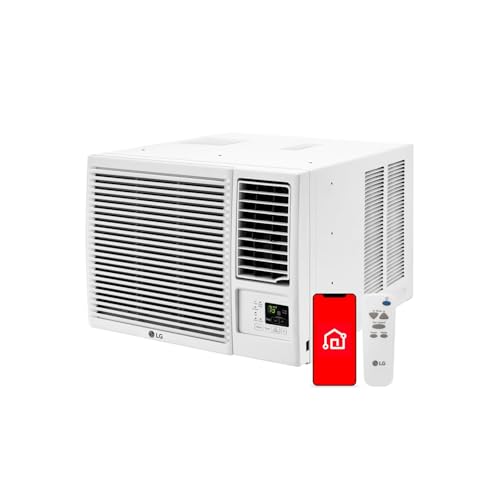
LG 23,000 BTU Smart Window AC with Heat is a higher-capacity window alternative with supplemental heat and a coverage of up to 1,440 square feet. It uses 230 volts, unlike the Soleus model’s 115-volt supply, so the electrical setup is an important compatibility distinction. LG ThinQ enables smartphone control, and the unit also works with Alexa and Hey Google; an auto-restart feature returns the unit to its previous operation after power is restored. The cooling, heating, and fan functions each have two speeds. This model suits a large room with compatible electrical service. Its 141-pound weight makes installation planning especially important compared with lighter listed units.
Bottom line: Pick this for a large room when the 230-volt electrical requirement and heavier installation are workable.
BLACK+DECKER 10,000 BTU Portable AC

BLACK+DECKER 10,000 BTU Portable AC differs from the window units by using a portable format with casters and side handles for moving it between rooms. It combines air conditioning, fan, and dehumidifier functions, and its remote has Follow Me control, which lets the remote act as a thermostat. The product is rated at 10,000 BTU and 5,550 BTU SACC, with coverage stated up to 450 square feet. This option suits buyers who need mobility instead of a window-mounted unit. It does not include heat, and a portable AC needs an exhaust route through a window, so it is not a match for rooms where that setup is impractical.
Bottom line: Choose this when mobility matters more than window-unit installation or built-in heat.
How to Choose an Air Conditioner Capacity
Start with room area, but treat a BTU rating as a sizing starting point rather than a guarantee of comfort. A common rule of thumb is about 20 BTU per square foot; ceiling height, direct sun, insulation, and occupancy can change the load. For example, 340 square feet at that rough rate is about 6,800 BTU before adjustments. Oversizing can cool a room quickly without running long enough to remove as much humidity, while undersizing can leave the unit running continuously. Use the room’s length multiplied by its width, then account for unusually sunny rooms or high ceilings. Match the unit’s coverage to the room and confirm that the manufacturer’s sizing guidance fits the space.
Window and Portable Air Conditioner Fit
Window air conditioners need a compatible opening, a secure support arrangement, and access to an electrical outlet; portable units need a window or other approved exhaust route. A saddle-mount unit sits across the sill, while a conventional window unit occupies the opening, so measure the sash opening and sill before choosing a format. Portable designs can move between rooms, but their exhaust hose still limits placement. A useful rule: if the room has no practical way to route hot exhaust outdoors, do not choose a portable AC. Window units are heavy appliances; use the required brackets and follow the installation directions to reduce the risk of a fall. Never block the unit’s air intake or exhaust with curtains or furniture.
Cooling, Heating, and Electrical Requirements
Check the electrical rating before choosing a unit with a particular capacity or heating feature. These options include 115-volt and 230-volt equipment, and a 230-volt model requires a compatible circuit rather than an ordinary 115-volt receptacle. Air-conditioner heating can mean supplemental heat, so do not assume a window AC replaces a primary heating system. A heat pump’s ability to provide warmth also depends on outdoor conditions and model limits; rely on the unit’s operating range for cold-weather use. Decide whether you need cooling alone, supplemental heat, or a separate heating appliance, then confirm your room’s circuit and outlet match the selected unit before installation.
Using and Maintaining a Room Air Conditioner
Clean the reusable air filter regularly—many room air conditioners call for cleaning about every two weeks during frequent use, though the specific maintenance schedule can differ by model. A clogged filter restricts airflow and can reduce cooling performance, so inspect it more often in dusty rooms. Keep the outdoor coil and the indoor air path clear, and make sure condensate can drain as intended. Set the thermostat to a comfortable target rather than repeatedly switching the unit on and off; closing doors to unused rooms helps limit the area being cooled. Before storing a seasonal unit, clean and dry its filter and follow its care instructions. Disconnect power before cleaning components that require access inside the unit.
Frequently Asked Questions
How many BTUs do I need for a room air conditioner?
A rough starting estimate is 20 BTU per square foot, so a 300-square-foot room starts near 6,000 BTU before adjustments. Direct sun, high ceilings, insulation, and the number of occupants can increase the cooling load.
Can a window air conditioner heat a room?
Some window air conditioners include a heating mode, but others provide cooling only. Check for a heating capacity and treat supplemental heat as an addition, not a guaranteed replacement for a primary heating system.
Does a 230-volt air conditioner need a special outlet?
A 230-volt AC needs a compatible 230-volt circuit and receptacle; it cannot be plugged into a standard 115-volt outlet. Confirm the circuit and plug requirements before installation.
How often should I clean an air conditioner filter?
A common interval during heavy use is about every two weeks, with more frequent checks in dusty conditions. Reusable filters should be cleaned and fully dried before reinstalling.
Do portable air conditioners need a window?
Most portable ACs need a way to exhaust hot air outdoors, commonly through a window kit. Without a suitable exhaust route, the unit cannot effectively remove heat from the room.