
Tachometer for Small Engines: 5 Types Compared

For most small engine owners, Runleader RL-HM011E is the best fit because it combines a 0–20,000 RPM tachometer with an hour meter and support for common 2- and 4-stroke gasoline engines. Choose a handheld meter or a different pickup style if you need a portable diagnostic tool or a particular mounting setup.
We earn a commission if you buy through links on this page. As an Amazon Associate I earn from qualifying purchases. Products are compared on manufacturer specifications, not hands-on testing.
- Best overall: Runleader RL-HM011E – Combines real-time RPM monitoring, engine-hour tracking and programmable service reminders.
- Best for handheld diagnostics: ES 328 EZ Tach Plus – Offers wireless or inductive pickup and supports 2- and 4-cycle engines from 1 to 8 cylinders.
- Best for expanded RPM range: Small Engine Tachometer with 3 Modes – Its maker specifies readings up to 36,000 RPM in 03 mode.
| Product | Best for | RPM range | Engine support | Additional function | Shop |
|---|---|---|---|---|---|
| Runleader RL-HM011E | Hours and RPM | 0–20,000 RPM | 2-stroke: 1–2 cylinders; 4-stroke: 1 | Hour meter and service timer | Check Price on Amazon |
| Runleader RL-HM011F | Service tracking | — | Programmable firing patterns | Hour meter and service timer | Check Price on Amazon |
| ES 328 EZ Tach Plus | Portable diagnostics | 0–20,000 RPM | 2- and 4-cycle; 1–8 cylinders | Backlit display and flashlight | Check Price on Amazon |
| Small Engine Tachometer with 3 Modes | High RPM readings | 0–18,000 RPM in 02 mode; up to 36 | Gasoline engines; 1–8 cylinders | Hour, service and max-RPM functions | Check Price on Amazon |
| Small Engine RPM Meter and Hour Gauge | Bracket mounting | — | Gasoline engines; cylinder support not given | Hour, service and max-RPM functions | Check Price on Amazon |
Tachometers for Small Engines
Match the pickup method and engine settings to the job, then compare the extra functions you will actually use.
Runleader RL-HM011E
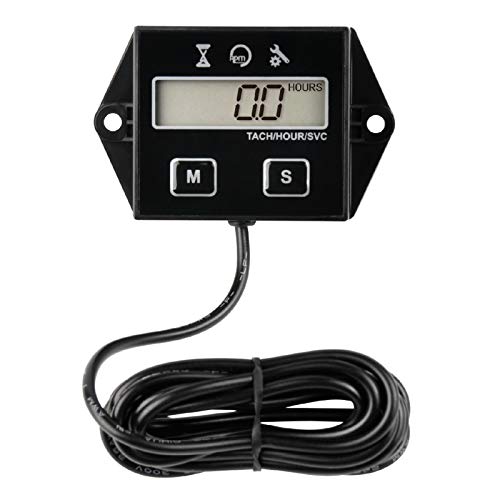
For a combined tachometer and maintenance counter, Runleader RL-HM011E pairs RPM readings with cumulative engine hours and a service timer. Its maker says it works with the 2-stroke and 4-stroke gasoline-engine configurations and provides 0.1-hour accuracy. A CR2450 battery powers the unit, and the display includes a maintenance alert. This suits owners who want to track runtime as well as engine speed. The limitation is its narrower stated cylinder support than a meter rated for 1–8 cylinders, so confirm your engine configuration matches before choosing it.
Bottom line: Choose this if you want runtime tracking and RPM in one gauge.
Runleader RL-HM011F
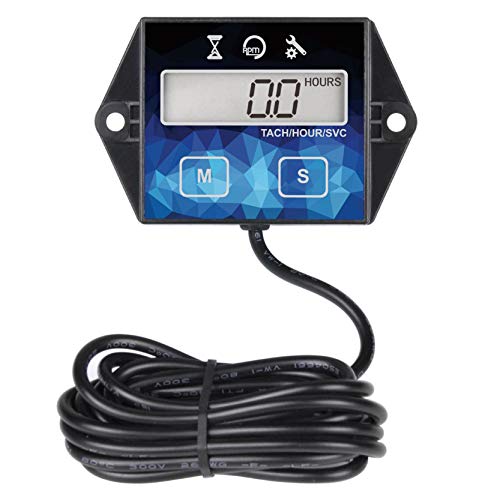
Runleader RL-HM011F is the hour-tracking option with a replaceable battery and a display that remains visible when the engine is off. Its maker says the tachometer can be programmed for different engine firing patterns, and its service timer counts down to a reminder. The CR2450 battery is replaceable, with data retained during the change. This fits owners prioritizing accumulated runtime and service prompts. Its features do not give a numeric RPM range or explicit engine-cylinder configurations, so verify those match your engine if a particular range or setup is essential.
Bottom line: Pick this for visible engine hours and a replaceable battery.
ES 328 EZ Tach Plus

Unlike the mounted hour-meter styles, ES 328 EZ Tach Plus is a handheld diagnostic tachometer with wireless sensing or an inductive clip connection. Its maker specifies a 0–20,000 RPM range, ±10 RPM accuracy, and support for 2- and 4-cycle engines from 1 to 8 cylinders. A backlit LCD and built-in flashlight are useful when working in dim areas. This suits tuning or checking several engines without installing a permanent gauge. It does not include the hour-meter and service-timer functions found on the Runleader choices.
Bottom line: Choose this for portable RPM checks across varied engines.
Small Engine Tachometer with 3 Modes

Small Engine Tachometer with 3 Modes stands out for its selectable RPM modes and broad set of tracking functions, including total hours, job hours, service time and maximum RPM. Its maker gives a 0–18,000 RPM range in 02 mode and up to 36,000 RPM in 03 mode, and says it supports 1–8-cylinder gasoline engines, including 2- and 4-stroke types. The green backlight is intended for dim conditions. This suits buyers who need the higher stated range; choosing the correct pulse mode is important because a wrong setting can produce misleading RPM readings.
Bottom line: Pick this if its selectable modes cover your engine’s RPM needs.
Small Engine RPM Meter and Hour Gauge

Small Engine RPM Meter and Hour Gauge differs with a bracket intended to secure the gauge to a tubular object and a clip that clamps around the spark-plug wire to receive a signal. Its maker says it includes total, job and service-hour functions, maximum RPM, an RPM alarm, a clock and memory through battery replacement. This suits a buyer who wants the meter mounted near the equipment rather than carried as a handheld tester.
Bottom line: Choose this if bracket mounting and spark-wire pickup suit your setup.
How to choose a small engine tachometer
Choose by pickup method first: handheld meters suit occasional checks, while a mounted gauge can combine RPM readings with runtime tracking. Inductive pickup reads ignition pulses from a spark-plug lead; wireless sensing avoids attaching a clip, while a wire clip generally needs access to the lead. Hour meters count engine runtime, and service timers add a maintenance reminder, but neither replaces checking the engine maker’s service schedule. Match the engine type, cylinder count and firing-pattern setting before relying on the RPM value. A practical rule: if you need to check multiple machines or move around an engine bay, select a handheld meter; for routine runtime records on one machine, favor an hour-meter style. Do not assume two devices share the same pulse setting just because both fit gasoline engines.
RPM range and engine compatibility
Match the tachometer’s maximum range to the engine’s operating range, not just its idle speed; a meter that tops out below the engine’s possible speed cannot cover the full measurement job. Small engines may use different ignition pulse patterns, and tachometers often let users select a mode to interpret those pulses. An incorrect setting can make the display read too high or too low. The product specifications here vary from a 0–20,000 RPM range to a mode-dependent ceiling of 36,000 RPM, while some give no numeric range. If the engine’s maximum speed or ignition pattern matters, check the engine manual or manufacturer before selecting a meter. Never rev an engine beyond its rated limit just to test a tachometer.
Pickup methods and safe installation
Inductive pickups sense ignition activity at the spark-plug wire, while a wireless meter reads without a physical clip connection. For a wired pickup, route the lead away from the muffler, belts, fan and other moving or hot parts; secure any slack so it cannot be pulled into the machinery. Install or reposition a clip with the engine off, and keep hands, clothing and tools clear while the engine runs. Handheld designs avoid leaving a gauge mounted, but require a safe position to read the display during operation. A useful decision rule is to choose a handheld meter when access is temporary or shared among machines, and a mounted gauge when recurring runtime tracking is the priority.
Compare tachometer styles by job
Different tachometer formats solve different jobs: the range and extras matter after the engine and pickup method are compatible. Use this guide to narrow the choice by task rather than by feature count alone.
| Job | Useful style | Check before use |
|---|---|---|
| Portable tuning across engines | Handheld wireless or inductive meter | Engine type, cylinder support and range |
| Routine runtime records | Hour-meter tachometer | Firing pattern and installation position |
| Higher-speed measurement | Meter with a suitable selectable range | Mode-specific maximum RPM |
Choose the simplest format that meets the job: extra service alerts or a clock do not improve an RPM reading if the pickup setting is wrong. For maintenance intervals, use the interval specified for the engine and its operating conditions rather than treating a meter’s programmable alert as a universal schedule.
Frequently Asked Questions
How do I set a tachometer for a two-stroke engine?
Select the mode that matches the engine’s ignition pulses, since two-stroke engines can have different ignition arrangements. A wrong pulse setting can make the displayed RPM inaccurate; use the engine or tachometer instructions to identify the correct mode.
Where should an inductive tachometer lead go?
Place its pickup at the spark-plug wire as directed for that meter, with the engine off during installation. Route the lead clear of hot exhaust parts, belts and other moving components before starting the engine.
Can one tachometer work on different small engines?
Some meters support multiple engine cycles and cylinder counts, but compatibility is model-specific. Before switching machines, confirm the engine type, cylinder support and firing-pattern setting, then select the appropriate mode.
Why does a small engine tachometer show the wrong RPM?
A mismatched pulse or firing-pattern setting is a common cause of an incorrect reading. Check the pickup connection and mode, and compare the engine’s expected operating range with the meter’s measurement range.
Is an hour-meter tachometer useful for maintenance?
Yes, an hour meter records runtime, which can help track service intervals that are specified in operating hours. Use the engine maker’s schedule because dusty conditions, heavy loads and other operating conditions can change maintenance needs.