
Rubber to Steel Adhesive: 5 Bonding Options Compared

For bonding rubber to steel, S-18 All-Purpose Adhesive is the most direct match because its maker identifies rubber-to-metal bonding as a use, including SBR rubber and neoprene. Choose a weatherstrip adhesive instead for automotive door or trunk seals; a general silicone or rubber repair glue may suit a different repair but is less specifically matched to a rubber-to-steel joint.
We earn a commission if you buy through links on this page. As an Amazon Associate I earn from qualifying purchases. Products are compared on manufacturer specifications, not hands-on testing.
- Best overall: S-18 All-Purpose Adhesive, 4 oz – Its maker specifically identifies SBR rubber and neoprene bonded to metal as a use.
- Best for automotive seals: HAOSLINE Weatherstrip Adhesive, 3.38 fl oz – It is intended for weatherstripping, rubber gaskets, metal, and door or trunk moldings.
- Best for small rubber repairs: LOOCTOT Black Rubber Glue, 20 g – The 20 g bottle targets rubber repairs and bonding rubber with other materials.
| Product | Best for | Adhesive type | Package size | Shop |
|---|---|---|---|---|
| S-18 All-Purpose Adhesive, 4 oz | Rubber-to-metal bonds | Contact cement | 4 oz | Check Price on Amazon |
| HAOSLINE Weatherstrip Adhesive, 3.38 fl oz | Automotive weatherstrips | Weatherstrip adhesive | 3.38 fl oz | Check Price on Amazon |
| LOOCTOT Black Rubber Glue, 20 g | Small rubber repairs | Rubber glue | 0.71 oz | Check Price on Amazon |
| INSOIA Super Black Rubber Glue, 20 g | Precision rubber fixes | Rubber glue | 0.71 oz | Check Price on Amazon |
| J-B Weld 31319 Black RTV Silicone, 3 oz | Uneven surface sealing | RTV silicone | 3 oz | Check Price on Amazon |
Rubber to Steel Adhesives Compared
Match the adhesive to the joint: a broad metal bond, an automotive seal, or a smaller rubber repair.
S-18 All-Purpose Adhesive, 4 oz

S-18 is the clearest fit for a rubber-to-steel joint because its maker specifically names rubber-to-metal bonding, including SBR rubber and neoprene. The off-white contact cement also bonds porous and nonporous materials such as metal, leather, felt, wood, and glass. Its maker says the adhesive is water resistant and offers oil resistance and peel strength, which may matter for upholstery or marine-related work. It is a 4 oz container. Contact cement is not the same application style as a squeeze-on instant glue, so buyers wanting a tiny spot repair should consider whether a larger contact-cement format suits the job.
Bottom line: Choose it for a direct rubber-to-metal application involving SBR rubber or neoprene.
HAOSLINE Weatherstrip Adhesive, 3.38 fl oz

For automotive rubber seals, this adhesive is more purpose-specific than a general-purpose bond product: it targets weatherstripping, rubber gaskets, metal, and door or trunk moldings. The maker says to press or clamp the joint for 1–3 minutes and allow 24 hours to dry; it also claims water and UV resistance and resistance to gasoline, oil, and most solvents. The 3.38 fl oz tube is intended for this kind of seal work, not engine gaskets. The application window and full drying time make it a less convenient choice when a repair must be returned to service immediately.
Bottom line: Pick it for rubber-to-metal automotive weatherstrip and molding repairs.
LOOCTOT Black Rubber Glue, 20 g

LOOCTOT is a small-format rubber glue for tire, tube, edge, and other rubber repairs; its maker also describes bonding rubber with other materials. The 20 g bottle has an anti-clogging cap, and the maker claims an initial set in 10–30 seconds and waterproofing after 24 hours of complete adhesion. That fast initial grab can suit a small repair, but the use examples center on rubber products rather than a named steel application. Wear gloves as the maker recommends, and do not assume a fast set means the bond is ready for full service before the 24-hour interval.
Bottom line: Consider it for a small rubber repair where the steel joint is not a specialized seal.
INSOIA Super Black Rubber Glue, 20 g
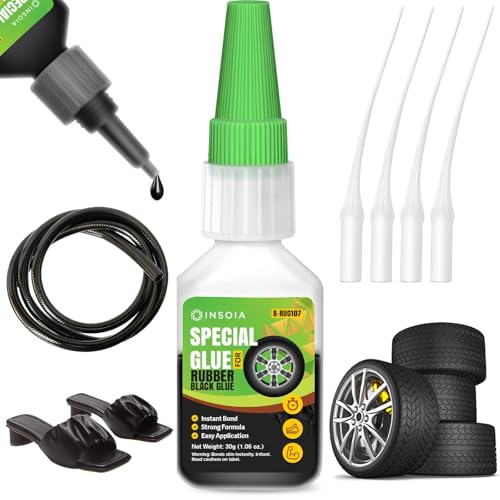
INSOIA stands out for its precision tips and compact 20 g bottle, with intended uses including rubber tires, tubes, shoe soles, belts, gaskets, and seals. The maker says it sets in 10–45 seconds and reaches full cure in 12–24 hours, with waterproof and heat-resistant properties after cure. Those examples make it a flexible rubber-repair option, but they do not specifically identify steel as the mating surface. Its faster initial set should not be confused with a full cure, so choose a different adhesive if the project requires a product explicitly designated for rubber bonded to metal.
Bottom line: Choose it for precise rubber repairs when a steel-specific bond is not required.
J-B Weld 31319 Black RTV Silicone, 3 oz

J-B Weld 31319 is a general-purpose RTV silicone sealant and adhesive designed for sealing and bonding uneven surfaces, making it distinct from the contact cement and rubber-repair glues here. Its black, 3 oz format may suit a joint where gap accommodation and sealing are central concerns. The specifications do not identify a rubber-to-steel application specifically, so this is a less direct match than an adhesive whose maker names rubber-to-metal bonding. It is a sensible consideration for uneven surfaces, but buyers seeking a dedicated automotive weatherstrip or rubber-to-steel bond should prioritize the more targeted choices.
Bottom line: Use it when bonding or sealing uneven surfaces is the key requirement.
How to Choose Rubber to Steel Adhesive
Start with the joint’s job: a broad bonded panel, a flexible automotive seal, or a small rubber repair calls for different adhesive formats. Contact cement is commonly applied to both surfaces, allowed to become tacky, then pressed together; the exact open time and application method depend on the product. RTV silicone cures through exposure to moisture in the air and is often selected for sealing or uneven joints rather than a thin, rigid bond. For a direct rubber-to-metal match, choose a product whose maker names that use. If the bonded assembly will face heat, oil, fuel, or water, check that the adhesive’s resistance matches the exposure instead of assuming all adhesives tolerate it.
Surface Preparation for Rubber and Steel
Clean, dry surfaces give adhesives a better chance to make close contact; dust, oil, release agents, and oxidation can interfere with bonding. Steel can be lightly abraded to remove surface oxidation and create a clean bonding area, then wiped free of residue and allowed to dry before adhesive application. Rubber surface treatments vary by material, and some rubbers have low surface energy that makes them difficult to bond; do not use an aggressive solvent without confirming it is compatible with the rubber. Keep the bonded faces aligned before contact cement grabs, because repositioning a contact bond can be difficult. A small trial on scrap material can reveal whether the adhesive attacks, stains, or fails to wet the particular rubber.
Contact Cement, Weatherstrip Glue, and RTV Silicone
Adhesive type is a practical way to narrow choices because the application method and purpose differ. Use this guide to match a joint’s priority to an adhesive family; compatibility with the exact rubber remains essential.
| Joint priority | Adhesive family | Typical use |
|---|---|---|
| Broad rubber-to-metal bond | Contact cement | Panels, upholstery, or larger bonded areas |
| Automotive rubber seal | Weatherstrip adhesive | Door seals and moldings |
| Uneven joint needing a seal | RTV silicone | Gap-filling and sealing applications |
| Small localized repair | Rubber glue | Spot repairs to rubber parts |
These categories are not interchangeable: a sealant may fill an uneven gap while a contact adhesive is designed to bond broad surfaces. Select by the joint’s shape and loading rather than by color or a general strength claim.
Safe Application and Cure Time
Solvent-based contact cements can release flammable vapors, so use them with strong ventilation and keep them away from flames, sparks, and hot surfaces. Follow the adhesive’s label for personal protection and cure time; a quick grab is not necessarily full cure. For example, one rubber glue here claims waterproofing only after 24 hours, while the automotive weatherstrip adhesive calls for 24 hours to dry. Clamp or press parts only as directed, and avoid loading the bond until its cure window is complete. Keep adhesives out of children’s reach, avoid skin and eye contact, and consult the safety label if adhesive contacts skin or eyes.
Frequently Asked Questions
Can rubber be bonded directly to steel?
Yes, rubber can be bonded directly to steel when the adhesive is compatible with that rubber and the metal surface is clean and dry. For broad joints, contact cement is a common approach; the specified application and cure window still determine when the assembly can be handled.
How should steel be prepared before gluing rubber?
Remove oil, dirt, and loose oxidation, then let the steel dry completely before applying adhesive. Light abrasion can help remove oxidation, but clean away all sanding residue so debris does not sit between the bonding faces.
How long should rubber-to-metal glue cure?
Cure time depends on the adhesive: a fast initial set is not the same as full cure. In these options, the maker gives 24 hours for full adhesion or drying for two of the rubber and weatherstrip glues, so avoid loading a joint before its product’s cure time.
Is contact cement or silicone better for rubber and steel?
Contact cement is generally the more direct choice for bonding broad rubber-to-metal faces, while RTV silicone is often chosen when sealing an uneven joint matters. Check the adhesive’s compatibility and resistance to the joint’s exposure before deciding.
Should I clamp rubber to steel while adhesive cures?
Clamping depends on the adhesive’s directions and joint geometry; some contact cement bonds by pressing coated surfaces together, while a weatherstrip adhesive option here calls for pressing or clamping for 1–3 minutes. Avoid excessive pressure that squeezes out adhesive or shifts a flexible seal.