
French Hair Pins for Thin Hair: 4 Options Compared

For a single French hair pin for thin hair, Kitsch Metal French Hair Pin is the clearest starting point because it is a metal French pin sold as one piece and its maker says it suits thin hair. Choose BEoffer 5-Inch French Hair Pins, 3.2-Inch Acetate French Hair Pins or Six-Piece Tortoiseshell French Hair Pins instead if you want multiple pins, a shorter pin or several colors and patterns.
We earn a commission if you buy through links on this page. As an Amazon Associate I earn from qualifying purchases. Products are compared on manufacturer specifications, not hands-on testing.
- Best overall: Kitsch Metal French Hair Pin – A single metal French pin whose maker says it holds thin hair.
- Best for color choice: BEoffer 5-Inch French Hair Pins – Three 5-inch U-shaped pins come in gold, silver and black.
- Best for shorter styles: 3.2-Inch Acetate French Hair Pins – The 3.2-inch acetate pins have a curved, serrated design.
- Best for variety: Six-Piece Tortoiseshell French Hair Pins – The six-piece set offers different patterns and colors.
| Product | Best for | Material | Length | Pack size | Shop |
|---|---|---|---|---|---|
| Kitsch Metal French Hair Pin | Single-pin styling | Metal | 5.12 in | 1 pin | Check Price on Amazon |
| BEoffer 5-Inch French Hair Pins | Three-color set | Metal (finish) | 5 in | 3 pins | Check Price on Amazon |
| 3.2-Inch Acetate French Hair Pins | Shorter pin option | Acetate | 3.2 in | 4 pins | Check Price on Amazon |
| Six-Piece Tortoiseshell French Hair Pins | Pattern variety | Cellulose acetate | — | 6 pins | Check Price on Amazon |
French Hair Pins for Thin Hair
Compare the pin length, material and set size to find a style that suits your updo and how much variety you want.
Kitsch Metal French Hair Pin

For someone seeking one metal French pin, Kitsch Metal French Hair Pin is the simplest option in this group. The pin measures 5.12 inches long and is sold as one piece in gold. Its maker says it can secure thin hair as well as other hair types, and names buns, twists, chignons and half-up styles as uses. That range makes it a fit for someone who wants one pin for several updos. The single-piece format offers less color and set variety than the multipacks, so it may not suit someone who wants spare pins or coordinated colors.
Bottom line: Choose this if you want one metal pin and the maker’s thin-hair claim suits your needs.
BEoffer 5-Inch French Hair Pins
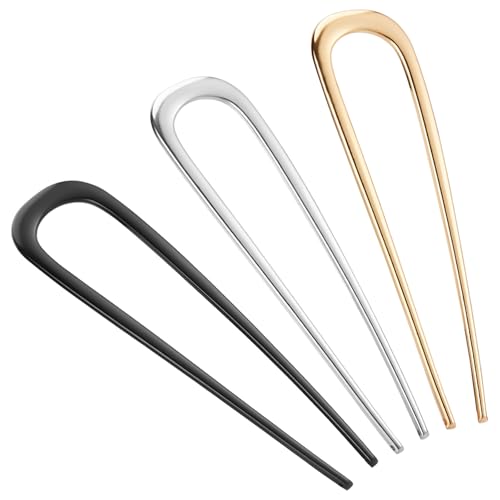
Color choice is the main distinction of BEoffer 5-Inch French Hair Pins: the three-pin set includes gold, silver and black U-shaped pins, each 5 inches long. The maker says the curved profile sits comfortably against the head and is intended for French twists, buns and updos. A three-piece set can be useful if you want to coordinate a pin with different outfits or keep spares. Compared with Kitsch Metal French Hair Pin, this set offers more finishes but not a single-pin purchase. Its styling uses are broad, so buyers focused specifically on a short pin should consider 3.2-Inch Acetate French Hair Pins.
Bottom line: Pick this if three finish options matter more than having just one pin.
3.2-Inch Acetate French Hair Pins

At 3.2 inches, 3.2-Inch Acetate French Hair Pins is the shorter option among the pins with a length here. It comes as a four-piece tortoiseshell set and uses acetate with a curved shape and serrated anti-slip design. The maker describes it for buns, half-up styles and French twists, making it a choice for someone who prefers a compact pin over the 5-inch options. Its shorter length may be less suitable when an updo needs a longer pin to cross through and anchor more hair; choose based on the amount of hair and style you need to secure.
Bottom line: Choose this if you prefer a shorter acetate pin and a four-piece set.
Six-Piece Tortoiseshell French Hair Pins

Pattern variety sets Six-Piece Tortoiseshell French Hair Pins apart: the six-piece U-shaped set has different colors and tortoiseshell patterns, and the maker specifically identifies thin-hair buns and twists as uses. The pins are made from cellulose acetate, a material the maker describes as sturdy. This option suits someone who wants several looks in one set rather than a single gold pin or a three-finish metal set.
Bottom line: Pick this if you want multiple patterns and a set marketed for thin-hair buns and twists.
How to Choose a French Hair Pin for Thin Hair
Start with the updo and pin length, not the pack size: a French pin needs enough length to pass through the folded hair and catch the base. Pins around 3 inches are compact; 5-inch pins give more reach for larger twists and buns. Hair density and bun size change how much pin is needed, so a shorter pin is a sensible starting choice for small, low-volume styles, while a longer pin can cross more of a larger fold. A curved profile helps the pin follow the head, and smooth, rounded ends can make insertion more comfortable. If you are unsure about fit, begin with one pin before choosing a larger set.
French Pins, U-Pins and Hair Clips Compared
French pins and U-pins both anchor an updo by passing through hair, but their shapes and how they engage the style differ. A French pin typically has a curved, fork-like profile that slides through a twist and catches the base; U-pins are open-ended and can be inserted at angles to pin sections in place. Clips use a hinge or teeth to grip hair rather than relying on a pin crossing through the updo. Fine hair can slip from a pin if the bun is too loose, so form a compact twist first and weave the pin through the outer fold and base. This guide separates the basic tool types.
| Tool type | How it holds | Useful for |
|---|---|---|
| French pin | Slides through a twist and catches its base | One-piece buns and French twists |
| U-pin | Anchors sections when inserted at an angle | Pinning loose sections of an updo |
| Hair clip | Teeth or a clasp grip hair | Fast sectioning or gathered styles |
How to Secure Fine Hair Without Pulling
Build grip into the hairstyle before inserting a pin: a smooth, loose bun gives a pin little to catch, while a compact twist provides a more secure path through the hair. Hold the bun with one hand, insert the pin through its outer edge, turn it toward the scalp, then push it through the base. Avoid forcing a pin against the scalp or yanking it through tangled hair; remove it by reversing its path. Hair pins are not substitutes for a firm hold during activities where loose hair could catch in equipment. Keep pins away from young children when they are not being worn, since small accessories can pose a choking risk.
Care and Fit Checks for Hair Pins
Check a pin for sharp edges, cracks or a bent shape before use; damaged ends can snag hair or scratch the scalp. Smooth metal pins and acetate pins have different construction, so do not bend a plastic pin to change its curve. Wipe residue from pins with a soft cloth and let them dry before storing, especially after styling products leave buildup. Keep pins in a pouch or separate compartment so pointed ends do not catch fabric or other accessories. For a new style, test the pin on a small updo first; if it slides out, adjust the twist or choose a length that reaches farther through the base.
Frequently Asked Questions
What length French hair pin works for thin hair?
A pin around 3 inches suits compact updos, while a 5-inch pin can reach through a larger twist or bun. Choose based on the size of the style and how much hair the pin must cross.
How do you keep a French hair pin from slipping?
Make a compact twist or bun before inserting the pin, then weave it through the outer fold and into the base. Very smooth, loose hair gives the pin less to catch, so adjust the bun rather than forcing the pin.
Are French hair pins better than clips for fine hair?
They hold differently: a French pin crosses through an updo, while a clip grips hair with teeth or a clasp. For a bun or twist, a well-anchored pin avoids relying on a clip’s grip over a broad section.
Can a French hair pin damage fine hair?
A smooth pin inserted and removed along its path is less likely to snag than one forced through tangles. Stop if the pin catches or presses painfully against the scalp, and check for rough or damaged ends before wearing it.
How many pins do I need for a thin-hair bun?
One well-placed French pin may secure a compact bun, while a larger or less structured updo may need additional pins. Start with one, test the hold with a gentle head movement, and add support only if the style shifts.