
Best Soccer Gifts for 8 Year Olds: 5 Picks by Play Style

For most 8-year-olds, Soccer Bot Indoor Trainer is the strongest pick because its three speed modes suit different skill levels and it is made for indoor soccer practice.
We earn a commission if you buy through links on this page. As an Amazon Associate I earn from qualifying purchases. Products are compared on manufacturer specifications, not hands-on testing.
- Best overall: Soccer Bot Indoor Trainer – Three speed modes let young players adjust the indoor dribbling challenge.
- Best for creative play: Paint-Your-Own Soccer Lamp Kit – The kit includes paints and glow-in-the-dark stickers for decorating a soccer lamp.
- Best for family game time: Mini Foosball Table Game – Two flippers, two balls, a scoreboard, and a goal bell make this a tabletop soccer game.
| Product | Best for | Type | Age fit | Dimensions (in.) | Shop |
|---|---|---|---|---|---|
| Soccer Bot Indoor Trainer | Indoor practice | Indoor soccer trainer | Ages 6+ | 7.5 × 7.5 × 6.5 | Check Price on Amazon |
| Mini Foosball Table Game | Family game time | Tabletop foosball game | Ages 4–12 in name | 21.7 × 4.6 × 12.4 | Check Price on Amazon |
| Paint-Your-Own Soccer Lamp Kit | Creative projects | Paintable soccer lamp kit | Ages 3–12 in name | 5.2 × 2.0 × 7.3 | Check Price on Amazon |
| Would You Rather? Soccer Edition | Soccer conversation | Soccer question book | Young players and families | 8 × 5 × 0.29 | Check Price on Amazon |
Soccer Gifts for 8 Year Olds
Choose by whether the child would rather practice, play a tabletop game, decorate, or read soccer-themed prompts.
Soccer Bot Indoor Trainer

For an 8-year-old who wants to practice footwork indoors, this sensor-based trainer stands apart with three speed modes and an LCD score tracker. The screen records current and highest scores, giving a child a simple way to track attempts. Its dimensions are about 7.5 × 7.5 × 6.5 inches, so it is a compact alternative to a full-size ball and open-field practice. The maker says it is designed to develop dribbling and ball control. Its indoor format is the limitation: choose another gift if outdoor kicking or a shared tabletop game is the priority.
Bottom line: Pick this for an aspiring player who wants adjustable indoor practice.
Mini Foosball Table Game

For a child who likes soccer but would rather play a tabletop match, this game uses two button-operated flippers to move the ball, unlike the other gifts here. The set includes a scoreboard, two balls, and a bell in the goal. At about 21.7 inches long, it is designed as a tabletop game rather than a full-size foosball table. The maker says the triggers control tackling, kicking, and passing. Its limitation is that it is a game, not a way to practice outdoor soccer skills; choose it for indoor play and shared turns.
Bottom line: Pick this for an 8-year-old who enjoys head-to-head indoor games.
Paint-Your-Own Soccer Lamp Kit
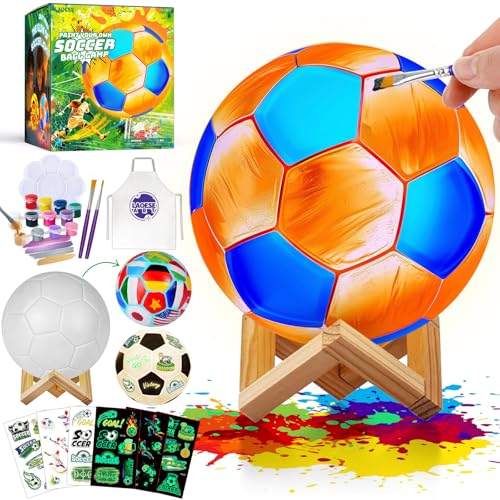
For an 8-year-old who likes making things as much as soccer, this craft kit offers a different kind of gift: a lamp to paint and decorate. It includes a blank soccer-ball lamp, wood base, 12 paint pots, more than 20 glow-in-the-dark stickers, and color-mixing instructions. The finished piece is intended as a room light or soccer-themed decoration. The kit’s appeal depends on the child wanting a sit-down craft rather than active play; it will not provide a ball, practice session, or game with a score to chase.
Bottom line: Choose this for a child who enjoys painting and room decorations.
Would You Rather? Soccer Edition

For soccer-themed fun without equipment or setup, this book centers on funny questions and impossible choices for young players, families, teens, and fans. Its 8-by-5-inch format is easy to bring along, and the slim 0.29-inch thickness makes it distinct from the activity-based gifts here. It can suit a child who enjoys talking about soccer or sharing prompts with family. The limitation is that it is a reading-and-conversation gift rather than a physical soccer activity; choose another option if the child wants to kick, build, paint, or control a game.
Bottom line: Pick this for a young fan who enjoys soccer questions and family conversation.
How to choose a soccer gift for an 8-year-old
Start with the child’s preferred kind of play: active practice, a shared game, making a project, or soccer-themed reading. For soccer practice, look for a ball in the child’s youth size; U.S. youth play commonly uses size 4 for ages 8–12, though team rules can differ. For indoor practice, a compact trainer can make sense when there is clear floor space and breakable items are out of range. Tabletop games and books work better when the gift needs little room or weather-independent play. Use this decision rule: if the child’s team uses a size 4 ball, do not choose a size 5 ball as their regular practice ball; confirm the league’s size before buying a ball for organized play.
| Child wants | Gift type to consider |
|---|---|
| Footwork practice indoors | Indoor soccer trainer |
| Casual outdoor kicking | Soccer ball in the right size |
| Shared indoor competition | Tabletop foosball game |
| Creative or quiet activity | Craft kit or soccer question book |
Soccer ball sizes for 8-year-olds
A size 4 soccer ball is commonly used for children ages 8–12, while size 3 is generally used for younger children and size 5 for older youth and adults. Age bands are a useful starting point, not a substitute for a league’s rules: programs can set their own ball size by age group or competition. Size affects how a ball feels under a child’s foot, so a larger ball may be harder to control for a player accustomed to size 4. Before giving a ball for team practice, check the team’s required size and the ball’s inflation guidance. A light-up feature is useful for casual low-light play, but it does not replace adequate visibility or a safe playing area.
Indoor soccer gifts and safe play space
Indoor soccer toys need an open, stable play surface and room for the child to move without striking furniture, windows, or other people. Clear a play area before using a moving toy or practicing footwork, and keep small loose parts away from younger children. A tabletop foosball game is a seated alternative when there is not enough room for kicking; place it on a level surface so it stays steady during play. For any indoor device, use it in the way its maker intends and stop play if it is damaged. Choose a compact game or book when the room cannot safely accommodate active movement.
Choosing between active and creative soccer gifts
Active gifts suit children who want movement and repetition, while a craft or question book suits a quieter interest in the sport. A trainer can hold attention through adjustable challenges; a regular ball offers a more familiar outdoor activity but depends on having a safe place to play and the right size. A paint-your-own kit makes the child part of the gift-making process, while a soccer question book creates a conversation activity that can include family. For an 8-year-old who will use a gift with siblings, consider age and supervision as well as interest: small components and paints require extra care around younger children, and a ball game needs enough space to play safely.
Frequently Asked Questions
What size soccer ball is right for an 8-year-old?
A size 4 ball is commonly used for ages 8–12 in youth soccer. Check the child’s league or team rule before choosing a ball for organized play, because age-group requirements can differ.
Can an 8-year-old practice soccer indoors?
Yes, with a clear area and a toy intended for indoor play. Move fragile objects and people out of the practice space, and avoid kicking a regular ball near windows or hard furniture.
What makes a soccer gift useful for rainy days?
An indoor game, trainer, craft kit, or soccer question book does not require an outdoor field. For active practice, allow enough clear floor space and keep the play area away from fragile objects.
How much space does an indoor soccer gift need?
A tabletop game needs a stable surface, while a footwork trainer needs a clear floor area around the child. Measure the available space and leave room to move without contacting furniture or other people.