
Electrically Conductive Wire Glue: 4 Options Compared

For a general low-voltage wire connection, Electrically Conductive Wire Glue is the closest match because it is specifically presented as wire glue and cures overnight. Choose a paste or pen-style option if its format better suits a small electronics repair; conductive adhesive is not a substitute for every soldered or high-current connection.
We earn a commission if you buy through links on this page. As an Amazon Associate I earn from qualifying purchases. Products are compared on manufacturer specifications, not hands-on testing.
- Best overall: Electrically Conductive Wire Glue – A 9 mL jar specifically presented for permanent low-voltage AC and DC wire connections.
- Best for PCB work: Nanotechnology Conductive Glue, 1 fl oz – A 1 fl oz cold-solder adhesive whose maker gives a resistance figure of 0.1 Ω/sq.
- Best for small repairs: Yuecoom Silver Conductive Paste – A silver paste in a 0.2 mL size.
- Best for pen format: Silver Conductive Paste Paint Pen – A silver conductive paint pen for electronics repair applications.
| Product | Best for | Volume | Color | Form | Shop |
|---|---|---|---|---|---|
| Electrically Conductive Wire Glue | Low-voltage wires | 9 mL | Clear | Jar | Check Price on Amazon |
| Nanotechnology Conductive Glue, 1 fl oz | PCB bonding | 1 fl oz | Dark gray | Glue | Check Price on Amazon |
| Yuecoom Silver Conductive Paste | Tiny spot repairs | 0.2 mL | Silver | Paste | Check Price on Amazon |
| Silver Conductive Paste Paint Pen | Pen-style application | — | Silver | Paint pen | Check Price on Amazon |
Electrically Conductive Wire Glue Options
Compare the connection use and application format before choosing a conductive adhesive.
Electrically Conductive Wire Glue
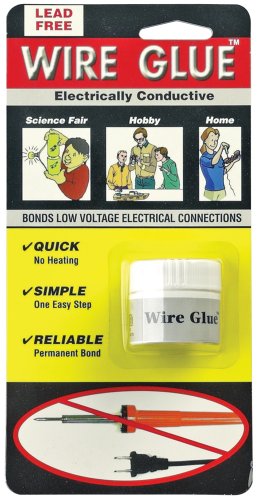
Unlike the silver paste alternatives, this clear jar product is specifically described for low-voltage AC and DC wire connections. The maker says it forms a permanent bond and cures overnight; a toothpick is suggested for application. Its 9 mL jar suits jobs where a small applicator is more useful than a pen. The main limitation is the low-voltage scope: do not assume it is appropriate for mains wiring or a connection carrying substantial current. Allow the overnight cure before putting a repaired connection back into service.
Bottom line: Pick this for a low-voltage wire repair where jar application works.
Nanotechnology Conductive Glue, 1 fl oz
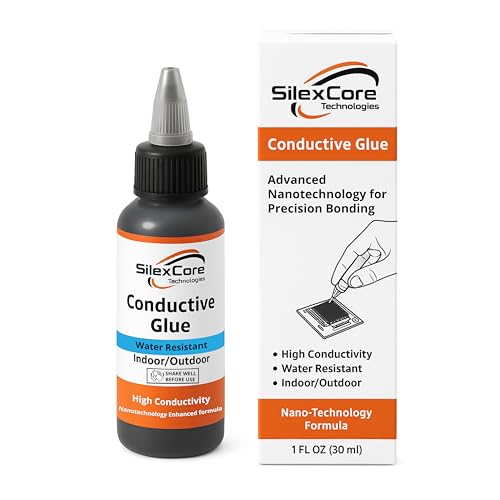
This is the largest container and the only option with a numerical resistance claim: the maker reports through-glue resistance as low as 0.1 Ω/sq. It is described as a room-temperature cold-solder alternative for low-voltage electronics and PCB bonding, without a soldering iron. That makes it a possible fit when heat could damage a sensitive component. The resistance figure is not a guarantee for every joint; connection geometry, adhesive thickness, and contact area affect the finished path.
Bottom line: Choose this for low-voltage PCB bonding when avoiding heat is important.
Yuecoom Silver Conductive Paste

The 0.2 mL quantity makes this silver paste the smallest-volume option here, suited to a small, targeted electronics repair rather than repeated larger jobs. The maker describes an adhesive silver-powder medium with abrasion and moisture resistance, and recommends cleaning the surface before application. Its application context includes electronics repair and cable repair. The maker also gives an electromagnetic shielding figure above 80 dB, but that claim should not be taken as a measure of resistance in a particular wire joint. This product’s tiny quantity is a limitation for anyone needing to cover multiple connections.
Bottom line: Pick this for a very small silver-paste repair.
Silver Conductive Paste Paint Pen

This option is presented as a silver conductive paint pen, making its application format the key distinction from the jar and glue products. The maker describes use for electronics repair and claims adhesion to ABS, PC, and ABS/PC plastic, along with an electromagnetic shielding effect above 80 dB. That may suit a repair involving those plastic substrates. The volume conflicts between the product name and stated specifications, so confirm the amount before ordering.
Bottom line: Choose this if a paint-pen format suits the repair and the volume is confirmed.
How to choose conductive wire glue
Choose by the connection’s voltage, current, surfaces, and application access. Conductive adhesives carry current through conductive particles in a bonding matrix; unlike solder, they do not create a metal-to-metal joint. The connection’s resistance and strength depend on contact area, bond thickness, and surface condition, so a product’s general conductivity claim cannot predict every joint. For small low-voltage repairs where heat is undesirable, a cold-applied adhesive may be useful. For mains wiring, high-current loads, or safety-critical connections, use a repair method and component rated for that duty instead. If the joint must flex, a rigid adhesive can crack; check that the product is suitable for movement before relying on it.
Preparing a wire or electronics surface
Clean, dry contact surfaces are a basic requirement for conductive adhesive; dirt, oil, and oxidation can interrupt the conductive path. On a wire repair, expose enough clean conductor to make a stable contact, but avoid removing so much insulation that adjacent conductors can touch. Keep adhesive out of connectors and neighboring traces, where a stray conductive smear can create an unintended path. Apply only enough material to bridge the intended surfaces, and support the joint while the adhesive cures. A product described as curing overnight still needs its full cure before power is restored. If a repair is near water, heat, or moving parts, confirm that the adhesive is rated for that environment.
Conductive glue, paste, and paint pen compared
Jar glue suits broader application with a small hand tool, while a paste or paint pen can offer a more localized application. Package form alone does not establish electrical performance: compare a specified resistance or intended use where available, and keep in mind that makers’ claims may use different test conditions. The table separates the formats and stated application contexts; it does not mean the products are interchangeable for every circuit.
| Format | Typical use to consider | Practical tradeoff |
|---|---|---|
| Jar glue | Wire-to-wire low-voltage connection | Requires controlled hand application |
| Conductive glue | Low-voltage component or PCB bonding | Check cure time and joint resistance |
| Paste or paint pen | Small electronics repair area | Useful for targeted application; confirm substrate fit |
Safe limits and common repair mistakes
Never treat an unspecified conductive adhesive as suitable for household mains voltage. Conductive adhesives can have more resistance than solder, and resistance creates heat when current flows; even a small resistance can matter under a high load. Keep power disconnected while applying and curing adhesive, and prevent accidental bridges between neighboring contacts. Do not judge a joint by appearance alone: inspect for a continuous bond and verify the circuit with an appropriate meter before reconnecting power. For any appliance, vehicle, or safety-related circuit, use a repair method approved for that application rather than relying on a general-purpose adhesive.
Frequently Asked Questions
Can conductive glue replace solder on a wire?
Conductive glue can bridge some low-voltage connections, but it is not automatically equivalent to solder. Solder generally creates a metal joint, while adhesive conducts through particles in a binder; avoid substituting it on mains or high-current wiring.
How long should conductive wire glue cure?
Cure time depends on the formula and conditions. The jar wire glue here is described as curing overnight; do not energize a repair until its adhesive has fully cured.
Does conductive glue work on plastic?
Some conductive adhesives bond to particular plastics, but compatibility is product-specific. One silver paste maker names ABS, PC, and ABS/PC; check the exact plastic type before applying another formula.
Can conductive adhesive carry high current?
Do not assume so unless the product is rated for the circuit’s current and voltage. Adhesive joints can add resistance, and under heavy current that resistance can generate heat.
Should I clean a surface before applying conductive glue?
Yes, start with clean, dry contact surfaces so dirt, oil, or oxidation do not interfere with the electrical path. Keep the adhesive confined to the intended contacts to avoid shorting nearby conductors.