
Best End of Life Planner Organizer: 5 Options Compared

End of Life Planner for Seniors, 7 × 10 in suits most people who want a senior-friendly end of life planner organizer, with large print, 16 tabs and inner pockets. Choose Lamorial End of Life Planner & Journal, A4 instead if you want 83 prompted pages in a bound journal, or Clever Fox When I Die Organizer Binder, Blue Surf if storing papers in multiple pockets matters more than a large-print layout.
An end-of-life planner is a guided place to record practical information and wishes; it does not replace signed legal documents such as a will or advance directive.
We earn a commission if you buy through links on this page. As an Amazon Associate I earn from qualifying purchases. Products are compared on manufacturer specifications, not hands-on testing.
- Best overall: End of Life Planner for Seniors, 7 × 10 in – Large print, 16 tabs and inner pockets combine readable prompts with space for papers.
- Best for guided prompts: Lamorial End of Life Planner & Journal, A4 – Its 83 prompted pages across 9 sections guide what to record.
- Best for paper storage: Clever Fox When I Die Organizer Binder, Blue Surf – Ten inner pockets provide separate places for important documents.
| Product | Best for | Size | Sections or tabs | Document storage | Shop |
|---|---|---|---|---|---|
| End of Life Planner for Seniors, 7 × 10 in | Large-print planning | 7 × 10 in | 16 tabs | Inner pockets | Check Price on Amazon |
| Lamorial End of Life Planner & Journal, A4 | Prompted journaling | A4 (8.39 × 11.18 in) | 9 sections, 83 pages | No pockets specified | Check Price on Amazon |
| End of Life Planner, Spiral, 7.36 × 10.4 in | Tabbed organization | 7.36 × 10.4 in | 16 sections | Inner pocket | Check Price on Amazon |
| Clever Fox End of Life Planner, Smoke Blue | Broad planning topics | 8.5 × 11 in | 16 sections | No pockets specified | Check Price on Amazon |
| Clever Fox When I Die Organizer Binder, Blue Surf | Loose-paper storage | 10.5 × 9 in | Sections, count unspecified | 10 inner pockets | Check Price on Amazon |
End of life planner organizers compared
Compare each format’s size, organization and paper-storage features before choosing how your family will use it.
End of Life Planner for Seniors, 7 × 10 in
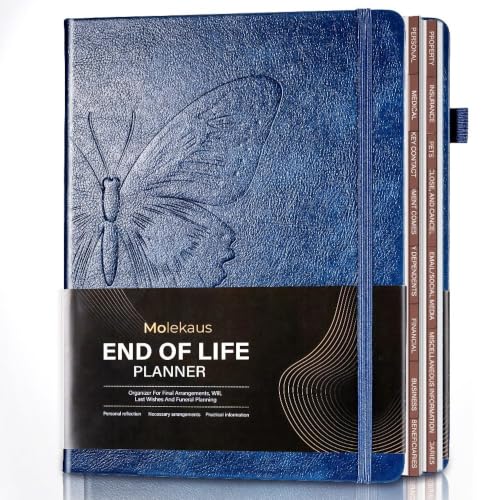
For a senior-focused format with large print, End of Life Planner for Seniors, 7 × 10 in combines bold, high-contrast text with 16 tabs and inner pockets. Its 7 × 10-inch pages give room to handwrite entries, while the tabbed sections divide the organizer into topics. The maker says the layout is designed to reduce eye fatigue and make it easier for older readers to use. This is a strong fit when legibility and keeping some papers with the planner matter. Its features do not establish that the pockets hold every original document securely, so keep critical originals in a suitable separate place.
Bottom line: Choose this if readable print, tabs and pockets are your priorities.
Lamorial End of Life Planner & Journal, A4

For a page-by-page writing guide, Lamorial End of Life Planner & Journal, A4 has 83 prompted pages divided across 9 sections, including access information, accounts and final wishes. At A4 size, it offers a larger writing area than a compact notebook. The maker says each page is prompted, so it can suit someone who prefers structured entries rather than deciding what to include from a blank page. Pages are bound in place and cannot be added or removed; that matters if you expect to expand the record or replace a page as information changes. Treat passwords and recovery codes as sensitive credentials.
Bottom line: Pick this if you want prompts on every page and a bound journal.
End of Life Planner, Spiral, 7.36 × 10.4 in
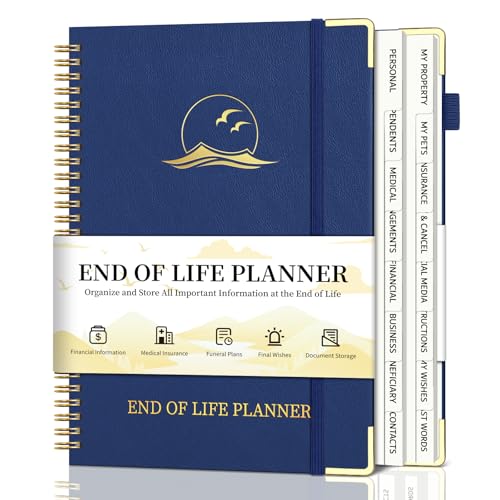
For a spiral-bound organizer with broad topic coverage, End of Life Planner, Spiral, 7.36 × 10.4 in has 16 sections spanning personal and family information, medical information, assets, beneficiaries, pets, vehicles and final arrangements. Its 7.36 × 10.4-inch format is close to a standard letter page but narrower. The maker says the tab classification helps simplify the planning process; the spiral format distinguishes it from bound journals. This suits a writer who wants separate labeled areas for different subjects.
Bottom line: Choose this for a spiral format organized into 16 topics.
Clever Fox End of Life Planner, Smoke Blue

For a letter-size planner covering varied planning topics, Clever Fox End of Life Planner, Smoke Blue offers 16 sections in an 8.5 × 11-inch format. Its subjects include medical and financial information, insurance, memberships, dependents and pets. The maker says the layout is designed to be easy to complete and to reduce misunderstandings. That range makes it a fit for someone who wants to gather household, care and financial records in one structured workbook. The features do not include pockets, so choose another format if keeping loose documents inside the planner is essential.
Bottom line: Pick this if you want letter-size pages and 16 planning sections.
Clever Fox When I Die Organizer Binder, Blue Surf

For storing paper alongside written instructions, Clever Fox When I Die Organizer Binder, Blue Surf has 10 inner pockets and sections for subjects such as contacts, accounts, medical history, assets, dependents and funeral wishes. Its 10.5 × 9-inch format is wider than tall, unlike the letter-size workbook options. The maker says it is intended to gather vital information and wishes in one organizer. This suits households with documents to sort into separate compartments. The features do not establish that the pockets are fireproof or secure, so keep irreplaceable originals in an appropriately protected location.
Bottom line: Choose this if you want multiple pockets for papers and records.
How to choose an end of life planner organizer
Choose by writing comfort, organization style and whether loose-paper storage is important. A 7 × 10-inch book can be easier to handle than an 8.5 × 11-inch letter-size planner, while larger pages leave more room for handwriting. Prompted pages guide the writer through topics; sectioned planners give broader categories, and pocket organizers add compartments for paper. Use a simple rule: if legibility is the deciding concern, prioritize a large-print format; if you need to file several documents with your notes, choose a format with multiple pockets. No organizer itself makes a will, power of attorney or medical directive legally valid, so use the correct state forms and signing requirements for those documents.
What to put in a planner and what needs a legal document
A planner is useful for locating records and communicating preferences, but it is not a substitute for executed legal paperwork. A will names an executor and directs property through probate; an advance directive records healthcare choices and may name a healthcare agent, with forms and signing rules varying by state. A durable financial power of attorney authorizes an agent during the signer’s life and generally ends at death, when an executor or personal representative handles estate administration. Keep the planner’s contact and account records consistent with the signed documents, and tell the appropriate trusted people where those originals are held. For legal forms, confirm state requirements with a qualified attorney or official state source.
How to store passwords and important papers safely
Keep a planner with account credentials in a controlled location, because a paper record can expose passwords, financial details and identity data if misplaced. A password manager with emergency access can provide a separate way to share credentials; two-factor authentication recovery codes should be stored securely apart from the account password when possible. For paper originals, a fire-resistant safe may help protect against heat, but make sure an authorized person can access it and knows where the key or combination is kept. Do not put the only copy of a will in a location nobody can open. Update credentials and contacts after major account or household changes, and review the record at least annually.
Frequently Asked Questions
Does an end of life planner replace a will?
No, a planner organizes information and wishes, while a will is a legal document that directs property and names an executor. A will generally goes through probate, and execution rules vary by state, so use properly prepared and signed documents.
How often should I update an end of life planner?
Review it at least once a year and after a major change such as a move, marriage, new account or change in healthcare agent. Passwords and contact details can become outdated sooner, so update those when they change.
Should passwords go in an end of life organizer?
Only if the organizer can be kept securely and the people who need access know how to retrieve it. A password manager with emergency access is another option; store two-factor recovery codes securely rather than treating a planner as a protected digital vault.
Can a family member use a financial power of attorney after death?
Generally, no: a durable financial power of attorney ends when the principal dies. The executor or personal representative named or appointed for the estate handles post-death administration, subject to state law.
Where should I keep original estate planning papers?
Keep originals in a protected place that an authorized person can access, and tell that person how to reach them. A safe-deposit box can delay access if nobody else is authorized, so verify access arrangements before storing the only original there.