
Yogurt in Glass Containers: 4 Jars Compared by Fit

For general yogurt portions, Ultimate Yogurt Jars, 6 oz is the clearest fit: its eight 6-ounce jars are sized for individual servings and come with lids. Choose Euro Cuisine Yogurt Maker Jars, 6 oz instead if you need jars compatible with a Euro Cuisine yogurt maker; for toppings kept separate or wider-mouth storage, consider the other styles.
Glass yogurt containers are reusable jars or cups for storing portions, and some are designed to fit a yogurt maker. Match capacity and jar shape to your serving routine and, for maker use, confirm the model compatibility before buying.
We earn a commission if you buy through links on this page. As an Amazon Associate I earn from qualifying purchases. Products are compared on manufacturer specifications, not hands-on testing.
- Best overall: Ultimate Yogurt Jars, 6 oz – Eight 6-ounce jars provide individual portions for yogurt and other snacks.
- Best for Euro Cuisine makers: Euro Cuisine Yogurt Maker Jars, 6 oz – The set is compatible with the YMX650, YM100 and YM80 makers.
- Best for separate toppings: ComSaf Dual-Layer Parfait Jars – Its two compartments keep toppings apart from the yogurt until serving.
| Product | Best for | Capacity | Count | Standout feature | Shop |
|---|---|---|---|---|---|
| Ultimate Yogurt Jars, 6 oz | Everyday portions | 6 oz | 8 jars | Airtight lids | Check Price on Amazon |
| Euro Cuisine Yogurt Maker Jars, 6 oz | Euro Cuisine makers | 6 oz | 8 jars | Maker-compatible | Check Price on Amazon |
| Povinmos Overnight Oats Jars, 10 oz | Wider-mouth storage | 10 oz | 3 jars | Screw-on lids | Check Price on Amazon |
| ComSaf Dual-Layer Parfait Jars | Separate toppings | 8 oz + 4 oz | 4 jars | Two compartments | Check Price on Amazon |
Yogurt in glass containers
Compare jar capacity, intended use and the lid or compartment design that best matches your routine.
Ultimate Yogurt Jars, 6 oz

For a straightforward set of single-serving yogurt jars, this option comes with eight 6-ounce glass containers and lids. The maker says the lids seal airtight, and the jars are dishwasher safe and BPA-free. The small serving size also suits pudding, oatmeal and other snacks, so the set can serve more than one meal-prep purpose. Choose it for portioning yogurt at home or taking snacks along. Its 6-ounce capacity may be too small if you prefer larger servings or want room for substantial toppings.
Bottom line: Choose these for compact, individual yogurt portions in a multi-jar set.
Euro Cuisine Yogurt Maker Jars, 6 oz

Unlike general-purpose jars, this set is specifically identified as compatible with Euro Cuisine YMX650, YM100 and YM80 yogurt makers. It includes eight 6-ounce glass jars, each suited to an individual portion; the maker says up to seven flavors can be prepared at once. The jars are dishwasher safe and made from BPA-free glass. This is the targeted choice when replacing or adding jars for one of those machines. Buyers with another yogurt maker brand should confirm the jar dimensions and fit before ordering rather than assume compatibility.
Bottom line: Pick these when your yogurt maker is one of the three named Euro Cuisine models.
Povinmos Overnight Oats Jars, 10 oz

These 10-ounce jars offer more capacity per container than the 6-ounce yogurt-focused sets, with three jars in the pack. Their wide mouths are intended to make filling, scooping and stirring easier, which can help when mixing yogurt with fruit or oats. The jars use thick soda-lime glass and food-grade plastic screw lids; the maker says a sealing ring provides an airtight, leakproof closure. They are a general food-storage option rather than a yogurt maker-specific set, so choose them for flexible meal prep, not machine incubation.
Bottom line: Choose these for larger portions and easy access for mixing or scooping.
ComSaf Dual-Layer Parfait Jars
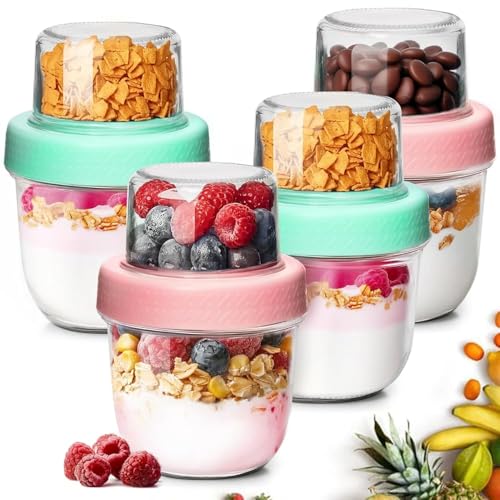
For yogurt with crunchy toppings, this set separates the main portion from the add-ins: each jar has an 8-ounce compartment and a 4-ounce compartment. The design lets you keep granola, cereal or fruit apart until serving, unlike a single-chamber jar. Four containers are included. The maker says the silicone-ring seals are airtight and leakproof for carrying; however, the two-part format is more specialized than a simple storage jar. Pick it for layered breakfasts or snacks, but a single-compartment container may suit plain yogurt storage better.
Bottom line: Pick these when keeping toppings apart until mealtime matters more than simple storage.
How to choose yogurt containers by serving size
Choose capacity by the yogurt portion plus any toppings, rather than by jar count alone. A 6-ounce jar suits a compact individual portion, while a 10-ounce jar gives more room for mixing or adding fruit; a dual-compartment cup separates the base from crunchy toppings. Wide mouths make filling and scooping easier, but can take more shelf width than narrow jars. For a portable snack, consider whether the lid seals securely and whether the container has one chamber or two.
| Use | Capacity or design | Decision rule |
|---|---|---|
| Small individual portions | About 6 oz | Choose when a compact serving is enough |
| Mix-ins or larger portions | 10 oz, single chamber | Choose when you need room to stir |
| Crunchy toppings kept separate | Two compartments | Choose when toppings should stay dry |
How to check yogurt maker jar fit
Yogurt maker jars must fit the machine’s rack and available lid clearance; a jar that looks similar can still be too wide or tall. Confirm the appliance model and the jar’s dimensions before using replacement containers. Some makers use a set of individual jars, while others are designed around a larger vessel, so capacity alone does not establish compatibility. For example, jars specifically identified for a maker should be treated as a fit for those named models, not as universal inserts. If the maker model or clearance is uncertain, verify it before ordering.
Glass, lids and food-storage safety
Glass is rigid and nonporous, but sudden temperature changes can cause thermal shock and breakage; do not pour hot contents into a cold jar or move a cold jar directly to heat. Refrigerate perishable yogurt at 40°F or below, and discard food left at room temperature for more than two hours. A screw lid or sealing ring can help contain spills, but airtight does not mean safe for heating or freezing. Check the container’s intended temperature use before exposing it to heat, and inspect glass for chips or cracks before filling.
Cleaning and carrying yogurt jars
Dishwasher-safe jars simplify routine cleanup, but lids and seals may need separate care depending on their materials. Remove food residue from threads and sealing rings so the lid can close evenly; trapped residue can interfere with a seal. For commuting, choose a leak-resistant closure and leave headroom rather than filling to the rim, especially when the jar includes separate topping compartments. Keep perishable yogurt chilled during transport; an insulated bag with a cold source helps limit warming. Do not assume a glass jar is shatterproof: pack it upright and protected from impacts.
Frequently Asked Questions
Can any glass jar go in a yogurt maker?
No, the jar needs to fit the maker’s rack and clearance. Check the appliance’s specified jar dimensions or compatible models before using a different container.
How much yogurt fits in a single serving jar?
Many individual yogurt portions are around 5 to 6 ounces. If you add fruit or granola, leave headroom or choose a larger container.
How should yogurt in glass containers be refrigerated?
Keep yogurt refrigerated at 40°F or below. Store sealed jars promptly after portioning, and avoid leaving perishable yogurt at room temperature for more than two hours.
Can glass yogurt jars go from cold to hot?
Avoid sudden temperature changes, which can cause glass to crack or shatter. Do not pour hot contents into a cold jar; let glass warm gradually and follow any heat-use limits for the specific container.
Do glass yogurt jars need airtight lids?
A secure lid helps contain odors and spills during refrigeration or transport. For carrying a jar in a bag, choose a container whose lid and seal are intended for leak-resistant travel, and keep it upright when practical.