
Finger Protectors for Kitchen: 5 Types Compared

For most kitchen prep, JADE KIT HPPE Finger Cots, 12 Count is the closest match because its reusable HPPE fingertip covers are designed for cutting tasks and come in a 12-piece set. Choose a steel guard instead if you want a rigid barrier over a finger; sleeves cover the fingertip, not the whole hand.
We earn a commission if you buy through links on this page. As an Amazon Associate I earn from qualifying purchases. Products are compared on manufacturer specifications, not hands-on testing.
- Best overall: JADE KIT HPPE Finger Cots, 12 Count – A 12-piece set of reusable HPPE fingertip covers is aimed at kitchen cutting tasks.
- Best for adjustable fit: SLXDEX Adjustable Stainless Steel Finger Guard – The stainless steel open ring adjusts to fit different fingers.
- Best for a prep set: CHENGU Finger Guard Set with Onion Holder – The set combines finger guards with an onion holder and slicer.
| Product | Best for | Style | Material | Count | Shop |
|---|---|---|---|---|---|
| JADE KIT HPPE Finger Cots, 12 Count | Reusable fingertip coverage | Fingertip sleeves | HPPE fabric | 12 | Check Price on Amazon |
| SLXDEX Adjustable Stainless Steel Finger Guard | Rigid finger barrier | Open-ring guard | Stainless steel | 2 | Check Price on Amazon |
| Honoson HPPE Finger Cots, 20 Count | Larger sleeve set | Fingertip sleeves | HPPE fabric | 20 | Check Price on Amazon |
| 10-Piece HPPE Cut-Resistant Finger Cots | Non-slip sleeve set | Fingertip sleeves | HPPE fabric | 10 | Check Price on Amazon |
| CHENGU Finger Guard Set with Onion Holder | Multi-tool prep set | Guards and food holder | Metal | 9 pieces | Check Price on Amazon |
Finger Protectors for Kitchen
Compare fingertip sleeves and rigid guards by coverage, material and set contents before choosing for your prep tasks.
JADE KIT HPPE Finger Cots, 12 Count

JADE KIT HPPE Finger Cots, 12 Count is a reusable fingertip sleeve set for cooks who want several covers for food prep and other hand tasks. The HPPE fabric is breathable, and the maker describes the cots as five-stage cut-resistant; that claim does not identify a test standard or mean the covers stop every knife injury. Each cot measures 2.36 inches long and 1 inch wide. The maker recommends measuring fingers for fit, which matters because loose fabric can shift during chopping. These cover fingertips rather than the full hand, so choose a full hand guard when broader coverage is needed.
Bottom line: Choose this set if you want reusable fabric fingertip covers for kitchen prep.
SLXDEX Adjustable Stainless Steel Finger Guard
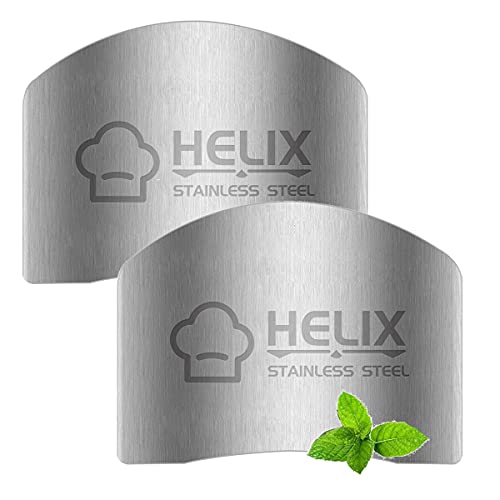
SLXDEX Adjustable Stainless Steel Finger Guard differs from fabric cots by using an adjustable open-ring stainless steel guard. The set has two guards, each 6.5 cm long, and the smooth-edged metal design leaves the fingertip positioned behind a rigid surface while slicing. Its adjustable ring may suit people who do not want a close-fitting fabric sleeve, but ring adjustment alone does not guarantee a secure fit on every hand. The guard covers a limited area and is not a substitute for controlled knife technique or a cut-resistant glove. Check that it stays stable before bringing a blade near it.
Bottom line: Pick this if you prefer a rigid, adjustable guard over a fabric sleeve.
Honoson HPPE Finger Cots, 20 Count

For buyers who want the largest sleeve quantity, Honoson HPPE Finger Cots, 20 Count includes 20 reusable HPPE finger cots. Each is 2.2 inches long, and the maker describes them as five-level cut-resistant; no test standard is identified, so do not treat that level as a guarantee against cuts. The cuffs are stitched, and the set is intended for kitchen, gardening, carving and craft tasks. A fingertip cot is a narrow barrier, not a glove, and may not cover enough area for jobs where the knife could contact the palm or neighboring fingers. Measure fit before relying on a sleeve during prep.
Bottom line: Choose this if you want a 20-count reusable sleeve set.
10-Piece HPPE Cut-Resistant Finger Cots

10-Piece HPPE Cut-Resistant Finger Cots is a 10-piece reusable HPPE sleeve set that emphasizes a non-slip thumb protector and breathable construction. The maker says the cuffs are precision-stitched to help the cots stay in place during tasks such as cooking, gardening and sculpting. Unlike a steel ring, this design conforms as a fabric cover; unlike the 12- and 20-piece sets, the quantity is 10. These covers protect only the fingers they fit and should not be treated as full-hand protection.
Bottom line: Pick this set if you specifically want a fabric sleeve set with a thumb protector.
CHENGU Finger Guard Set with Onion Holder
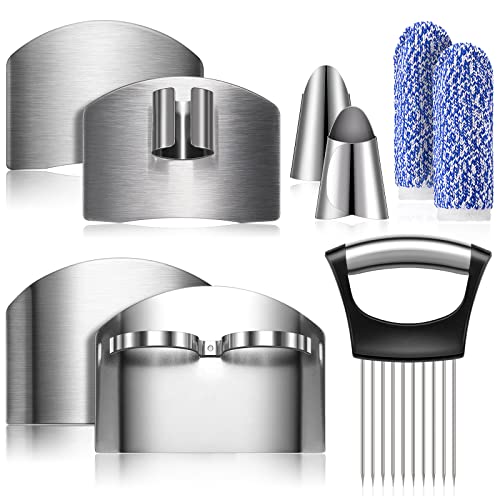
CHENGU Finger Guard Set with Onion Holder is a mixed kitchen set rather than a set of fingertip sleeves: it includes finger guards, a knife, thumb peelers and an onion holder slicer among nine pieces. Its two-finger guard measures 2.99 by 2.17 inches, the single-finger guard 2.48 by 2.17 inches, and the holder 5.51 by 3.66 inches. That combination may suit cooks who want a slicing aid alongside finger barriers. The set is less focused than a pack of reusable cots, and its several parts mean more pieces to keep track of during prep. Use the holder only with ingredients it can securely retain.
Bottom line: Choose this if you want finger guards bundled with an onion holder and other prep tools.
How to choose a kitchen finger protector
Choose the protector by the kind of contact you want to guard against: a fabric cot covers a fingertip, while an open-ring guard puts a rigid surface in front of part of a finger. Reusable sleeves are flexible and may be easier to wear across different tasks; metal guards are more rigid but still cover only a small area. Neither design makes a knife injury-proof. For frequent chopping or work near the palm, use a properly fitted cut-resistant glove rather than assuming a fingertip cover protects the whole hand. For quick vegetable prep, favor a protector that stays stable without interfering with your grip; if it shifts when you curl your fingers, stop and refit it before cutting.
Fit and coverage for finger guards
Fit matters because a protector that slips can move into the knife path or interfere with a controlled grip. Finger sleeves should sit securely over the fingertip without restricting circulation; the maker of JADE KIT HPPE Finger Cots, 12 Count specifically advises measuring for fit. Ring-style guards should be adjusted so they remain stable as the hand moves, and their metal surface should face the blade while fingers stay curled back. A fingertip sleeve is not a substitute for hand coverage: choose a glove when the task exposes the palm or several fingers. Before cutting, test the fit with the knife set down, then reposition if the protector slides or catches on the ingredient.
Finger sleeves versus stainless steel guards
Fabric finger cots and metal guards work differently, so choose by coverage and feel rather than assuming one type suits every task. Fabric sleeves cover the fingertip and flex with the finger; the products here use HPPE fabric, with different pack counts. An open-ring stainless steel guard is rigid and adjustable, but its protective area remains limited. A multi-tool set can add a holder for guiding ingredients, which differs from wearing a single-finger sleeve. The table compares the basic use case; it does not imply that any guard can prevent every cut.
| Style | Typical use | Tradeoff |
|---|---|---|
| Fabric fingertip cot | Covering one fingertip | Flexible, limited coverage |
| Open-ring steel guard | Putting a rigid surface before a finger | Adjustable, still limited coverage |
| Holder-and-guard set | Guiding an ingredient during slicing | More pieces to handle |
Safer knife technique with finger protectors
A finger guard is a backup barrier, not a replacement for knife control. Keep the guiding hand in a claw grip, with fingertips curled away from the blade and knuckles leading the cut; move the ingredient in small, controlled increments. A stable cutting board matters too: place a damp towel beneath it if the board slides on the counter. Do not force a blade through hard ingredients or cut toward a hand holding food. If a sleeve or guard catches, shifts or blocks a secure grip, pause and reposition it rather than continuing. Keep the blade pointed away from the body when carrying or setting it down.
Frequently Asked Questions
Can finger cots stop every kitchen knife cut?
No fingertip cot should be treated as cut-proof. The HPPE cots here are maker-described as cut-resistant, but that claim does not establish protection against every knife or cutting force.
How should a kitchen finger sleeve fit?
A sleeve should stay on the fingertip without pinching or sliding during a curled-finger grip. Measure the finger before selecting a sleeve, then test the fit with the knife set down.
Are metal finger guards better than fabric sleeves?
They offer different styles of coverage rather than a universal advantage. A metal open ring is rigid and adjustable, while a fabric cot flexes over the fingertip; both protect only a limited area.
What hand position is safest when chopping vegetables?
Use a claw grip, curling fingertips back while the knuckles guide the blade. Keep the cutting board from sliding and stop if a guard interferes with that grip.
When should I use a cut-resistant glove instead?
Use a properly fitted glove when the task exposes more than a fingertip, such as the palm or several fingers. A fingertip sleeve or ring guard does not cover the whole hand.