
Magnavox 6 Element Infrared Heater: Models Compared

The options do not include a Magnavox heater; OSTBA 6-Element Cabinet Heater is the closest match because it is a 1,500W six-element infrared cabinet heater with low and ECO settings. Choose a different model if you specifically need the Magnavox brand or want a unit with a room-coverage figure.
Infrared space heaters warm nearby objects and people directly, while fans help distribute warmth through a room.
We earn a commission if you buy through links on this page. As an Amazon Associate I earn from qualifying purchases. Products are compared on manufacturer specifications, not hands-on testing.
- Best overall: OSTBA 6-Element Cabinet Heater – Six elements, 1,000W and 1,500W heat, ECO and fan-only modes, and a 41–95°F thermostat.
- Best for larger stated coverage: RealSmart 6-Element Heater – The maker says it heats spaces up to 350 square feet and includes six quartz elements.
| Product | Best for | Heating elements | Thermostat range | Stated room coverage | Shop |
|---|---|---|---|---|---|
| OSTBA 6-Element Cabinet Heater | Flexible heat modes | 6 | 41–95°F | — | Check Price on Amazon |
| RealSmart 6-Element Heater | Larger stated rooms | 6 quartz | 50–90°F | Up to 350 sq ft | Check Price on Amazon |
| WEWARM 6-Element Heater | Compact footprint | 6 quartz | 50–90°F | Up to 300 sq ft | Check Price on Amazon |
Six-element infrared heaters
Compare the heat settings, thermostat ranges and stated coverage to find a heater suited to your room and controls preferences.
OSTBA 6-Element Cabinet Heater
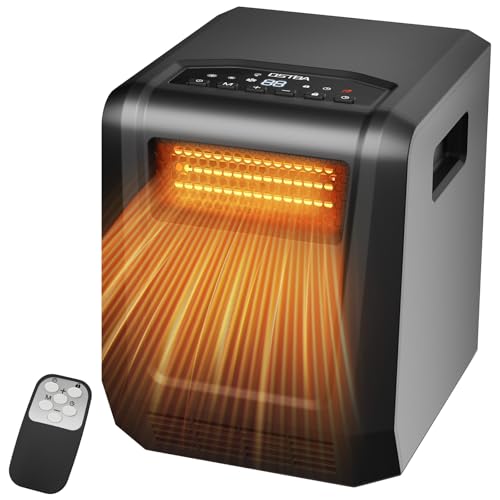
Six elements plus four operating modes set this cabinet heater apart: fan-only, 1,000W low, 1,500W high and ECO. The 41–95°F thermostat, digital controls, remote, 0–12-hour timer and child lock give buyers several ways to manage settings. Tip-over and overheat protection are built in. The maker says the heater provides quick 1,500W warmth. Its dimensions are 14.96 inches high, 12.91 inches long and 11.65 inches wide, making it the tallest and widest of the three six-element models here. Choose it for control options; the specifications give no room-coverage figure, so confirm suitability for your room before ordering.
Bottom line: Choose this if you want fan-only operation and a thermostat that reaches 41°F.
RealSmart 6-Element Heater

RealSmart pairs six quartz tubes with a coverage claim of up to 350 square feet, more than the WEWARM model’s 300-square-foot claim. The maker says its 1,000W, 1,500W and ECO settings provide warmth, and ECO mode is said to maintain 68°F automatically. A 50–90°F thermostat, remote and 12-hour timer provide everyday controls, with tip-over and overheat protection. At 12.4 inches high, 9.3 inches long and 9.8 inches wide, it has a compact footprint. Choose it when the coverage matters; the thermostat does not extend as low as the OSTBA’s.
Bottom line: Choose this for a compact six-quartz-element heater with a 350-square-foot coverage claim.
WEWARM 6-Element Heater

The WEWARM is the shortest of the three six-element models here at 12.6 inches high, and it claims coverage up to 300 square feet. It has 1,000W and 1,500W settings plus ECO mode, a 50–90°F thermostat, a 12-hour timer and stated 34 dB operation. The maker says the thermostat automatically adjusts heating to maintain the selected temperature. Child lock, tip-over and overheat protection are included among the named features. Its 9.84-inch length and 10.03-inch width create a small cabinet footprint, but the coverage is lower than RealSmart’s, which matters when considering a larger room.
Bottom line: Choose this for a short cabinet heater with a 300-square-foot coverage claim.
How to choose a six-element infrared heater
Start with wattage, then compare thermostat control, coverage claims and safety features. A 1,500W heater draws about 12.5 amps on a 120V circuit, so avoid running it on a circuit already carrying several high-draw appliances. A 1,000W setting draws about 8.3 amps. Infrared radiation warms people and surfaces in its path; a fan can spread warmed air, but room layout and drafts affect comfort. For these models, a coverage figure is a maker claim rather than a guarantee: choose a model whose area meets or exceeds the room area, then account for open doorways and poor insulation. Do not use a portable electric heater with an extension cord; plug it directly into a wall outlet and keep it clear of combustibles.
Room coverage and heater placement
Room coverage is only a starting point because ceiling height, insulation, drafts and outdoor temperature change how much supplemental heat a space needs. Measure the room’s floor area by multiplying length by width, and consider connected open spaces separately rather than assuming a heater will warm adjoining rooms evenly. Keep portable heaters at least 3 feet from bedding, curtains, furniture and other combustible materials, and place them on a stable, level surface. Avoid positioning a heater where a doorway, walkway or pet can knock it over. A unit with tip-over protection adds a shutoff feature, but it does not replace careful placement or supervision.
Infrared versus infrared and PTC heat
Infrared heaters transfer radiant energy directly to nearby people and surfaces, so they can feel warm before all the air in a room changes temperature. Fan-assisted designs move warmed air farther, although airflow may also create noise or drafts. A PTC element heats air through a ceramic resistive component, while a quartz infrared element radiates heat; combined designs use both methods. The DR-968 is the only model explicitly described with infrared quartz plus PTC, while the six-element models specify quartz elements. Choose a radiant-focused design for warmth in its line of sight, or a dual design if air circulation is also a priority. Neither type reduces the electrical energy needed for a given 1,500W setting.
Safe use and operating costs
Safe operation starts with the outlet: a 1,500W heater on a 120V supply draws roughly 12.5 amps, so do not share a circuit with another high-wattage appliance. A 1,500W heater running for one hour uses 1.5 kilowatt-hours; a 1,000W setting uses 1 kilowatt-hour per hour. Actual energy use changes with cycling and selected mode. Place the heater on a hard, level surface, keep a 3-foot clearance from combustibles and switch it off when leaving the room or going to sleep. Tip-over and overheat shutoffs are useful safeguards, not permission to leave a portable heater unattended.
Frequently Asked Questions
How many watts does a six-element infrared heater use?
The models here offer 1,500W high heat, and some also provide a 1,000W setting. On a 120V supply, those settings draw about 12.5 amps and 8.3 amps respectively.
How much electricity does a 1500W heater use?
A 1,500W heater uses 1.5 kilowatt-hours for each hour it runs continuously at full power. Thermostat cycling or a lower setting reduces actual use over time.
How far should a space heater be from curtains?
Keep a portable space heater at least 3 feet from curtains, bedding, furniture and other combustible materials. Place it on a stable, level floor away from walkways and doorways.
Can an infrared heater warm an entire room?
Infrared heaters warm people and surfaces directly, while room-wide comfort depends on the unit’s output, layout, drafts and insulation. Compare the maker’s coverage claim with the room’s measured floor area, and treat open adjoining spaces as additional heating load.
Can a portable space heater run overnight?
A portable space heater should be switched off when you go to sleep or leave the room. A timer or tip-over shutoff is an added safeguard, not a substitute for supervision and safe clearance.