
AA Battery Charger Solar: Options Compared by Power

For an AA battery charger that runs on solar power, Phefop 1 W Solar Charger is the matching choice because it has a 1 W, 4 V panel and four charging positions. Choose a USB or AC charger instead if you need a more controllable indoor power source, or select solar-light cells if you need batteries rather than a charger.
We earn a commission if you buy through links on this page. As an Amazon Associate I earn from qualifying purchases. Products are compared on manufacturer specifications, not hands-on testing.
- Best overall: Phefop 1 W Solar Charger – A portable solar panel charger with four charging positions for AA or AAA 1.2 V batteries.
- Best for USB charging: POWEROWL 8-Bay USB Charger – Eight independent bays accept NiMH or NiCd AA and AAA rechargeable batteries.
- Best for solar lights: EBL 8-Bay AC Charger – The 20-pack supplies 1,600 mAh NiMH AA cells for solar lights and household devices.
| Product | Best for | Power input | Charging capacity | Battery type | Shop |
|---|---|---|---|---|---|
| Phefop 1 W Solar Charger | Outdoor solar charging | 1 W, 4 V solar panel | 4 positions | AA and AAA 1.2 V | Check Price on Amazon |
| POWEROWL 8-Bay USB Charger | USB-powered charging | USB input | 8 independent bays | NiMH or NiCd AA/AAA | Check Price on Amazon |
| EBL 8-Bay AC Charger | AC-powered charging | AC plug | 1–8 cells | NiMH or NiCd AA/AAA | Check Price on Amazon |
| Kruta 1,600 mAh AA Solar Cells | Solar-light replacement cells | Not a charger | 20 AA cells | 1,600 mAh NiMH, 1.2 V | Check Price on Amazon |
AA Battery Chargers and Solar Options
Compare the solar-powered charger with plug-in chargers and rechargeable AA cells to match the power source to your use.
Phefop 1 W Solar Charger

The Phefop is the only solar-powered AA/AAA charger among these options, with a 1 W, 4 V polysilicon panel and four charging positions. Its 98 g body measures 4.53 × 2.76 × 1.06 inches, which suits packing for outdoor use. The maker describes it as a charger for AA and AAA 1.2 V batteries; the maker does not establish a charging time or performance in cloudy conditions. Choose it when access to sunlight matters more than charging speed or predictable indoor power.
Bottom line: Pick this if you need a compact charger powered by sunlight.
POWEROWL 8-Bay USB Charger
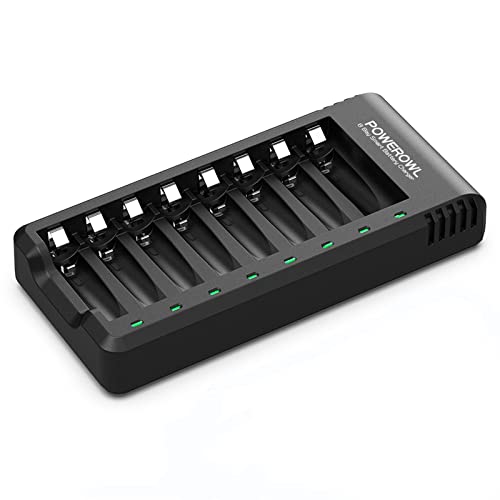
The POWEROWL differs from the solar model by taking USB power and providing eight independent bays. It accepts NiMH or NiCd AA and AAA rechargeable batteries, and its LED indicator signals charging status; the maker says chip control stops charging when cells are full. The maker recommends a 5 V/2 A plug, though no adapter is included. This makes it a fit for charging several compatible cells from a USB source, but not for users who need a solar-powered unit or support for other battery chemistries.
Bottom line: Choose this for multiple compatible cells and a USB power source.
EBL 8-Bay AC Charger

The EBL uses an AC plug rather than solar or USB power and can charge one to eight NiMH or NiCd AA or AAA cells. Its LED distinguishes charging, full charge, and a bad or non-rechargeable battery; the maker says the charger stops for improper input, defective cells, or short circuits, then switches to trickle charging. Those controls suit home charging when an outlet is available. It is not a solar charger, and its compatibility is limited to the rechargeable chemistries named by the maker.
Bottom line: Pick this for outlet-powered charging of one to eight compatible cells.
Kruta 1,600 mAh AA Solar Cells

The Kruta product is a pack of 20 rechargeable AA cells, not a battery charger. Each cell has 1,600 mAh capacity and 1.2 V NiMH chemistry, making the pack relevant to solar garden lights and other household devices that accept AA cells. The maker claims up to 1,200 recharge cycles, but these cells do not themselves charge from sunlight; a compatible charger is still needed. Choose them when you need replacement cells for solar lights, not a standalone charging device.
Bottom line: Choose these cells when solar lights need compatible AA replacements.
How to choose a solar AA battery charger
A solar charger makes sense when you can leave its panel in direct sunlight and can wait for charging; a USB or AC charger is more practical when you need dependable indoor power. The only panel model here is rated at 1 W and 4 V, but those figures alone do not establish how long a charge takes. Sun angle, shade, cloud cover, and the battery’s capacity all affect panel output and charge time. For a trip, compare the panel’s charging positions with the number of cells you expect to use, and bring a separate power plan if the batteries are essential. Do not assume a solar-light battery pack is itself a charger.
AA and AAA battery compatibility
Check both battery size and chemistry before charging: AA and AAA describe physical formats, while NiMH and NiCd describe chemistries. The plug-in options here are explicitly limited to NiMH or NiCd cells, while the solar charger is described for AA and AAA 1.2 V batteries. A battery’s voltage and chemistry must match the charger; never put alkaline or other non-rechargeable cells in a rechargeable-cell charger. Capacity is measured in milliamp-hours (mAh), and higher capacity generally means more energy to replenish, not necessarily a longer service life in every device. If you need the solar unit to charge a specific chemistry, confirm compatibility before ordering.
Charger types compared by power source
Choose the power source that matches where you will charge: sunlight for off-grid use, USB for flexible access to powered devices, or an AC plug for a household outlet. A solar panel depends on light and placement; a USB charger can draw from a compatible adapter, laptop, or car charger; an AC model plugs into an outlet. The Kruta pack is a fourth category—batteries, not charging equipment. This table separates what each type supplies.
| Type | Power source | Best fit |
|---|---|---|
| Solar charger | Sunlight | Outdoor charging without an outlet |
| USB charger | USB power | Flexible powered locations |
| AC charger | Wall outlet | Home charging |
| Solar-light cells | Not a charger | Replacing AA batteries |
Charging safety and battery care
Use a charger only with rechargeable cells of the compatible size and chemistry, and remove cells that are damaged, leaking, or unusually hot. Rechargeable AA cells are commonly NiMH at 1.2 V, while disposable alkaline AAs are nominally 1.5 V and are not rechargeable. Keep charging equipment dry, especially a portable solar unit used outdoors, and avoid leaving batteries in direct heat. The maker says the plug-in chargers use automatic cutoff features, but that does not make incompatible or damaged batteries safe to charge. For mixed battery sizes, place each cell in a bay intended for its format and follow the polarity markings.
Frequently Asked Questions
Can a solar AA charger work indoors?
A solar panel needs bright direct light, so indoor charging through a window may be slow or inconsistent. For routine indoor charging, a USB or AC charger avoids dependence on sunlight.
How long does a 1 W solar charger take?
A 1 W rating does not give a fixed charging time because sunlight, panel angle, shade, and battery capacity change the energy reaching the cells. Treat charging as weather-dependent and do not rely on it for a time-critical battery supply.
Can I charge alkaline AA batteries in these chargers?
No; alkaline AA cells are disposable and should not be put in chargers intended for NiMH or NiCd rechargeables. Check the battery label for rechargeable chemistry before charging.
What does 1,600 mAh mean for an AA cell?
A 1,600 mAh rating is a measure of electrical capacity, not charging speed or voltage. The Kruta cells are 1.2 V NiMH AA batteries, so they require a compatible rechargeable-cell charger.
How many batteries can an eight-bay charger charge?
An eight-bay charger can hold up to eight cells, but compatibility still depends on the supported size and chemistry. The POWEROWL and EBL models support NiMH or NiCd AA and AAA batteries.