
Small Wire to Wire Connectors: 3 Types Compared

For small wire-to-wire connections, AIRIC Insulated Butt Splice Kit suits permanent inline splices because its crimp terminals cover 22–10 AWG; choose Double Wire Plug-In Connectors instead when you need quick connection and disconnection on 22, 20 or 18 AWG wire. These connectors join conductors by crimping, twisting or locking them together.
Choose a different style when the job calls for a compact twist-on cap rather than a crimped or plug-in connection. Match the connector to the wire gauge and connection method, and disconnect power before wiring.
We earn a commission if you buy through links on this page. As an Amazon Associate I earn from qualifying purchases. Products are compared on manufacturer specifications, not hands-on testing.
- Best overall: AIRIC Insulated Butt Splice Kit – Its insulated butt splices cover three color-coded wire ranges from 22–10 AWG.
- Best for quick disconnects: Double Wire Plug-In Connectors – Its locking-buckle connectors are designed for push-in connection and release on 22, 20 and 18 AWG wire.
- Best for twist-on joins: 180-Piece Spring Wire Caps – The kit uses spring inserts in insulating plastic shells for twist-on wire connections.
| Product | Best for | Connection style | Wire size | Quantity | Shop |
|---|---|---|---|---|---|
| AIRIC Insulated Butt Splice Kit | Crimped inline splices | Insulated butt splice | 22–10 AWG | 200 pieces | Check Price on Amazon |
| Double Wire Plug-In Connectors | Quick disconnections | Push-in locking plug | 22, 20, 18 AWG | 100 pieces | Check Price on Amazon |
| 180-Piece Spring Wire Caps | Twist-on connections | Spring insert twist cap | — | 180 pieces | Check Price on Amazon |
Small wire to wire connectors compared
Choose by the wire gauge you need to join and whether the connection should be crimped, twisted or quickly disconnected.
AIRIC Insulated Butt Splice Kit

For a crimped inline splice across several wire sizes, AIRIC Insulated Butt Splice Kit includes 200 insulated butt connectors in three color-coded ranges: 22–16 AWG, 16–14 AWG and 12–10 AWG. A flared barrel helps guide wire into the terminal, and a wire stop helps position it for crimping. The manufacturer identifies the kit as UL and describes use in automotive, home and project wiring.
This kit suits buyers who want multiple crimp sizes in one assortment. It requires a compatible crimping tool, so it is not the choice for tool-free connections or reusable disconnects.
Bottom line: Pick it for permanent-style crimp splices when your wire falls within one of its three ranges.
Double Wire Plug-In Connectors

For tool-free mating and separation, Double Wire Plug-In Connectors uses push-in plug connectors with a locking buckle rather than a crimp barrel or twist-on spring. The kit is sized for 22, 20 and 18 AWG wire and contains 100 connectors. Its design is aimed at quick wiring changes, adjustments and troubleshooting; the maker says stripping and soldering are not required.
Choose this style when frequent disconnection matters more than a conventional crimp splice. Its wire-size range is narrower than the 22–10 AWG assortment in AIRIC Insulated Butt Splice Kit, so it will not cover larger conductors in that kit’s range.
Bottom line: Pick it for quick connect-and-release work with 22, 20 or 18 AWG wire.
180-Piece Spring Wire Caps
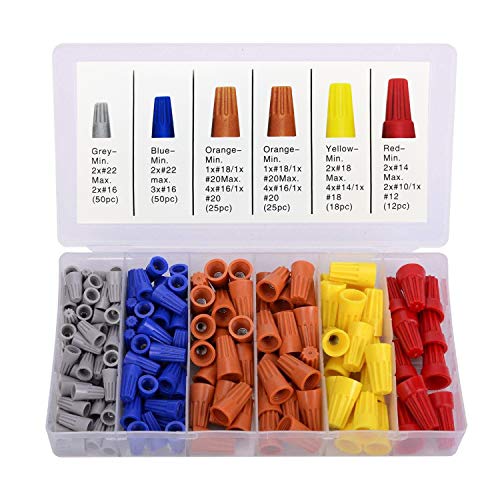
For a twist-on connection rather than an inline crimp or plug, 180-Piece Spring Wire Caps uses a metal spring insert inside a plastic shell. The 180-piece set includes caps in grey, blue, orange, yellow and red. Its compact round shells have the model and specification on top, according to the maker, making this a different connection approach from the lever or buckle styles.
These caps suit buyers who specifically want spring-based twist connectors. The range of compatible wire sizes is not established here, so confirm that the cap is rated for your conductor size and wire combination before using it.
Bottom line: Pick it when a spring-based twist-on cap is the connection style you need.
How to choose small wire-to-wire connectors
Choose a connector by wire gauge, joining method and whether you need to separate the wires later. AWG numbers run in reverse: 22 AWG wire is smaller than 12 AWG, so a connector’s range must include the conductor size. A crimp butt splice joins wires end-to-end; a spring cap twists conductors together; a plug-in connector is intended to mate and separate. For these options, use AIRIC Insulated Butt Splice Kit for covered crimp sizes, 180-Piece Spring Wire Caps for twist-on caps, or Double Wire Plug-In Connectors for quick disconnects on its sizes.
For a wire smaller than 22 AWG or larger than 10 AWG, none of those stated ranges provides a match. Do not choose by color alone: color conventions differ among connector styles, and the usable wire range is the deciding specification.
Connector styles and their tradeoffs
Crimp, twist-on and plug-in connectors solve different wiring needs. A butt splice crimps conductors in line and generally makes a fixed join; a twist cap uses a spring to hold joined conductors; a plug-in pair allows separation without undoing a crimp. A crimp needs the correct tool and a completed crimp that holds the conductor, while twist caps depend on a compatible wire combination and correct installation.
The table separates the three methods by practical use. When a circuit may need maintenance, choose a connection intended to disconnect; when a continuous inline join is needed, use a compatible butt splice.
| Need | Connector style | Example |
|---|---|---|
| Inline permanent-style join | Crimp butt splice | AIRIC Insulated Butt Splice Kit |
| Spring-held joined wires | Twist-on cap | 180-Piece Spring Wire Caps |
| Quick separation | Locking plug-in | Double Wire Plug-In Connectors |
Wire gauge, stripping and connection fit
Match the connector’s approved AWG range to every conductor in the joint; a connector sized for 22–16 AWG is not automatically suitable for 12 AWG wire. Strip only the length needed to seat the conductor, keeping bare metal from extending beyond an insulated barrel or cap. For a crimp, use a crimper made for the terminal type and check that a firm pull does not loosen the wire.
For twist caps, conductor count and wire combination matter alongside gauge, so check the cap’s range before joining mixed sizes. For plug-in connectors, insert the wire fully and engage the lock as directed by the maker. Disconnect power first, and use connectors rated for the circuit and environment.
Electrical safety when joining small wires
Disconnect the circuit at its power source before stripping or joining wires; a small conductor can still carry a hazardous voltage or short a source. Insulation on a connector does not establish that it is appropriate for every voltage, current, location or exposure. Use a connector with ratings suitable for the circuit, and keep joins protected from moisture and physical damage unless the connector is specifically rated for those conditions.
For household branch-circuit wiring, follow local electrical code and use connectors approved for that application; small project connectors should not be assumed suitable for building wiring. If you cannot identify the circuit voltage or connector rating, stop and verify both before making the connection.
Frequently Asked Questions
What does AWG mean on a wire connector?
AWG is the American Wire Gauge size system, and the number gets smaller as the wire gets thicker. A connector marked 22–16 AWG is intended for conductors within that range, not a 12 AWG wire.
Do butt splice connectors need a crimping tool?
Yes, an insulated butt splice is installed by crimping the metal barrel onto the conductor with a compatible crimp tool. After crimping, check that the wire is held securely and that no bare conductor extends past the insulation.
Can twist-on caps join different wire sizes?
Some twist-on caps accommodate combinations of conductor sizes, but the permitted gauge range and conductor count must match the cap. Verify those limits before joining mixed-size wires.
Should power be off before joining small wires?
Yes, disconnect the circuit from its power source before cutting, stripping or joining conductors. Confirm that the circuit is de-energized with an appropriate tester before touching bare wire.
Can I reuse a push-in wire connector?
The maker describes Double Wire Plug-In Connectors as reusable, with a locking buckle for connection and disconnection. Reuse only when the connector, wire end and locking mechanism remain undamaged and its rating fits the circuit.