
Weider Pro Home Gym: Bench and Weight Set Compared

For a Weider Pro home gym, Weider Pro 265 Bench and 80 Lb. Set is the direct match: it pairs an adjustable bench with an 80-pound vinyl weight set and barbell. Choose a cage-style alternative if you want guided Smith-machine lifts or pulley stations rather than a bench-based setup.
Before buying Weider Pro 265 Bench and 80 Lb. Set, confirm its weight capacity and dimensions for your space.
We earn a commission if you buy through links on this page. As an Amazon Associate I earn from qualifying purchases. Products are compared on manufacturer specifications, not hands-on testing.
- Best overall: Weider Pro 265 Bench and 80 Lb. Set – The only Weider Pro option, with an adjustable bench, barbell and 80-pound vinyl set.
- Best for cable exercises: RitFit M1 Pro Smith Machine – Combines a Smith machine and cable crossover with a bench and 260 pounds of plates.
- Best for pulley stations: Marcy Pro PM-5108 Cage System – Includes high- and low-pulley stations, a removable bench and a squat cage.
| Product | Best for | Included weights | Exercise stations | Dimensions | Shop |
|---|---|---|---|---|---|
| Weider Pro 265 Bench and 80 Lb. Set | Bench-based lifting | 80 lb vinyl set | Preacher curl, leg developer | — | Check Price on Amazon |
| RitFit M1 Pro Smith Machine | Smith and cables | 260 lb plates | Smith machine, cable crossover | 63 × 47.8 × 85.2 in | Check Price on Amazon |
| Marcy Pro PM-5108 Cage System | Pulley strength work | — | High/low pulley, squat cage | 50.75 × 42.25 × 83.75 in | Check Price on Amazon |
| Marcy Pro SM-7553 Smith Cage | Smith and bodyweight | — | Smith cage, dip and pull-up | 73.2 × 83.3 × 90 in | Check Price on Amazon |
Weider Pro Home Gym and Alternatives
Compare the bench-based Weider Pro set with three cage systems by included equipment and footprint.
Weider Pro 265 Bench and 80 Lb. Set

Unlike the cage systems, this Weider Pro setup centers on an adjustable bench with a fixed upright rack. The package includes an 80-pound vinyl weight set and barbell, plus a preacher curl station and foam-padded leg developer. The bench adjusts for different exercises, making this a fit for someone seeking a traditional bench-and-weight setup rather than cable training or a Smith machine. A fixed upright keeps weights in a rack when not in use. Confirm the bench’s weight capacity and dimensions for your space before buying.
Bottom line: Choose this if you want a bench, barbell and included weights instead of a cage system.
RitFit M1 Pro Smith Machine

This alternative combines a Smith machine and cable crossover in a 63-by-47.8-inch footprint, rather than the Weider Pro’s bench-and-barbell arrangement. The package includes a bench, 260 pounds of weight plates, a barbell and handles, with a lat pulldown and cable crossover. Its 85.2-inch height also makes ceiling clearance a key fit check: allow room above the frame and for safe movement around the equipment. It suits buyers planning cable exercises alongside guided bar work, but needs more dedicated floor space than a standalone bench.
Bottom line: Pick this if guided bar work and cable exercises are priorities.
Marcy Pro PM-5108 Cage System
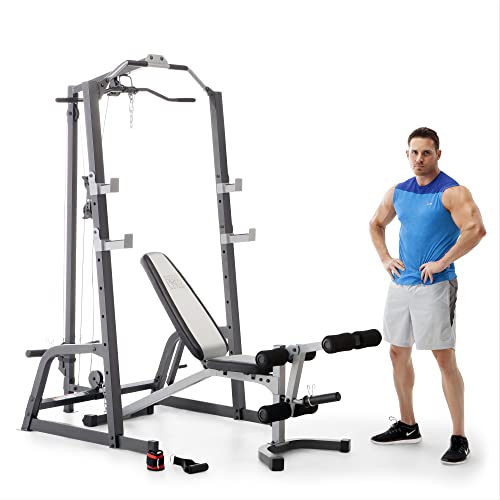
Compared with the Weider Pro bench set, this Marcy system adds a squat cage and high- and low-pulley stations while using a removable bench. The multi-position bench adjusts to incline, flat and decline positions. Its frame measures 50.75 inches long, 42.25 inches wide and 83.75 inches high, useful measurements for planning a training area. The cage is made from 14-gauge square tubing and has a guided weight trolley. Weight plates are not included in the package facts, so this is less turnkey than a set that explicitly includes weights.
Bottom line: Choose this if you want pulley stations and a cage with a removable bench.
Marcy Pro SM-7553 Smith Cage

This Marcy is the largest frame among these alternatives at 73.2 inches long, 83.3 inches wide and 90 inches high. It pairs a Smith machine with a power rack, adjustable dip station and multi-grip pull-up station; the row plate supports seated rows. Bar catches and safety catches are included for exercises such as squats and presses, and a landmine attachment adds another training option. The broad exercise mix suits users who want a large, multi-station cage, but the 90-inch height and wide footprint call for careful room measurement.
Bottom line: Pick this if you have room for a large Smith cage and want dip and pull-up stations.
Choosing a Weider Pro Home Gym Setup
Choose a bench set for free-weight exercises and a cage system when guided-bar or pulley stations are central to your routine. The Weider Pro package includes a barbell and 80 pounds of vinyl weights; the cage alternatives describe different station combinations, so compare the movements you plan to do rather than treating all home gyms as interchangeable. Measure the room’s usable floor area and ceiling height before selecting a frame. Leave enough space to move around the equipment and load a bar safely. A barbell needs room beyond the bench itself, while cable exercises require a clear path for the handle and body. Confirm the weight capacity of the bench and rack before loading them.
How Much Room a Home Gym Needs
Measure the equipment footprint, ceiling height and the working space around each station before choosing a home gym. The footprints range from the PM-5108 at 50.75 by 42.25 inches to the SM-7553 at 73.2 by 83.3 inches; frame dimensions alone do not include a user’s movement area. Add clearance for a barbell’s ends, bench adjustments, pull-ups and cable travel, based on the exercises you intend to perform. Check ceiling height against the tallest frame, then allow additional overhead space for standing and raising your arms. If the available floor area is under 6 by 6 feet, a bench-based setup is generally easier to fit than a large cage, though measure the actual equipment and movement space.
Use this comparison to match station types with the exercises you want.
| Setup type | Training emphasis | Space implication |
|---|---|---|
| Bench and weight set | Barbell and bench exercises | Check bench footprint and room for barbell |
| Smith cage | Guided bar work, rack or bodyweight stations | Allow room around frame and overhead |
| Cage with pulleys | Bar work plus cable exercises | Keep the cable path clear |
Home Gym Safety and Setup
Set strength equipment on a level, stable floor and secure every adjustable bench position before lifting. Smith rails and rack catches provide a defined stop only when their height is set for the exercise; place catches below the bar’s normal range but high enough to prevent a trapped position. Use a spotter for heavy free-bar lifts when safety catches are not available. Keep plates balanced on both sides of a bar, and do not exceed the bench, rack or bar’s rated capacity. For cable systems, inspect cables and attachments before each session and stop using any equipment with visible damage. Maintain clear space around the lifter so a dropped plate or moving bar does not strike nearby objects.
Frequently Asked Questions
How do I choose between a bench and a Smith cage?
Choose a bench setup for free-weight lifts and simpler space planning; choose a Smith cage if guided-bar work, rack catches or cable stations matter. Measure floor and ceiling clearance before committing to a frame.
How much ceiling height does a home gym need?
Start with the frame height and add headroom for standing and overhead movement. These options range from 83.75 to 90 inches tall, so a ceiling only slightly taller than the frame may feel restrictive.
What floor space should I allow for a home gym?
The frames range from 50.75 by 42.25 inches to 73.2 by 83.3 inches. Add room for barbell loading, bench adjustment and any pull-up or cable movements you plan to perform.
Are Smith machine safety catches enough for heavy lifting?
Smith rails and catches help limit bar travel when correctly positioned, but they do not replace proper setup or equipment capacity limits. Set the catches for the lift and use a spotter for heavy free-bar work.
How should I check a home gym bench before lifting?
Confirm the bench locks securely in each intended angle and stays stable on a level floor. Check the load capacity, including the user’s weight and the lifted load, before use.