
FX Audio DAC X6: Specs and Alternatives Compared

The FX-Audio DAC-X6 suits listeners who need USB, coaxial, or optical input and headphone support from 16 to 300 ohms. Choose a different DAC amp if you need microphone input or USB-C, or if you want a higher-resolution DAC format.
A desktop DAC amp converts digital audio to analog and can amplify headphones or feed powered speakers; confirm your source’s output connection before choosing.
We earn a commission if you buy through links on this page. As an Amazon Associate I earn from qualifying purchases. Products are compared on manufacturer specifications, not hands-on testing.
- Best overall: FX-Audio DAC-X6 – Its 16–300-ohm headphone range and USB, coaxial, and optical inputs cover a broad desktop setup.
- Best for gaming: Fosi Audio K5 Pro – It adds a microphone input, USB-C, and bass and treble controls.
- Best for tone controls: Fosi Audio Q4 – It combines USB, optical, and coaxial inputs with bass and treble adjustment.
| Product | Best for | Inputs | Outputs | Headphone range | Shop |
|---|---|---|---|---|---|
| FX-Audio DAC-X6 | Wide headphone range | USB, coaxial, optical | RCA, headphone | 16–300 ohms | Check Price on Amazon |
| Fosi Audio K5 Pro | Gaming with mic | USB-C, optical, coaxial | RCA, 3.5 mm AUX | — | Check Price on Amazon |
| Fosi Audio Q4 | Simple tone control | USB, optical, coaxial | RCA, 3.5 mm headphone | 16–200 ohms | Check Price on Amazon |
| FX-Audio DA06 | High-resolution decoding | — | — | — | Check Price on Amazon |
FX Audio DAC X6 and desktop DAC amp alternatives
Compare connection options and headphone compatibility before matching a DAC amp to your source and listening setup.
FX-Audio DAC-X6
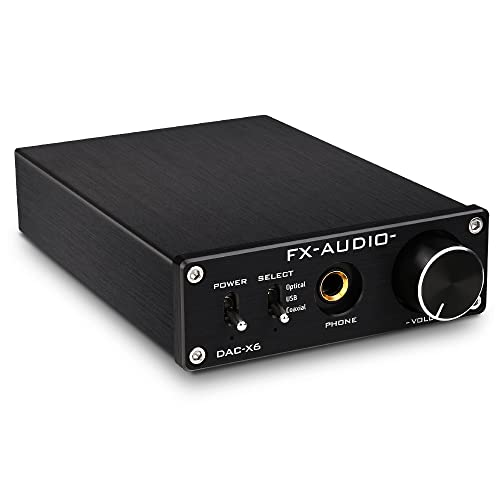
Unlike the alternatives here, the FX-Audio DAC-X6 specifies headphone compatibility up to 300 ohms. It has USB, coaxial, and optical inputs, plus RCA and headphone outputs, so it can serve headphones or a connected stereo setup. The maker identifies its conversion format as 24-bit/96 kHz and its supply as 12 V DC.
The replaceable op amp may appeal to someone who wants component-level upgrades. The feature data cuts off during the rear-panel connection description, so confirm the exact USB connector type if cable fit matters to your setup.
Bottom line: Choose this if your headphones fall within its 16–300-ohm range and you need all three digital input types.
Fosi Audio K5 Pro
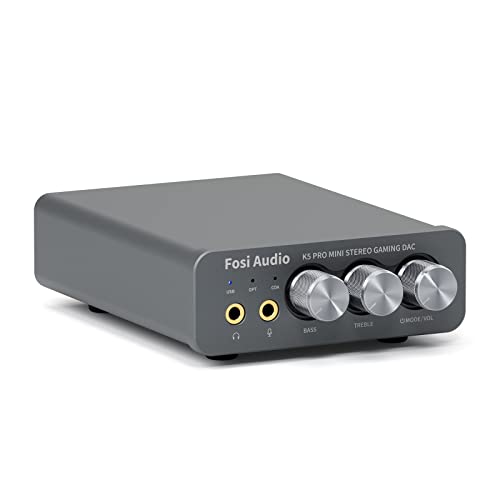
The Fosi Audio K5 Pro is the option here that includes a microphone input, making it a distinct fit for a gaming desk or voice chat. It takes USB-C, optical, or coaxial audio and sends analog audio to RCA or 3.5 mm AUX; bass and treble controls provide direct tone adjustment. The maker gives a 24-bit/192-kHz format and describes a combined charging and audio USB-C port.
Unlike the FX-Audio DAC-X6, the maker gives no headphone impedance range, so verify compatibility if your headphones have unusually high impedance.
Bottom line: Pick this for a gaming setup where microphone input and USB-C are priorities.
Fosi Audio Q4

The Fosi Audio Q4 differs from the FX-Audio DAC-X6 with built-in bass and treble controls and a headphone range of 16 to 200 ohms. USB, optical, and coaxial inputs connect digital sources, while RCA and 3.5 mm outputs support headphones or an amplifier and powered speakers. Its maker describes plug-and-play use without driver installation.
Its impedance ceiling is lower than the DAC-X6’s, so listeners with headphones above 200 ohms should compare the compatibility range before selecting it. The maker does not provide a sample-rate figure.
Bottom line: Choose this for a compact DAC amp with tone knobs and headphones up to 200 ohms.
FX-Audio DA06
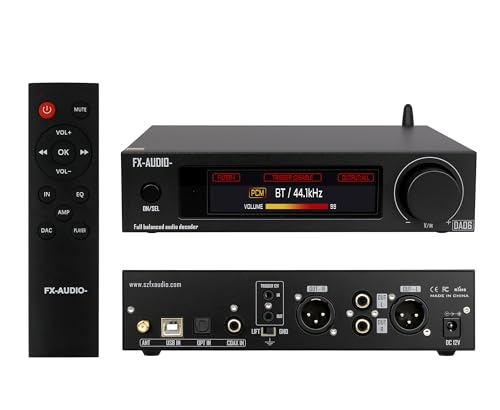
The FX-Audio DA06 is a different kind of alternative: a high-resolution decoder rather than a headphone amp with an impedance range. The maker specifies dual AKM4493SEQ conversion chips, XMOS XU316, up to 768 kHz/32-bit PCM and DSD512, plus a remote control. It also names Bluetooth codec support including LDAC, aptX HD, AAC, and SBC.
This distinction matters if you need a direct headphone connection rather than a DAC for a broader audio system.
Bottom line: Consider this if high-resolution decoding matters more than a headphone-drive range.
How to choose a desktop DAC amp
Start with the digital output your source actually provides, then match the DAC amp’s analog output to the next device. USB commonly serves computers, while optical and coaxial S/PDIF are common on TVs, disc players, and other home audio equipment; check connector availability on both ends. For headphones, compare impedance range and remember that impedance alone does not determine loudness: sensitivity and the amplifier’s output capability also matter. A practical rule is to favor a model with a range that includes your headphone impedance, and verify capability for demanding low-sensitivity headphones. For powered speakers or a stereo receiver, confirm whether you need RCA or a headphone jack; these are different signal destinations.
Which connections matter for your setup
Choose inputs based on the source and outputs based on the destination. USB-C on a DAC does not guarantee phone compatibility by itself: the phone, cable, and DAC must support audio over that connection, and a combined charging/audio port can have specific connection requirements. Optical S/PDIF is useful when a source and DAC both have optical ports, while coaxial digital uses a different cable and socket despite carrying a similar digital signal. RCA is a stereo analog connection for powered speakers or an amplifier; a 3.5 mm jack commonly accepts headphones or AUX input. Make a simple source-to-DAC-to-destination map before deciding, especially when using a TV or console.
| Need | Connection to check | Fit clue |
|---|---|---|
| Computer audio | USB audio | Confirm cable and device support |
| TV or disc source | Optical or coaxial digital | Match the source’s available port |
| Powered speakers or receiver | RCA analog output | Check the destination input |
| Headphone listening | Headphone output and impedance range | Ensure the range covers the headphones |
Headphone impedance and amplifier matching
Headphone impedance is measured in ohms, but a higher number alone does not prove that a headphone needs more power. Sensitivity, usually expressed per milliwatt or per volt, affects how much output is needed for a given listening level, and manufacturers do not always provide comparable sensitivity figures. If your headphones are 250 or 300 ohms, select a DAC amp whose range reaches that value and check the headphone maker’s sensitivity guidance. For headphones below 16 ohms, verify the amp supports that load; an impedance range beginning at 16 ohms does not establish performance below it. Keep listening levels conservative, since loud headphone playback can damage hearing.
DAC format numbers and real-world use
Sample rate and bit depth describe supported digital formats, not a guarantee that one DAC will sound better in every system. CD audio uses 44.1 kHz/16-bit PCM, and many music and video sources use other rates; the source and DAC need to agree on a supported format. Higher-format support is useful only when the source sends that format and the rest of the chain can handle it. Also distinguish a DAC amp, which includes headphone amplification, from a DAC that primarily decodes signals for another component. Avoid choosing solely by the largest sample-rate number: connection fit, headphone capability, and the needed analog output are more consequential for a working setup.
Frequently Asked Questions
Does the FX-Audio DAC-X6 work with 250-ohm headphones?
The range for the FX-Audio DAC-X6 is 16 to 300 ohms, which includes 250-ohm headphones. Impedance compatibility does not by itself guarantee a preferred volume; headphone sensitivity also affects required output.
Can I connect the DAC-X6 to powered speakers?
The FX-Audio DAC-X6 has RCA output, a common connection for powered speakers with stereo RCA inputs. Check that the speakers accept RCA analog input rather than only another connector.
What is the difference between optical and coaxial audio?
Optical S/PDIF carries digital audio over a fiber-optic cable, while coaxial S/PDIF uses an electrical signal over a coaxial cable. The source and DAC must have matching port types, and the two cable plugs are not interchangeable.
Will a USB-C DAC work with my phone?
A USB-C connection can carry digital audio, but phone compatibility depends on USB audio support, the DAC’s requirements, and the cable. For a combined charging and audio port, verify that the phone can use audio through that port while connected.
Do higher sample rates make a DAC sound better?
A higher supported sample rate does not guarantee an audible improvement by itself. The source must provide that format, and 44.1 kHz/16-bit PCM already covers standard CD audio.