
Silicone Baking Cupcake Liners: 3 Options Compared

For a named Amazon Basics silicone baking cupcake liner set, choose Amazon Basics Silicone Baking Cups, 24-Pack if you need 24 standard-pan cups; its 2.9-inch dimensions and 428°F oven limit set the fit.
We earn a commission if you buy through links on this page. As an Amazon Associate I earn from qualifying purchases. Products are compared on manufacturer specifications, not hands-on testing.
- Best overall: Amazon Basics Silicone Baking Cups, 24-Pack – A 24-pack sized for standard muffin pans, with a 428°F oven limit.
- Best for higher heat: Silicone Baking Cups, 24-Pack – Its oven-safe range reaches 446°F.
- Best for small batches: Amazon Basics Silicone Baking Cups, 12-Pack – The 12-pack has the same 2.9-inch dimensions as the 24-pack.
| Product | Best for | Pack count | Dimensions | Oven limit | Shop |
|---|---|---|---|---|---|
| Amazon Basics Silicone Baking Cups, 24-Pack | Standard muffin pans | 24 cups | 2.9 × 2.9 × 1.3 in | 428°F | Check Price on Amazon |
| Silicone Baking Cups, 24-Pack | Higher oven limit | 24 cups | — | 446°F | Check Price on Amazon |
| Amazon Basics Silicone Baking Cups, 12-Pack | Small batches | 12 cups | 2.9 × 2.9 × 1.3 in | 428°F | Check Price on Amazon |
Silicone Baking Cupcake Liners Compared
Compare pack size, dimensions and oven limits to find reusable cups suited to your batch size and pan.
Amazon Basics Silicone Baking Cups, 24-Pack

Amazon Basics Silicone Baking Cups, 24-Pack offers 24 cups sized to work with any standard muffin pan, making it a match for a full two-dozen batch without changing the pan. The food-grade, BPA-free silicone is reusable, flexible and nonstick, and the cups can go in the dishwasher, microwave and freezer. Amazon Basics says the cups are oven-safe to 428°F. The 2.9-inch dimensions suit standard-pan baking, but buyers wanting a larger set for three full batches should compare the 36-pack instead.
Bottom line: Choose this set for two dozen reusable cups that fit a standard muffin pan.
Silicone Baking Cups, 24-Pack

Silicone Baking Cups, 24-Pack stands apart with an oven-safe range up to 446°F, the highest limit among these sets. The 24 food-grade silicone cups are BPA-free and intended for muffins, cupcakes, pudding, tarts and other treats; they are also described as freezer-, microwave- and dishwasher-safe. The maker gives a lower temperature boundary of -104°F. Its dimensions are not supplied, so buyers matching cups to a particular muffin pan should confirm the fit before ordering. The set suits those who want 24 reusable cups and a higher stated oven ceiling.
Bottom line: Pick this set if its higher oven limit matters and you can verify pan fit.
Amazon Basics Silicone Baking Cups, 12-Pack
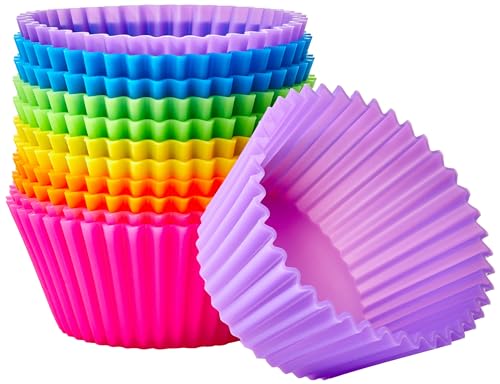
Amazon Basics Silicone Baking Cups, 12-Pack has the same 2.9 × 2.9 × 1.3-inch dimensions and 428°F oven limit as the 24-cup Amazon Basics set, but supplies half as many cups. Its food-grade, BPA-free silicone is reusable, nonstick and suitable for standard muffin pans, as well as microwave and freezer use. The cups are dishwasher-safe and stain- and odor-resistant. This smaller count fits occasional baking or a single 12-cup batch; anyone preparing multiple batches at once may prefer a larger pack.
Bottom line: Choose this pack for one standard-size batch or occasional baking.
How to choose silicone baking cupcake liners
Start with pan fit and batch size: standard muffin pans generally use cups about 2 inches across the base, while top diameters often run around 2.5 to 3 inches. A 12-cup set covers one full standard pan; 24 cups cover two batches, and 36 cover three. Silicone cups are flexible molds that hold batter while baking and can be reused in place of disposable paper liners. For a standard muffin pan, compare the base diameter rather than the flared rim. If the product dimensions are absent, confirm the fit before ordering.
Oven limits are product-specific; common food-grade silicone bakeware is rated around 400°F to 450°F, but the maker’s limit controls. Leave room between filled cups so hot air can circulate, and place freestanding flexible cups on a rigid baking sheet before filling.
Standard and smaller cup sizes
Standard cupcake liners typically have a base near 2 inches and a top near 2.5 to 3 inches; smaller molds have narrower bases and shallower walls. Top width alone can mislead because fluted sides widen above the base.
This size chart translates the dimensions into a practical fit check.
| Dimension cue | Likely use | Check |
|---|---|---|
| Base near 2 in | Standard muffin pan | Compare base-to-cavity fit |
| Base 1.75 in, height 1.18 in | Smaller treats and portions | Expect less batter per cup |
| Top width only | Fit remains uncertain | Check base diameter |
For a regular muffin-pan cavity, choose cups with a base close to 2 inches; if the base is below that, expect a smaller baked portion or more movement in the cavity.
Using and cleaning reusable silicone cups
Set freestanding silicone cups on a firm baking sheet before filling; flexible walls can wobble when moved full. Paper liners are not required for nonstick silicone cups, but fill each cup only about two-thirds full to leave room for batter expansion and reduce overflow. Follow each product’s temperature limit rather than assuming all silicone has the same rating.
Let baked food cool briefly before flexing the cup away from it, since hot sugar and steam can burn. Dishwasher-safe cups can go in a dishwasher, while handwashing with dish soap works for routine residue. Grease buildup can accumulate on silicone, so avoid abrasive scrubbers and inspect cups for tears or sticky residue before reusing them.
Silicone liners compared with paper
Silicone liners are reusable and often release baked goods without grease, while paper liners are single-use and easy to discard. Silicone requires washing after each batch; paper avoids that cleanup but creates repeat waste and may need support from a muffin pan. Both types need the right size for the cavity, and neither removes the need to leave headroom for rising batter.
Choose silicone when you bake often enough to reuse and wash the cups, or when you want flexible cups for snacks and frozen portions. Choose paper for one-off baking where cleanup matters more than reuse. Never put silicone cups directly over a stove flame or under a broiler unless the maker explicitly permits that use; ordinary oven-safe ratings do not establish broiler safety.
Frequently Asked Questions
Do silicone cupcake liners need to be greased?
Most silicone baking cups are nonstick and do not need greasing for ordinary cupcakes. For a new recipe with sticky batter, a light test batch can reveal whether release is clean without applying excess oil.
Can silicone baking cups go directly on an oven rack?
Flexible cups are easier and safer to move when set on a rigid baking sheet before filling. This also supports the sides if batter makes a cup tip or deform.
How full should silicone cupcake liners be?
Fill standard muffin cups about two-thirds full to allow batter to rise without spilling over. Very shallow or small cups may need less batter because their capacity is lower.
Are silicone cupcake liners safe at 450 degrees?
Only cups with an oven limit of at least 450°F should be used at that temperature. One set here gives a 446°F upper limit and another gives 428°F, so neither reaches 450°F.
How do you remove cupcakes from silicone liners?
Cool the cupcakes for several minutes, then gently peel the flexible wall away from the edge. Pulling while the baked good is very hot can tear a tender crumb and expose hands to steam.