
Best Wheeled Battery Charger: 5 Models Compared

Schumacher DSR140 is the best wheeled battery charger for most buyers who need 12V and 24V compatibility plus a 200A engine start. Choose a different model if you only need 6V/12V charging, prefer automatic operation, or need a higher stated start output.
A wheeled charger combines a battery charger with boost or engine-start modes in a movable shop unit; match its voltage and charging mode to the battery before connecting it.
We earn a commission if you buy through links on this page. As an Amazon Associate I earn from qualifying purchases. Products are compared on manufacturer specifications, not hands-on testing.
- Best overall: Schumacher DSR140 – Supports 12V and 24V batteries and provides a 200A 12V engine start.
- Best for 6V batteries: Schumacher SC1446 – Supports 6V and 12V batteries and includes a 135-minute manual timer.
- Best for automatic charging: VEVOR Wheeled Charger – The maker describes automatic charging for lead-acid and lithium batteries.
| Product | Best for | Charging output | Engine start | Voltage | Shop |
|---|---|---|---|---|---|
| Schumacher DSR140 | Mixed-voltage shops | 10A | 200A at 12V | 12V/24V | Check Price on Amazon |
| Schumacher SC1446 | 6V and 12V work | 10A | 200A | 6V/12V | Check Price on Amazon |
| VEVOR Wheeled Charger | Automatic charging | 60A | 300A at 12V | 6V/12V/24V | Check Price on Amazon |
| Schumacher SC1353 | Testing and storage | 6A | 200A | 6V/12V | Check Price on Amazon |
| Schumacher SC1633 | Manual 12V charging | 10A | 200A at 12V | 12V/24V | Check Price on Amazon |
Wheeled Battery Chargers Compared
Compare voltage support, charging output and engine-start ratings to find the right shop charger for your batteries.
Schumacher DSR140

For mixed-voltage work, this model supports 12V and 24V batteries while its 200A engine-start mode is for 12V systems. It also offers 50A 12V boost and 25A 12V/24V boost, with a 135-minute manual timer and analog ammeter. The maker says it works with standard, AGM, gel and deep-cycle batteries, including power-sport, auto and marine applications. Its manual controls suit buyers who want to select and monitor charging stages directly. The trade-off is that manual timing requires attention; choose an automatic model if you want charging to adjust without that oversight.
Bottom line: Choose it for a shop handling both 12V and 24V batteries that wants manual control.
Schumacher SC1446

Unlike the 12V/24V units, this charger covers 6V and 12V batteries, making it a fit for buyers maintaining older 6V equipment alongside common 12V vehicles. It combines 10A charging with a 200A engine start and 20A/40A boost modes. The maker says it supports standard, AGM, gel and deep-cycle batteries and includes a 135-minute manual timer. That timer gives the operator direct control but also means charging is not a set-and-forget process. Pick another model if 24V compatibility is essential.
Bottom line: Choose it when 6V support and a manual timer matter more than 24V capability.
VEVOR Wheeled Charger

For buyers prioritizing automatic operation and a higher stated engine-start rating, this unit supports 6V, 12V and 24V systems and lists a 300A 12V start. Its name gives a 60A charging rating; the maker describes multi-stage automatic charging for lead-acid and lithium batteries. That combination differs from the manual-timer models, which offer operator-selected control. The broad chemistry claim makes battery-type compatibility especially important to verify against the battery label before use. The unit weighs 18.74 lb, but its charging approach and stated ratings may not suit buyers seeking an analog, manually timed charger.
Bottom line: Choose it if automatic operation and support for several system voltages are priorities.
Schumacher SC1353

For buyers who want electrical-system checks alongside charging, this model includes a battery and alternator tester, a feature not identified for the other options. It supports 6V and 12V batteries, with 6A charging, a 40A boost and a 200A engine-start rating. The maker says its trickle-charge function adjusts during storage and that it works with power-sport, auto and marine batteries. Its lower stated charging current is a consideration for users who want a higher-current charger; choose another option if 10A or more charging output is important.
Bottom line: Choose it for 6V/12V use when built-in battery and alternator checks are useful.
Schumacher SC1633
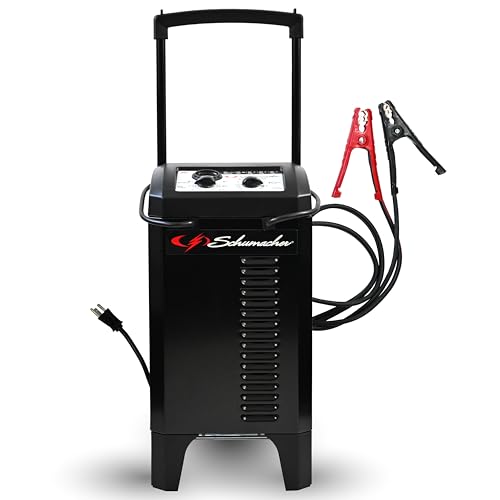
For users focused on 12V charging with 24V boost capability, this model combines 10A 12V charging, a 200A 12V engine start and 50A 12V plus 25A 12V/24V boost modes. It has a 135-minute timer, manual rate selection and an analog ammeter, so the operator chooses settings and watches charging progress. The maker says it works with standard, AGM, gel and deep-cycle batteries. This is a manual-control choice rather than an automatic charger; buyers seeking hands-off charging should consider a different operating style.
Bottom line: Choose it for manual 12V charging with 24V boost capability and a visual meter.
How to choose a wheeled battery charger
Start by matching the charger’s voltage setting to the battery system: a 12V battery needs a 12V mode, while a 24V system needs a charger explicitly rated for 24V. Charging current is another key choice. A common lead-acid rule of thumb is charging current near 10% of the battery’s amp-hour capacity; a 60Ah battery would therefore pair with roughly 6A, subject to the battery maker’s limits. Faster boost or engine-start ratings are separate modes, not ordinary charging current. If your work includes both voltage systems, choose a unit listing both rather than assuming a 12V engine-start rating applies to 24V.
For occasional car-battery maintenance, a lower charging rate can be adequate; frequent shop use may justify higher output, provided the battery accepts it.
Charging, boost and engine-start modes
Charging modes replenish a battery over time, while boost modes supply higher current for a short recovery period and engine-start modes assist cranking. Those ratings are not interchangeable: a 200A engine-start figure does not mean the unit charges a battery at 200A continuously. Standard 12V lead-acid batteries contain six cells, while 24V lead-acid systems typically use twelve cells in series, so selecting the correct system voltage matters.
Use the following mode distinction when comparing controls; never treat a boost rating as a normal charging rate.
| Mode | Purpose | Buyer check |
|---|---|---|
| Charge | Replenish battery over time | Match current to battery capacity and limits |
| Boost | Short high-current recovery | Use only on supported voltage and battery type |
| Engine start | Assist engine cranking | Check the rated voltage and starting procedure |
Battery compatibility and safe setup
Check both system voltage and chemistry before connecting a charger; lead-acid, AGM, gel and lithium batteries can require different charging profiles. A charger that lists a chemistry is not automatically appropriate for every battery of that chemistry, so use the battery’s own charging limits as the deciding constraint. Charge lead-acid batteries in a well-ventilated area because charging can release hydrogen, which is flammable. Keep sparks, flames and smoking materials away, and connect clamps with the charger off where the manufacturer’s procedure allows.
For an under-hood battery, check clamp reach and keep cables away from belts, fans and hot parts. Stop if a battery is cracked, leaking or unusually hot rather than trying a boost mode.
Frequently Asked Questions
Can a wheeled charger charge a 24V battery?
Only if the charger explicitly supports 24V charging. A 12V engine-start rating does not establish 24V start capability, so match the mode to the battery system.
How many amps should I use to charge a car battery?
A common lead-acid guideline is about 10% of battery capacity in amp-hours; for a 60Ah battery, that is roughly 6A. Follow the battery maker’s maximum charge-current limit if it is lower.
Is engine-start amperage the charging rate?
No. Engine-start amperage is a short-duration starting rating, while charging current is the rate used to replenish the battery over time. Compare those figures separately.
Can I leave a manual-timer charger connected overnight?
A manual-timer charger should not be treated as an unattended overnight maintainer. Its timer requires the operator to manage the charging period, and the correct duration depends on battery state and charge rate.
Where should I use a lead-acid battery charger?
Use it in a well-ventilated area because charging lead-acid batteries can release flammable hydrogen gas. Keep flames and sparks away, and do not charge a cracked or leaking battery.