
Best Mouthwash for Remineralization: 4 Mineral Rinses

Davids Hydroxi Mouthwash Kit is the best fit for most people seeking a mouthwash for remineralization because its formula uses nano-hydroxyapatite and the kit provides 96 rinses when mixed as directed. Choose another option if you want a ready-to-use bottle, a nano-hydroxyapatite percentage, or a fluoride rinse instead.
We earn a commission if you buy through links on this page. As an Amazon Associate I earn from qualifying purchases. Products are compared on manufacturer specifications, not hands-on testing.
- Best overall: Davids Hydroxi Mouthwash Kit – Its nano-hydroxyapatite formula comes in a kit that provides 96 rinses when properly mixed.
- Best for ingredient specifics: Xylitol Mouthwash with Nano Hydroxyapatite – It identifies 5% nano-hydroxyapatite and includes xylitol.
- Best for a larger bottle: Happy Tooth Hydroxyapatite Mouthwash – The fluoride-free, alcohol-free rinse comes in a 20-fl-oz bottle.
| Product | Best for | Active ingredient | Bottle size | Shop |
|---|---|---|---|---|
| Davids Hydroxi Mouthwash Kit | Concentrated kit | Nano-hydroxyapatite | 16 fl oz | Check Price on Amazon |
| Xylitol Mouthwash with Nano Hydroxyapatite | Ingredient specifics | 5% nano-hydroxyapatite, xylitol | 8 fl oz | Check Price on Amazon |
| Happy Tooth Hydroxyapatite Mouthwash | Larger bottle | Hydroxyapatite | 20 fl oz | Check Price on Amazon |
Mouthwash for Remineralization
Compare the mineral ingredients and format to find a rinse that suits your oral-care routine.
Davids Hydroxi Mouthwash Kit

Davids Hydroxi Mouthwash Kit stands out for its nano-hydroxyapatite formula and kit format, which the maker says provides 96 rinses when properly mixed in the included bottle. The formula is alcohol-free and fluoride-free, with peppermint and spearmint oils for mint flavor. It may suit buyers who want a mineral rinse that can be mixed at home and who also want a rinse marketed for dry-mouth relief. The tradeoff is that it requires mixing, so a ready-to-use bottle may be more convenient for a simple daily routine.
Bottom line: Choose this if you want a mix-at-home nano-hydroxyapatite rinse.
Xylitol Mouthwash with Nano Hydroxyapatite
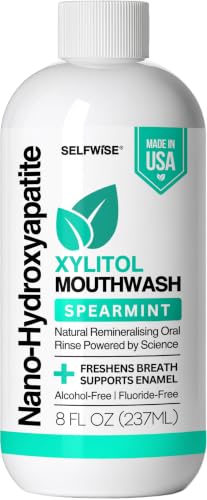
Xylitol Mouthwash with Nano Hydroxyapatite is the only option here with a 5% nano-hydroxyapatite concentration, paired with xylitol. The alcohol-free, fluoride-free formula uses spearmint, peppermint oil, and menthol for flavor. That ingredient specificity can help shoppers who want to compare formulas by concentration rather than by general mineral claims. Its 8-fl-oz bottle is smaller than the 16- and 20-fl-oz options in this group, so it may be less suitable for buyers who prefer a larger bottle for routine use.
Bottom line: Pick this if a nano-hydroxyapatite concentration matters to you.
Happy Tooth Hydroxyapatite Mouthwash

Happy Tooth Hydroxyapatite Mouthwash offers the largest bottle among these remineralizing options at 20 fl oz, with hydroxyapatite as its featured mineral ingredient. The formula is fluoride-free and alcohol-free, and the maker describes it as suitable for adults and children. It may fit households looking for a mint rinse in a larger ready-to-use bottle. Unlike the options that identify nano-hydroxyapatite or give a concentration, this formula names hydroxyapatite without specifying a nano form or percentage; buyers comparing those distinctions should weigh that limitation.
Bottom line: Choose this if you prefer a larger, fluoride-free hydroxyapatite rinse.
How to Choose a Remineralizing Mouthwash
Start by deciding whether you want fluoride or a fluoride-free mineral rinse. Fluoride is the established active ingredient in cavity-prevention rinses; daily over-the-counter rinses commonly contain 0.05% sodium fluoride, while prescription rinses can be stronger. Hydroxyapatite rinses use a different approach and are not interchangeable with fluoride products. Compare the active ingredient, concentration when provided, and whether the bottle is ready to use or needs mixing. If you have frequent cavities, a dry mouth, or dental work, ask a dentist whether a fluoride rinse belongs in your routine rather than replacing it with a fluoride-free option.
| Need | What to compare |
|---|---|
| Fluoride cavity protection | Look for a fluoride rinse and follow its label |
| Hydroxyapatite formula | Check whether nano-hydroxyapatite or a concentration is identified |
| Mineral rinse without hydroxyapatite | Review ingredients and intended purpose |
Hydroxyapatite and Fluoride Rinses Compared
Fluoride and hydroxyapatite are different active ingredients, so compare them by purpose instead of treating the names as equivalent. Fluoride supports remineralization and is used in cavity-prevention products; common daily over-the-counter rinses use 0.05% sodium fluoride. Hydroxyapatite is a calcium-phosphate mineral found in tooth enamel, and some rinses use it as their featured mineral ingredient. Specifications may identify hydroxyapatite without naming a concentration or nano form, so shoppers focused on those specifics should check the package before choosing. Avoid swallowing mouthwash, and keep rinses out of reach of young children.
How to Use Mouthwash in an Oral-Care Routine
Mouthwash supplements brushing and flossing; it does not remove plaque as reliably as brushing with a toothbrush or clean between teeth like floss. Brush twice daily for two minutes with fluoride toothpaste, and clean between teeth once each day. For a fluoride rinse, use the amount and timing on its label; rinsing immediately after brushing can wash away concentrated toothpaste fluoride, so use mouthwash at a different time when possible. A kit that must be mixed adds a preparation step, while a ready-to-use rinse does not. Follow age directions carefully, since young children may swallow rinse rather than spit it out.
Common Mistakes When Choosing a Mineral Rinse
Do not assume that every product described as mineral-rich has the same ingredients or cavity-prevention role. A hydroxyapatite rinse, an alkalizing rinse with calcium carbonate, and a fluoride rinse are distinct choices. Also avoid equating “fluoride-free” with stronger enamel protection: the phrase identifies what a formula omits, not how well it prevents cavities. Check any concentration and the directions for mixing or use; when a precise active ingredient matters, confirm the package before ordering. Persistent tooth sensitivity, pain, or visible spots call for a dental evaluation rather than relying on mouthwash alone.
Frequently Asked Questions
Does hydroxyapatite mouthwash replace fluoride toothpaste?
No; mouthwash is an add-on, not a replacement for brushing with fluoride toothpaste. Brush twice a day for two minutes, and ask a dentist before dropping fluoride if you have elevated cavity risk.
Should I use mouthwash right after brushing?
For fluoride toothpaste, rinsing immediately can wash away some of its fluoride. Use mouthwash at a separate time when practical, and follow the directions on both products.
How often should I use remineralizing mouthwash?
Use the frequency on the product label, since formulas and dilution directions differ. Brushing twice daily and cleaning between teeth once daily remain the core routine.
Is nano-hydroxyapatite the same as hydroxyapatite?
Nano-hydroxyapatite refers to hydroxyapatite in nanoscale particles, while a product that says only hydroxyapatite does not identify that form. Compare the ingredient wording and any concentration if those distinctions matter to you.
Can children use remineralizing mouthwash safely?
Only use a rinse with age directions appropriate for the child, and supervise any child who may swallow it. Young children should not use mouthwash unless they can reliably swish and spit.