
Dayton Audio HTA100: Specs and Alternatives Compared

The Dayton Audio HTA100 suits listeners who want a hybrid tube stereo amplifier with Bluetooth and a dedicated phono input; its 50 watts per channel at 4 ohms is the key power figure. Choose a different option if you need more output, a subwoofer-only amplifier, or a complete speaker-and-turntable package.
The HTA100 combines vacuum tubes in its preamp circuit with a Class A/B amplifier, so it is a stereo integrated amp rather than a tube power amp throughout.
We earn a commission if you buy through links on this page. As an Amazon Associate I earn from qualifying purchases. Products are compared on manufacturer specifications, not hands-on testing.
- Best overall: Dayton Audio HTA100 – Combines 50 watts per channel at 4 ohms with Bluetooth 5.0, digital inputs and a dedicated phono input.
- Best for more output: Dayton Audio HTA200 – Provides 100 watts per channel at 4 ohms, twice the HTA100’s channel output.
- Best for a complete setup: Dayton Audio Hi-Fi Floorstanding Stereo System – Bundles the HTA100 with T65 floorstanding speakers and a TT-1BTW turntable.
| Product | Best for | Power at 4 ohms | Amplifier type | Notable connections | Shop |
|---|---|---|---|---|---|
| Dayton Audio HTA100 | Hybrid stereo listening | 50 W/channel RMS | Hybrid tube, Class A/B | Bluetooth 5.0, phono, USB, optical, coaxial | Check Price on Amazon |
| Dayton Audio HTA200 | Higher channel output | 100 W/channel RMS | Hybrid tube, Class A/B | Bluetooth 5.0, phono, USB, optical, coaxial | Check Price on Amazon |
| Dayton Audio DTA-100LF | Subwoofer amplification | 100 W at 4 ohms | Low-frequency amplifier | RCA line inputs and outputs | Check Price on Amazon |
| Dayton Audio Hi-Fi Floorstanding Stereo System | Bundled stereo components | 50 W/channel | Hybrid tube amplifier | USB and Bluetooth turntable | Check Price on Amazon |
Dayton Audio HTA100 and related audio options
Compare the HTA100 with related amplifiers and a bundled stereo system by output, design and included components.
Dayton Audio HTA100

The HTA100 is the direct match for a search for this model: it pairs tubes in the preamp circuit with a Class A/B amplifier and provides 50 watts per channel RMS at 4 ohms. Inputs include Bluetooth 5.0, USB DAC, optical, coaxial, AUX and a dedicated phono input, with a subwoofer output and headphone jack also available. Dayton Audio describes the hybrid design as combining tube character with modern solid-state operation. It suits a system that needs several source connections in one stereo amp; buyers seeking more than 50 watts per channel at 4 ohms should consider the higher-output HTA200 instead.
Bottom line: Choose this for a hybrid stereo amp with a dedicated phono input and varied source connections.
Dayton Audio HTA200
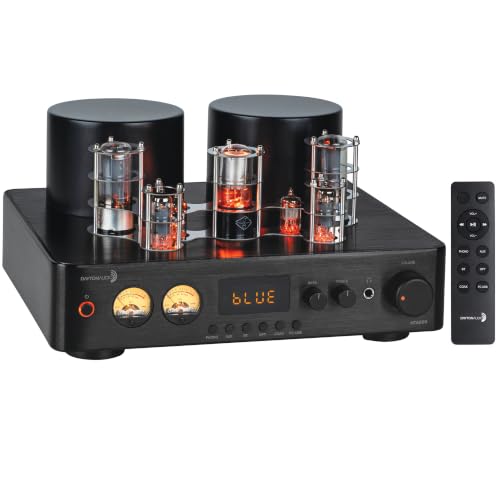
The HTA200 stands apart from the HTA100 with twice the channel output: 100 watts per channel RMS at 4 ohms. It uses the same general hybrid approach, with tubes in the preamp circuit and a Class A/B amplifier, and includes Bluetooth 5.0, a USB DAC, optical and coaxial inputs, RCA and phono connectivity, plus a sub output and headphone jack. A remote is included. Dayton Audio positions its output for larger home systems and demanding speakers. It is a sensible alternative when the added power matters, but it is not the exact HTA100 model requested.
Bottom line: Pick this when your priority is the higher 100-watt-per-channel output at 4 ohms.
Dayton Audio DTA-100LF

The DTA-100LF is a low-frequency amplifier, not a full-range integrated stereo amp like the HTA100. Its output is rated at 70 watts at 8 ohms and 100 watts at 4 ohms, and its controls include adjustable phase, a subsonic filter, a low-pass filter and single-band EQ. RCA line inputs and outputs and auto-on functionality are also included. This model suits someone adding controlled low-frequency amplification to a system. Its low-pass and subsonic controls serve a different role from the HTA100’s stereo source switching, so it is not a substitute for a general-purpose integrated amplifier.
Bottom line: Choose this for adjustable low-frequency amplification, not as an HTA100 replacement.
Dayton Audio Hi-Fi Floorstanding Stereo System

The floorstanding stereo system differs from buying the HTA100 alone because it bundles that amplifier with T65 floorstanding speakers and a TT-1BTW belt-drive turntable. The amplifier is the HTA100, rated at 50 watts per channel, while the speakers use two 6.5-inch woofers and a 1-inch silk-dome tweeter with a crossover network. The turntable has USB and Bluetooth connectivity.
Bottom line: Pick this if you want the HTA100 packaged with T65 speakers and a TT-1BTW turntable.
How to choose an integrated stereo amplifier
Start with speaker impedance and the amplifier’s rated power at that impedance, rather than comparing wattage figures without their conditions. The HTA100 rating is 50 watts per channel RMS at 4 ohms; the HTA200 rating is 100 watts per channel RMS at 4 ohms. Check your speaker’s nominal impedance and recommended amplifier power in its manual, then compare matching units. RMS ratings describe continuous output more usefully than peak figures, but room size, listening distance and speaker sensitivity also affect how much power is needed. For a basic decision rule, if your speakers are rated at 4 ohms and you want the higher stated output of these two, the HTA200 is the relevant option. Avoid assuming that more watts alone guarantees better sound or compatibility.
Matching speakers and amplifier power
Speaker impedance is a load, and an amplifier must be designed to work safely with the speaker’s impedance. Common home speakers are often rated at 4, 6 or 8 ohms; a speaker’s impedance can vary with frequency, so its nominal rating is not a fixed resistance at every moment. Use the speaker maker’s recommended amplifier range and the amp’s rating at the same impedance when comparing. The figures distinguish the HTA100 and HTA200 at 4 ohms, but do not establish suitability for every speaker or room. If a speaker label or manual calls for a minimum amplifier load or specific power range, verify that match before connecting; never assume a receiver’s rating at one impedance applies at another.
Understanding hybrid tube and Class A/B designs
A hybrid tube amplifier uses vacuum tubes in one part of the signal path and solid-state amplification elsewhere; the HTA100 and HTA200 put tubes in the preamp circuit and use Class A/B amplification. Class A/B is a common linear amplifier topology that balances output capability and efficiency relative to pure Class A operation. The visible tubes and VU meters are design features, but they do not by themselves establish output power, sound quality or speaker compatibility. For this pair, compare the RMS output at 4 ohms and the connections you need. A buyer specifically seeking an all-tube power stage should verify the circuit design before purchase, because these models are described as hybrid rather than fully tube-powered.
Choosing the right audio connections
Match every source to an input before selecting an amplifier. Turntables with a built-in phono preamp can use a line-level input; a turntable without one generally needs a phono input or separate phono preamp. The HTA100 and HTA200 have dedicated phono inputs, and the HTA100 also lists a USB DAC, optical and coaxial digital inputs, Bluetooth 5.0 and AUX. Optical and coaxial connections are digital, while RCA and AUX are analog, so use the output type your source actually provides. For a computer, a USB DAC can accept digital audio directly; confirm the computer and cable connection are compatible. If you plan to add a subwoofer, check that its input accepts the amplifier’s subwoofer output.
Frequently Asked Questions
Can the HTA100 power 4-ohm speakers?
The HTA100 is rated at 50 watts per channel RMS at 4 ohms. Confirm your speaker’s nominal impedance and amplifier recommendations in its manual before connecting.
Does the HTA100 have a phono input for a turntable?
Yes, the HTA100 has a dedicated phono input. A turntable with its own phono preamp may instead connect through a line-level input, depending on the turntable’s output setting.
What does hybrid tube amplification mean?
Hybrid tube amplification uses tubes in one circuit stage and solid-state amplification in another. The HTA100’s tubes are in the preamp circuit, while its power amplifier is Class A/B.
When should I choose the HTA200 instead?
Choose the HTA200 when its 100 watts per channel RMS at 4 ohms better suits your power needs; the HTA100 is rated at 50 watts per channel at 4 ohms. Match the amplifier rating to your speakers’ impedance and recommended power range.
Can I connect a subwoofer to the HTA100?
The HTA100 has a subwoofer output. Check that the subwoofer accepts the output connection and use its setup controls to blend bass with the main speakers.