
Air Pump for Paddle Board: 3 SUP Pumps Compared

Rechargeable SUP Pump, 50 PSI suits paddlers who want cordless inflation between launches, thanks to its built-in rechargeable battery and stated capacity for up to four boards at 12 PSI per charge. Choose a car-powered model instead if you prefer plugging into a 12V vehicle socket or want the shorter inflation time.
These electric SUP pumps inflate boards to a preset pressure and can also deflate them; the board’s own pressure limit should decide your setting.
We earn a commission if you buy through links on this page. As an Amazon Associate I earn from qualifying purchases. Products are compared on manufacturer specifications, not hands-on testing.
- Best overall: Rechargeable SUP Pump, 50 PSI – The built-in 12,000mAh battery is rated for up to four boards at 12 PSI per charge.
- Best for faster inflation: KOSMEGAL 20-PSI SUP Pump – The maker says it inflates a 10.6-foot board to 12 PSI in about seven minutes.
- Best for car-side pumping: 12V Dual-Stage SUP Pump, 20 PSI – It runs from a 12V car socket and is stated to inflate an 11-foot board to 12 PSI in about six minutes.
| Product | Best for | Pressure ceiling | Power source | Inflation time to 12 PSI | Shop |
|---|---|---|---|---|---|
| Rechargeable SUP Pump, 50 PSI | Cordless sessions | 50 PSI | 12,000mAh battery; 12V DC | 8.5 min or less | Check Price on Amazon |
| KOSMEGAL 20-PSI SUP Pump | Multiple boards | 20 PSI | 12V DC car connector | About 7 min | Check Price on Amazon |
| 12V Dual-Stage SUP Pump, 20 PSI | Quick car launches | 20 PSI | 12V car socket | About 6 min | Check Price on Amazon |
Air Pumps for Paddle Boards
Compare pressure ceilings, power sources and maker-stated inflation times before choosing a SUP pump.
Rechargeable SUP Pump, 50 PSI

Rechargeable SUP Pump, 50 PSI is the only pump here with a built-in rechargeable battery, making it the cordless choice for beach launches away from a vehicle. The maker says its three-stage system inflates a board to 12 PSI in 8.5 minutes or less, deflates in two minutes, and can handle up to four boards at 12 PSI per charge. It also supports 12V DC vehicle power. Its 50-PSI ceiling is not a target for a SUP: set the pump to the pressure printed on your board, and note that the maker’s battery capacity applies to 12 PSI.
Bottom line: Choose this if cordless operation matters more than the shortest inflation time.
KOSMEGAL 20-PSI SUP Pump
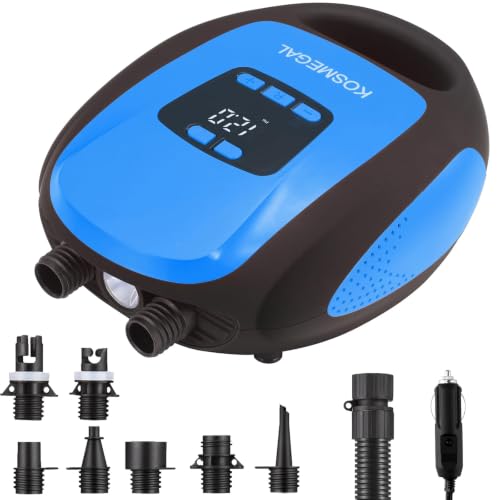
KOSMEGAL 20-PSI SUP Pump is aimed at paddlers inflating one board after another from a vehicle, with a built-in cooling fan and heat-dissipating housing. The maker says it inflates a 10.6-foot SUP to 12 PSI in about seven minutes; the 20-PSI ceiling covers common inflatable SUP pressures, but the board’s own limit should set the target. Its controls allow pressure settings in PSI, kPa, bar or kg/cm², and it has auto-off, deflation and seven nozzles. Unlike Rechargeable SUP Pump, 50 PSI, this model is powered through a 12V DC car connector rather than a built-in battery.
Bottom line: Choose this for car-powered inflation and back-to-back board sessions.
12V Dual-Stage SUP Pump, 20 PSI

12V Dual-Stage SUP Pump, 20 PSI has the shortest inflation time here: the maker says its dual-stage pump fills an 11-foot SUP to 12 PSI in about six minutes. Stage one delivers up to 360 L/min for fast filling, then stage two delivers 100 L/min for high-pressure inflation up to 20 PSI. The pump also has auto-off, deflation and seven nozzles. Its key constraint is power: it must remain connected to a 12V car socket and has no built-in battery, so it is not suited to launches without access to a vehicle power source.
Bottom line: Choose this when the fastest fill time and a 12V car socket fit your routine.
How to Choose an Air Pump for a Paddle Board
Start with the board’s recommended PSI, then choose the power source that matches your launch. Many inflatable SUPs are designed for roughly 12–15 PSI, but the printed board limit takes precedence; a pump’s maximum pressure is a ceiling, not a recommended setting. A practical rule: if you launch away from a vehicle, choose a rechargeable pump; if you launch beside a car and need repeated fills, a car-powered unit is a straightforward fit. Check whether the pump has auto-off and a compatible valve nozzle, since these reduce guesswork and prevent a loose connection from wasting airflow. Do not exceed the board’s pressure, especially in direct sun, where heated air can raise internal pressure.
Rechargeable and 12V Paddle Board Pumps
Rechargeable pumps bring their own power, while 12V models draw power from a vehicle socket and need to stay connected during operation. That difference matters more than a high pressure ceiling for many launch sites: cordless operation helps where cars cannot park nearby, while a socket-powered pump avoids relying on a charged internal battery. Inflation-time figures are useful only when the board length and target PSI are comparable; the examples here range from about six to 8.5 minutes at 12 PSI, but they use different board lengths. Use this need-to-choice table to narrow the type before comparing controls and attachments.
| Launch situation | Suitable pump type | Tradeoff |
|---|---|---|
| No vehicle at launch | Rechargeable | Plan around charge capacity |
| Vehicle beside board | 12V car-powered | Requires socket connection |
| Several boards in a row | Fan-cooled or multi-board rated | Confirm the maker’s capacity |
Pressure Settings and SUP Valve Fit
Set an electric pump to the board maker’s recommended PSI, not the pump’s maximum. A typical inflatable SUP target is around 12–15 PSI, though board construction and design change the correct value; a 20- or 50-PSI pump can exceed that range, so check the board label before switching it on. The nozzle also has to seat firmly in the board’s valve, which is commonly a high-pressure twist-lock style on inflatable SUPs. If air escapes around the connection, stop and reseat the nozzle rather than raising the target pressure. Keep the pump and hose clear of standing water, and let equipment cool if the housing becomes hot during repeated inflation.
Frequently Asked Questions
How much PSI does a paddle board need?
Many inflatable SUPs use about 12–15 PSI, but the pressure printed on the board is the deciding limit. Set the pump to that value rather than its maximum rating.
Can I use a car-powered SUP pump without the engine running?
A 12V socket-powered pump requires a working vehicle socket and must remain connected while it runs. Vehicle socket behavior varies, so check that the socket supplies power before starting a long inflation session.
How long does an electric paddle board pump take?
The examples here range from about six to 8.5 minutes to reach 12 PSI, depending on pump and board length. A different board size or target pressure can change the time.
Are paddle board electric pumps safe to leave unattended?
Auto-off stops a pump at its preset pressure, but it does not replace checking the board’s maximum PSI or monitoring the setup. Keep the hose connection secure and the pump away from water while it operates.
Can these SUP pumps deflate a paddle board?
Each of these three pumps includes a deflation function. Use the board’s valve and pump nozzle configuration correctly, and avoid pulling on the valve while air is being removed.