
Best Glue for Upholstery Foam: 4 Options Compared

For most upholstery foam repairs, 3M Headliner & Fabric Adhesive Spray is the strongest fit because it is made for fabric and foam on automotive surfaces and is described as heat- and moisture-resistant. Choose another option if you need a set working window, or if your project is a lightweight craft rather than upholstery.
Spray adhesives spread across larger surfaces, while a tacky craft glue is better suited to small, lightweight pieces. Check foam compatibility on a hidden scrap first: some adhesive solvents can damage foam.
We earn a commission if you buy through links on this page. As an Amazon Associate I earn from qualifying purchases. Products are compared on manufacturer specifications, not hands-on testing.
- Best overall: 3M Headliner & Fabric Adhesive Spray – Its use covers foam and upholstery on metal, plastic or wood, with heat and moisture resistance.
- Best for timed assembly: WEICON Adhesive Spray Extra Strong 500 ml – The flash-off time is 5–10 minutes, with an open time of up to 45 minutes.
- Best for porous surfaces: AK Trading Multipurpose Spray Adhesive – Its high-solids formula is intended for uneven or porous surfaces, including upholstery foam.
| Product | Best for | Size | Working time | Shop |
|---|---|---|---|---|
| 3M Headliner & Fabric Adhesive Spray | Automotive upholstery | 18.1 oz; 4-pack | — | Check Price on Amazon |
| WEICON Adhesive Spray Extra Strong 500 ml | Timed upholstery work | 500 ml | 5–10 min flash-off; up to 45 min open | Check Price on Amazon |
| AK Trading Multipurpose Spray Adhesive | Porous foam panels | 12 oz | — | Check Price on Amazon |
| Fast Tack Multipurpose Spray Adhesive | Multi-material repairs | 16.9 fl oz | Fast tack; exact time — | Check Price on Amazon |
Glue for upholstery foam
Match adhesive coverage and working time to the foam, fabric and surface you need to join.
3M Headliner & Fabric Adhesive Spray
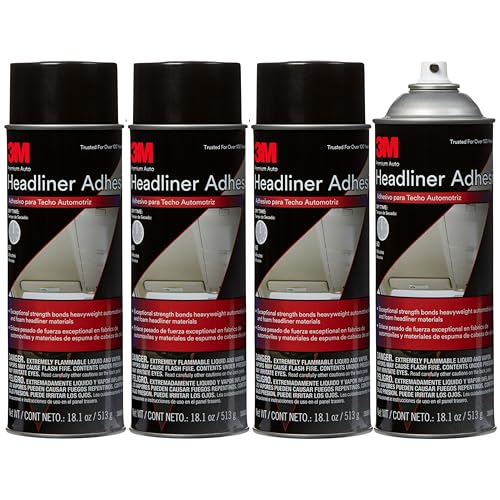
For automotive foam and fabric repairs, this aerosol is explicitly intended for headliners and upholstery on metal, plastic or wood. The package contains four 18.1-ounce cans, and its adjustable nozzle is designed to distribute a fine mist. The maker says the bond resists heat and moisture, which suits vehicle interiors better than a craft glue. The limitation is its automotive emphasis: for a small craft or a job needing a defined open time, another format may be easier to manage. Test a hidden foam scrap before covering a large area.
Bottom line: Choose this for automotive foam-to-surface repairs where heat and moisture resistance matter.
WEICON Adhesive Spray Extra Strong 500 ml

For a job that needs a defined assembly window, this spray gives a flash-off time of 5–10 minutes and an open time of up to 45 minutes. The maker says it bonds foam, textile, leather, wood, metal and plastic, including rough or uneven surfaces; the yield is 4 m². Its temperature range is −20 to 80°C. Those figures help plan a larger upholstery assembly, but they do not establish compatibility with every foam formulation. Confirm the foam stays intact on a scrap before applying adhesive across a finished cushion.
Bottom line: Choose this when a timed assembly window and broad material compatibility are useful.
AK Trading Multipurpose Spray Adhesive

For porous or irregular panels, this 12-ounce aerosol is distinguished by its high-solids formulation, which the maker says suits uneven or porous surfaces. The maker also describes the bond as waterproof, flexible and transparent, with temporary and permanent bonding uses. That flexibility may suit acoustic panels and craft upholstery foam where a rigid glue line is undesirable. The limitation is that the product facts do not establish a working time or a specific foam chemistry. Test a small offcut first, especially when the foam will be visible or difficult to replace.
Bottom line: Choose this for porous or uneven foam panels where a flexible bond is wanted.
Fast Tack Multipurpose Spray Adhesive

For a mixed-material repair involving foam, carpet or fabric, this 16.9-ounce spray covers a broader range of stated uses than a craft tack glue. The maker says it bonds compatible foam and upholstery materials, along with leather, felt, cardboard and paper, to prepared wood, metal, concrete or glass. A fast tack format can help hold pieces in position during assembly. The limitation is that “compatible foam” does not identify foam types, and no exact tack time is given. Verify material compatibility on a scrap and use the spray only with good ventilation.
Bottom line: Choose this for a repair that combines foam with several different materials.
How to choose glue for upholstery foam
Choose by the surfaces being joined, the size of the repair and how long you need to position the pieces. Spray adhesives are practical for broad, even coverage; a thick tacky glue is easier to control on tiny craft pieces. Upholstery work often joins foam to fabric, wood or metal, so confirm that the adhesive supports both materials rather than relying on a general-purpose label. Foam chemistry matters: solvent-based adhesives can soften or melt some foams, so test a hidden scrap and let it dry before proceeding. For an automotive headliner or door panel, favor an adhesive whose uses include vehicle interiors. For rough, porous panels, a formula intended for uneven surfaces is a more relevant match.
How to apply spray adhesive to foam
Apply spray adhesive in a ventilated area and keep the aerosol away from flames, sparks and hot surfaces; aerosol vapors and propellants can ignite. A light, even coat is easier to control than saturating the foam, which can leave a stiff or uneven bond. On contact adhesives, flash-off time is the wait before joining, while open time is the period in which the surfaces can still be bonded; the WEICON product gives 5–10 minutes and up to 45 minutes, respectively. Follow the can’s directions for coat placement and joining, since formulas differ. Test a scrap first, then press the surfaces evenly rather than stretching the fabric over the foam.
Foam adhesive formats compared
Spray adhesives suit broader surfaces, while thick craft glue gives more control on small, lightweight pieces. Use this guide to match the format to the job, then verify foam compatibility before full application.
| Job | Useful format | Decision point |
|---|---|---|
| Automotive headliner or panel | Automotive upholstery spray | Stated heat and moisture resistance |
| Large or porous panel | Spray for uneven surfaces | Coverage and foam scrap test |
| Small craft detail | Thick tacky glue | Precise application over broad coverage |
Do not treat all foam as interchangeable: upholstery foam, craft foam and acoustic foam can respond differently to solvents. If the foam will be hidden under fabric, a tiny scrap test is still useful because damage may appear only after the adhesive has had time to set.
Common mistakes when bonding upholstery foam
The most common mistake is applying an untested adhesive directly to an entire cushion; a small offcut can reveal whether foam shrinks, softens or discolors. Overspraying is another problem because excess adhesive may soak through fabric or create a hard patch in flexible foam. Keep the nozzle moving and use controlled coverage rather than holding it in one place. Also avoid stretching upholstery fabric while the adhesive is setting, since tension can pull a bond loose later. For vehicle interiors, heat exposure matters: an adhesive not intended for automotive conditions may not hold as expected. Ventilate the work area and remove ignition sources before spraying.
Frequently Asked Questions
Can spray adhesive melt upholstery foam?
Yes, some solvent-based sprays can soften or damage certain foam types. Test on a hidden scrap and wait for the adhesive to dry before using it on the full piece.
How long should spray adhesive flash off?
The time depends on the formula; one option here states 5–10 minutes of flash-off and up to 45 minutes of open time. Treat those figures as specific to that adhesive, not a general rule for every spray.
Is spray adhesive safe to use indoors?
Use aerosol adhesive only with strong ventilation and keep it away from flames, sparks and hot surfaces. Vapors and propellants can ignite, so avoid spraying near pilot lights or operating heaters.
How can I bond foam to fabric evenly?
Use controlled, even coverage and test the adhesive on a foam scrap first. Avoid saturating the foam or stretching fabric as the bond sets, which can cause hard patches or pull the joined surfaces apart.