
Long Handled Grass Sickle: 4 Tools Compared by Reach

For a long handled grass sickle aimed at mixed weeds, the Zenport’s 30.5-inch length and 9-inch curved carbon-steel blade combine reach with controlled pull cuts. Choose another style if you need an adjustable handle or a double-edged blade specifically for swinging through tall grass.
A grass sickle is a hand-powered cutting tool with a curved or serrated blade; longer handles let you work with less bending, but blade shape determines the cutting motion.
We earn a commission if you buy through links on this page. As an Amazon Associate I earn from qualifying purchases. Products are compared on manufacturer specifications, not hands-on testing.
- Best overall: Zenport 30.5-Inch Curved Sickle – Its 30.5-inch overall length and 9-inch curved blade suit controlled cutting across weeds, vines and stems.
- Best for adjustable reach: Haipeiyl Adjustable Long-Handle Sickle – Three handle lengths let you adapt reach to your height and clearing task.
| Product | Best for | Overall length | Blade length | Blade material | Shop |
|---|---|---|---|---|---|
| Zenport 30.5-Inch Curved Sickle | Controlled pull cuts | 30.5 in | 9 in | Carbon steel | Check Price on Amazon |
| Haipeiyl Adjustable Long-Handle Sickle | Adjustable reach | 17.3 in* | 12.6 in | — | Check Price on Amazon |
| YEELOR 51-Inch Adjustable Sickle | Mixed-edge cutting | 54.7 in | — | Stainless steel | Check Price on Amazon |
| HOAIXUN 32 cm Adjustable Scythe | Three-length settings | — | 12.6 in | — | Check Price on Amazon |
Long Handled Grass Sickle Options
Compare blade style and handle construction to match the tool to your cutting motion and working area.
Zenport 30.5-Inch Curved Sickle

The Zenport is the clearest fit for controlled pull-cutting: its curved 9-inch carbon-steel blade is paired with a 30.5-inch overall length. The wooden grip and extended reach are intended for weeds, vines, undergrowth and plant stems, with less bending across larger areas. This shape favors drawing the blade through growth rather than relying on a wide two-sided swing. The limitation is its fixed length; choose an adjustable model if different users or changing reach needs are part of the job.
Bottom line: Choose this for a fixed-reach sickle suited to precise pull cuts.
Haipeiyl Adjustable Long-Handle Sickle

The Haipeiyl stands out for a three-position handle and a long, 12.6-inch blade, offering a different reach setup from the fixed-length options. Its interlocking beech wood handle is intended for sturdier support while clearing brush, and the maker describes short settings for precision work and full extension for tall growth. The overall length is 17.3 inches in the dimensions, so do not assume that figure represents the extended working length; verify the extended reach before ordering if it is essential.
Bottom line: Pick this when adjustable reach matters more than a fixed overall-length figure.
YEELOR 51-Inch Adjustable Sickle
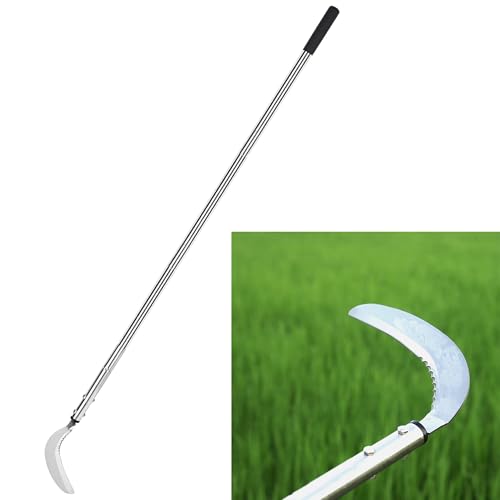
The YEELOR combines a straight edge and a wavy edge, unlike the single curved blades on the other sickles. Its stainless-steel handle and blade are paired with a nominal 51-inch adjustable handle, while the overall dimensions give a 54.7-inch length. The maker says the straight edge is for soft weeds and the wavy edge for tougher growth, making the two-edge arrangement useful when vegetation varies.
Bottom line: Choose this for a long stainless-steel tool with two edge styles.
HOAIXUN 32 cm Adjustable Scythe

The HOAIXUN pairs a 32-centimeter blade with a three-section adjustable solid-wood handle, a combination aimed at covering more ground than a short sickle while varying the working length. Its interlocking wood construction distinguishes it from the stainless-steel-handled option, and the maker says the extended blade can cut soft weeds and tough vines. The dimensions supplied do not establish assembled overall reach, so confirm that measurement if you need a particular standing working height. Its broad cutting emphasis may also be less suited to delicate, close trimming.
Bottom line: Pick this for a long blade and three adjustable handle sections.
How to choose a long handled grass sickle
Start with the cutting motion: curved sickles favor pull cuts, while serrated grass whips are swung through a wider patch. Blade length affects the swath but also makes close trimming less precise; a 9-inch blade is a manageable size for selective weed and vine work, while blades around 12.6 inches cover more per stroke. Handle reach matters just as much: an adjustable handle is useful when users differ in height or tasks alternate between borders and taller growth. For a defined standing working height, compare assembled length rather than blade length alone. Keep the blade path clear of feet, legs and nearby people, and wear eye protection and sturdy footwear when cutting brush.
Grass sickles and grass whips compared
A sickle and a grass whip are not interchangeable: the sickle’s curved blade pulls through selected stems, while a grass whip’s serrated edge cuts on a swing. Select a sickle for vines, weeds or trimming around plants; choose a whip for open areas of tall grass where a broader swing is practical. The following guide separates the tool types by their working motion and best setting.
| Tool type | Cutting motion | Suited task |
|---|---|---|
| Curved sickle | Pull cut | Selective weeds and vines |
| Two-edge sickle | Edge-specific cut | Mixed soft and tough growth |
| Serrated grass whip | Swing cut | Open patches of tall grass |
Handle reach and blade size
Blade length and total tool length describe different measurements: a 12.6-inch blade does not mean the handle provides standing reach. For lower-bending work, choose a long-handled design with a verified assembled length; if your working area needs precision near beds, a shorter blade gives better control. Adjustable three-position handles can accommodate different tasks, but confirm the extended measurement before relying on them for ditches or tall borders. A long blade also needs more clearance on each stroke, so leave a buffer from fences, irrigation lines and hard surfaces. Avoid cutting above shoulder height, where the blade is harder to control.
Safe use and basic sickle care
Keep the cutting zone clear and make controlled strokes away from your body; a sharp blade can cause severe cuts even during light weeding. Wear gloves, eye protection and sturdy closed-toe footwear, and do not swing where another person or pet could enter the arc. After use, remove damp plant residue and dry the blade before storage; carbon steel can rust if left wet, while stainless steel can still corrode under neglect. Store the tool with the edge covered or secured away from children. Check handle joints and fasteners before work, especially on sectional or adjustable tools, and stop if a joint loosens.
Frequently Asked Questions
How long should a long handled grass sickle be?
Choose a handle that reaches your working area without forcing a bent posture, and compare assembled length rather than blade size. A 30.5-inch tool provides extended reach for routine vegetation work, but a fixed length may not fit every user or task.
Is a curved sickle or grass whip better for weeds?
A curved sickle is better for selective pull cuts around individual stems, while a grass whip suits broader swings through open tall grass. Leave extra clearance for the whip’s swing arc, especially near fences or other people.
How do I prevent a carbon steel sickle from rusting?
Dry a carbon-steel blade after every wet or dewy session and store it indoors. A thin protective oil film helps when the tool will sit unused, and rust should be removed before it pits the edge.
Can an adjustable sickle reach the same length for every user?
No; handle positions create fixed settings rather than a custom fit for every height. Confirm the fully extended assembled length and choose a setting that lets you cut below shoulder height with control.
What safety gear should I use when cutting tall grass?
Wear eye protection, gloves and sturdy closed-toe footwear, and keep other people and pets outside the blade’s working arc. Long-handled blades can throw grit or clipped stems, so avoid cutting toward a path or occupied area.