
Best Extra Large Dog Shoes: 5 Options by Fit

For the widest paw range, choose DcOaGt Size 9 Mesh Boots, which is sized for paws 3.2 to 3.3 inches wide. If your dog’s paws are narrower, compare the measured width with QUMY Size 8 Dog Shoes or XSY&G Size 6 Dog Shoes; for boots designed to extend up the leg, consider NAMSAN Long-Legged Winter Boots instead.
Dog shoes cover the paws with a sole and upper, and fit depends more on paw width than a breed label or weight estimate.
We earn a commission if you buy through links on this page. As an Amazon Associate I earn from qualifying purchases. Products are compared on manufacturer specifications, not hands-on testing.
- Best overall: DcOaGt Size 9 Mesh Boots – Its size 9 is specifically sized for paw widths of 3.2 to 3.3 inches.
- Best for size range: QUMY Size 8 Dog Shoes – Its size chart reaches size 8, for dogs listed at 74 to 88 pounds.
- Best for long legs: NAMSAN Long-Legged Winter Boots – Its design is intended to wrap above the knees of long-legged dogs.
| Product | Best for | Largest stated paw width | Weight range | Design | Shop |
|---|---|---|---|---|---|
| DcOaGt Size 9 Mesh Boots | Widest paws | 3.2–3.3 in | — | Mesh, waterproof toe | Check Price on Amazon |
| QUMY Size 8 Dog Shoes | Broader size chart | 3.0 in | 74–88 lb | Adjustable straps | Check Price on Amazon |
| XSY&G Size 6 Dog Shoes | Mid-size paws | 2.5 in | 52–70 lb | Anti-slip sole | Check Price on Amazon |
| NAMSAN Long-Legged Winter Boots | Leg coverage | — | — | Waterproof fabric, warm lining | Check Price on Amazon |
| XXL Waterproof Dog Shoes | All-season use | — | — | Breathable, waterproof | Check Price on Amazon |
Extra Large Dog Shoes Compared
Match each boot’s sizing guidance and construction to your dog’s paw measurements and intended use.
DcOaGt Size 9 Mesh Boots

For the widest explicitly sized paws in this group, this boot’s size 9 is intended for widths of 3.2 to 3.3 inches. The product combines a space-leather toe with a tightly woven air-mesh upper and a reflective strip, making it a fit to consider for owners prioritizing a breathable upper. The maker says the toe material is waterproof. Measure carefully: the size range is narrow, so a paw outside it calls for a different size or model rather than relying on a weight estimate.
Bottom line: Choose this pair when your dog’s paw width measures 3.2 to 3.3 inches.
QUMY Size 8 Dog Shoes
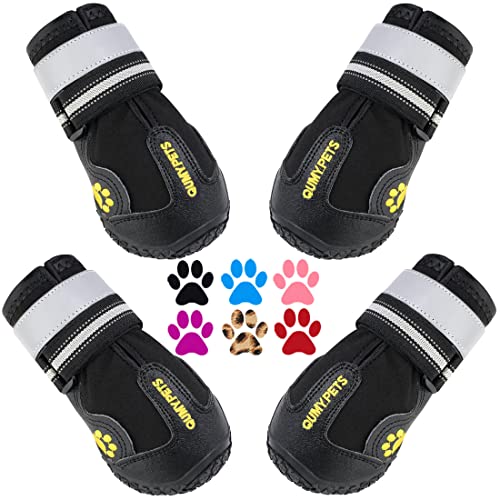
This option offers a size chart through size 8, with that size listed for dogs weighing 74 to 88 pounds and paws measuring 3.0 by 3.3 inches. The product also has a split-seam opening and two adjustable reflective straps, which can help owners secure the boot around the paw. The maker describes the shoes as water-resistant and suitable for outdoor walks and indoor hard floors. The width is smaller than the size 9 range of DcOaGt Size 9 Mesh Boots, so it is not the better match for paws wider than 3 inches.
Bottom line: Pick this if the size 8 dimensions match your dog’s measured paw.
XSY&G Size 6 Dog Shoes
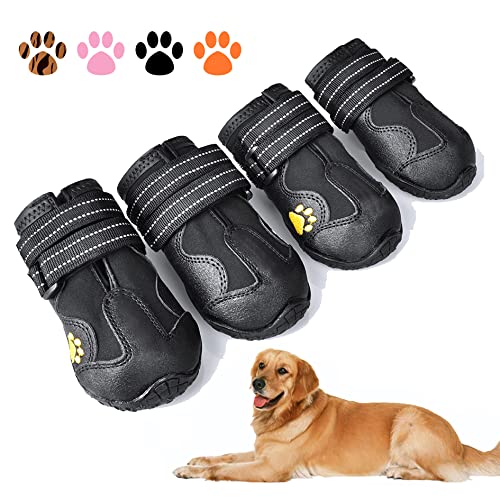
This size 6 is the narrower measured option here: its dimensions are 2.9 inches long by 2.5 inches wide, with a 52-to-70-pound weight guide. The product has a durable anti-slip sole and soft, breathable fabric, and the maker says it can be used indoors or outdoors in wet or dry conditions. It may suit a large dog with relatively narrow paws, but the width is well below the range for DcOaGt Size 9 Mesh Boots. Use paw measurement, not the breed examples, to decide whether it fits.
Bottom line: Choose it for a dog in the weight range whose paws measure about 2.5 inches wide.
NAMSAN Long-Legged Winter Boots

Unlike ankle-height paw boots, this style is designed for long-legged dogs and can be wrapped above the knees. Its waterproof fabric and polycotton lining are intended for keeping legs dry and warm in cold, wet conditions; the product also uses hook-and-loop straps and an elastic cord at the top for adjustment. This is the relevant choice when leg coverage matters more than a paw-width match. Because the size is XL (#5) without a paw measurement, confirm the fit before relying on it for a particular dog.
Bottom line: Choose this for long-legged dogs needing extended winter leg coverage.
XXL Waterproof Dog Shoes

This pair is presented as an all-season option for hot pavement, snow, rain, and mud, with adjustable straps and non-slip soles. The maker says the waterproof material keeps paws dry while the breathable fabric helps with heat management. Its XXL label alone does not establish a paw-width fit, so this is harder to match than QUMY Size 8 Dog Shoes or DcOaGt Size 9 Mesh Boots, which provide measurements. Look for an actual paw-width range before choosing it for a dog with especially broad paws.
Bottom line: Consider it for all-season use only after confirming the paw-width fit.
How to Measure for Extra Large Dog Shoes
Measure paw width while your dog is standing, because weight on the paw can spread it wider than when lifted. Place the paw on paper, mark its widest points, and measure across; repeat for all four paws because front and rear paws can differ. Match the width to the maker’s sizing range, then check length if the chart supplies it. A size label such as XL or XXL is not a substitute for a measurement. If a paw falls between sizes, compare the boot’s opening and closure style, and avoid sizing down so tightly that the straps compress the paw.
Choosing a Sole for Pavement, Snow, and Floors
Choose footwear by surface and weather, not by a general promise of all-season use. A grippy sole is useful on smooth indoor floors, while a waterproof upper matters in wet snow or rain; breathable mesh can be more comfortable in warm conditions but is not automatically waterproof. Hot pavement can burn paw pads, so check the surface with your hand and avoid walks if it feels too hot to hold comfortably. For winter outings, inspect paws for packed snow or ice between toes after walks. Boots should stay secure without restricting circulation or normal movement.
Dog Shoe Fit and Style Differences
Use paw width as the first filter, then choose construction for the job. The table compares the distinct sizing guidance and design cues available across these options; a blank measurement means the model cannot be width-matched from a range.
| Need | Relevant sizing cue | Design cue |
|---|---|---|
| Wider paws | 3.2–3.3 in width | Mesh upper, waterproof toe |
| Measured size chart | Up to 3.0 in width | Adjustable reflective straps |
| Extended leg coverage | Confirm paw fit | Wraps above knees |
| All-season claims | Confirm paw-width range | Waterproof, breathable materials |
For a paw wider than 3 inches, start with a model whose chart explicitly covers that width. A dog with long legs may need a taller upper even when an ordinary boot fits the paw.
Putting On and Caring for Dog Boots
Introduce boots indoors for short sessions before a full walk; many dogs need time to adjust to the changed feel underfoot. Open the boot fully, seat the paw so the toes reach the front without being curled, and fasten straps snugly rather than tightly. Check after a few minutes that the boot has not twisted or slipped, then remove it if your dog limps or shows discomfort. After wet or muddy use, clean the surface and let the boots dry fully before storing them. Hand-washable fabric is a specific convenience only where the maker identifies it, so check the care directions for the chosen pair.
Frequently Asked Questions
How do I measure my dog’s paw for boots?
Measure the widest part of the paw while your dog is standing and bearing weight. Measure all four paws, since front and rear widths can differ, and use the largest measurement when comparing against a width chart.
Should dog boots be tight or loose?
They should be secure without squeezing the paw or limiting movement. Check the fit after a few minutes of walking; slipping or twisting means the boot needs adjustment or a different size.
Can dog shoes protect paws from hot pavement?
Boots with a sole can create a barrier between paw pads and hot ground, but they do not make every surface safe. If pavement feels too hot to hold your hand against comfortably, choose shade or postpone the walk.
How many dog boots should I use?
Most dog boot sets are intended to cover all four paws, but fit should be checked on each paw. Front and rear paws can differ in width, so use measurements rather than assuming one foot represents all four.
How can I help my dog adjust to wearing boots?
Start with brief indoor sessions and reward calm steps before extending the time. Stop if the dog limps or seems uncomfortable, and check that each boot remains aligned and does not rub.