
Best Glow in the Dark Markers for Different Projects

Pagather 8-Color Acrylic Markers suits most craft buyers because its 2 mm tip and eight acrylic colors are intended for multiple surfaces, though its glow requires UV or blacklight rather than darkness alone. Choose Toodler 8-Color Jumbo Chalk Markers for wide signage, MRNEVVCO 12-Color Body Art Markers for temporary body art, or 12 Acrylic UV Paint Markers for fine detail under blacklight.
We earn a commission if you buy through links on this page. As an Amazon Associate I earn from qualifying purchases. Products are compared on manufacturer specifications, not hands-on testing.
- Best overall: Pagather 8-Color Acrylic Markers – Its 2 mm tip and acrylic colors are specified for a range of craft surfaces, with UV-activated glow.
- Best for bold signs: Toodler 8-Color Jumbo Chalk Markers – The 10 mm jumbo nib offers wide, medium, and fine line options.
- Best for body art: MRNEVVCO 12-Color Body Art Markers – The 12-color set is made for temporary face and body designs.
- Best for fine detail: 12 Acrylic UV Paint Markers – Its 0.7 mm tip is suited to small lines and lettering.
| Product | Best for | Ink type or use | Tip | Set size | Shop |
|---|---|---|---|---|---|
| Pagather 8-Color Acrylic Markers | Multi-surface crafts | Acrylic | 2 mm round | 8 colors | Check Price on Amazon |
| Toodler 8-Color Jumbo Chalk Markers | Bold signage | Liquid chalk | 10 mm jumbo nib | 8 colors | Check Price on Amazon |
| MRNEVVCO 12-Color Body Art Markers | Temporary body art | Cosmetic-grade ink | — | 12 colors | Check Price on Amazon |
| 12 Acrylic UV Paint Markers | Fine craft detail | Water-based acrylic | 0.7 mm fine | 12 markers | Check Price on Amazon |
Glow in the Dark Markers
Compare the ink and tip first: these options range from craft acrylic markers to UV-reactive chalk and body-art pens.
Pagather 8-Color Acrylic Markers
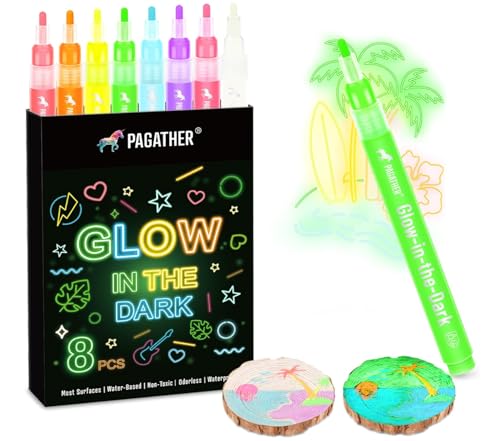
Pagather 8-Color Acrylic Markers stands out for its range of craft surfaces, including rock, fabric, glass, wood, and canvas. The set has eight acrylic colors and a 2 mm reinforced round tip for controlled lines. Its glow effect requires UV or blacklight in the dark; sunlight or UV exposure for five minutes is described as charging the colors, not as a promise that they glow without a lamp. The marker suits craft projects that need a medium-width line across different materials. It is less suitable for very fine lettering than the 0.7 mm option.
Bottom line: Choose it for versatile craft surfaces and a 2 mm line.
Toodler 8-Color Jumbo Chalk Markers
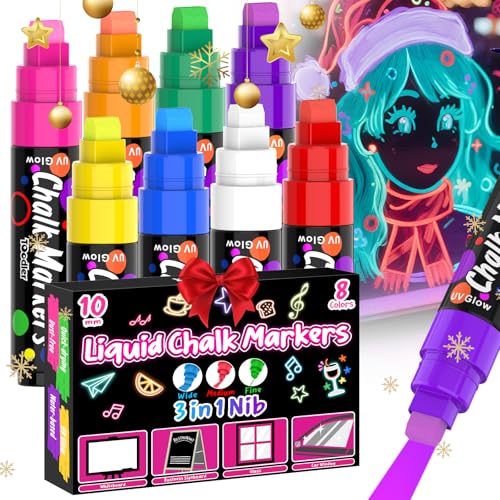
Toodler 8-Color Jumbo Chalk Markers is the signage-focused choice, with eight neon liquid chalk colors and a 10 mm jumbo nib designed to make wide, medium, or fine marks. The ink is described as UV-activated, so the intended glow effect calls for a UV or blacklight environment. This set suits large lettering, diagrams, and party displays better than small illustrations. Its broad nib is the main trade-off: choose a finer marker if the work depends on tiny details or narrow outlines. The product name also identifies the ink as chalk, distinguishing it from acrylic paint markers.
Bottom line: Choose it for large, adaptable lettering under UV light.
MRNEVVCO 12-Color Body Art Markers

MRNEVVCO 12-Color Body Art Markers is made for temporary face and body designs rather than general craft surfaces, and its 12-color set is the largest color count among these markers. The product identifies its ink as cosmetic-grade and cites ASTM D-4236, MSDS, and EN-71; those claims do not make every use suitable for every person. Its effect appears under UV light, so it is not the pick for a glow that works in a dark room without blacklight. Choose it when the intended canvas is skin and the use is temporary body art.
Bottom line: Choose it for temporary face or body designs under UV.
12 Acrylic UV Paint Markers

12 Acrylic UV Paint Markers offers the finest specified point here: a 0.7 mm tip for outlines, lettering, highlights, and other small details. Its 12-marker set combines 10 neon UV-reactive colors with black and white, and the ink is described as water-based acrylic. The neon colors glow under blacklight, making this a fit for detailed craft art rather than an afterglow marker for ordinary darkness. The extra-fine tip is useful for precision, but it covers less area per stroke than the 2 mm and 10 mm alternatives.
Bottom line: Choose it for fine lines and layered craft details.
How to Choose Glow in the Dark Markers
Choose by light effect first: UV-reactive fluorescent ink needs a blacklight, while phosphorescent material can store light and glow after the light source is removed. A product that says it glows under UV should not be assumed to glow on its own in a dark room. Next match tip width to the mark: a 0.7 mm tip favors small details, while a 10 mm nib suits bolder signage. For craft surfaces, identify whether the ink is acrylic or chalk; those are different formulations and should not be treated as interchangeable. If your project needs a particular surface finish or washability, confirm that property before ordering.
UV Glow Versus Afterglow
UV-reactive markers fluoresce while ultraviolet light shines on them; that is different from phosphorescent ink that continues glowing after charging. Blacklights commonly emit UVA, often around 365 or 395 nanometers, and different inks can look brighter under one wavelength than another. The marker descriptions here specify blacklight or UV effects rather than a sustained glow after the lamp turns off. For a dark-room project without a blacklight, look for a product explicitly described as phosphorescent or glow-after-charging. Test the intended lamp and surface together before making a large design, since background color and distance from the UV source affect how vivid fluorescent marks appear.
Match Marker Tip to the Project
Tip width determines practical line scale: a 0.7 mm point is suited to narrow lettering, a 2 mm point to medium strokes, and a 10 mm jumbo nib to broad marks. A multi-edge nib can make several line widths, but its widest edge still takes more space and control than a fine tip. On signs, sketch a small sample at the actual viewing distance before filling in large areas. On detailed art, choose the finer point for outlines and reserve broad markers for larger shapes. Avoid expecting a single marker to deliver both tiny detail and rapid coverage equally well.
Using UV and Body-Art Markers Safely
Use a UV-reactive marker with a blacklight rather than treating its color as ordinary glow paint, and avoid shining UV lamps directly into eyes. UV exposure can harm eyes and skin, so follow the lamp maker’s safety guidance and limit unnecessary exposure. A marker made for face or body art is a different category from a craft acrylic marker; do not substitute craft ink on skin. Keep marker ink away from eyes and mouth, and stop using a body-art product if irritation occurs.
Frequently Asked Questions
Do glow markers work without a blacklight?
UV-reactive markers generally need a UV or blacklight source to show their fluorescent effect. For light-independent afterglow, choose ink specifically described as phosphorescent and check its charging requirements.
What is the difference between UV and glow paint?
UV-reactive color fluoresces while ultraviolet light is present, whereas phosphorescent paint can continue glowing after the charging light is removed. Check the wording for the specific effect rather than assuming every neon marker has afterglow.
Which marker tip is best for small lettering?
A 0.7 mm tip is the most appropriate among these options for small lettering and narrow outlines. A 2 mm tip makes a wider stroke, and a 10 mm nib is aimed more at signage than fine text.
Can craft glow markers be used on skin?
Use only a marker intended for face or body art on skin; craft acrylic and chalk markers are not substitutes. Even cosmetic-grade body markers may not suit every person, so avoid eyes and mouth and discontinue use if irritation appears.
How can I make UV marker colors look brighter?
Use the marker under a UV or blacklight and test it on the intended background before completing the design. Blacklights commonly use 365 or 395 nm UVA, and different inks can respond differently to those wavelengths.