
Mouse Proof Floor Vent Covers: 5 Options Compared

4×12 Floor Vent Mesh Covers is the closest match for mouse proof floor vent covers because its maker describes a dense mesh cover as a mouse barrier and gives a 4-by-12-inch fit. For a magnetic vent or a different opening size, choose a screen or trap designed for that specific surface and measurement instead.
We earn a commission if you buy through links on this page. As an Amazon Associate I earn from qualifying purchases. Products are compared on manufacturer specifications, not hands-on testing.
- Best overall: 4×12 Floor Vent Mesh Covers – The maker explicitly describes a dense mesh as a mouse barrier, and the cover fits 4-by-12-inch registers.
- Best for magnetic vents: Magnetic Vent Screens, 5×11 in. – Four corner neodymium magnets attach to magnetic metal vents sized 5–6 inches wide by 11–12 inches long.
- Best for 4-by-10-inch registers: 4×10 Floor Vent Mesh Traps, 5-Pack – The five mesh traps are sized for a 4-by-10-inch duct opening and fit over the register.
| Product | Best for | Fits | Attachment | Pack count | Shop |
|---|---|---|---|---|---|
| 4×12 Floor Vent Mesh Covers | Mouse barrier | 4 x 12 in. | Mesh trap; attachment — | 4 | Check Price on Amazon |
| Magnetic Vent Screens, 5×11 in. | Magnetic registers | 5–6 x 11–12 in. | Four neodymium magnets | 3 | Check Price on Amazon |
| 4×10 Floor Vent Mesh Traps, 5-Pack | 4×10 registers | 4 x 10 in. | Mesh trap; fits over register | 5 | Check Price on Amazon |
| 4×10 Net Traps with Steel Frames | Frame-supported traps | 4 x 10 in. | Steel spreader frames | 4 | Check Price on Amazon |
| Modern Wave Magnetic Screens, 5×11 in. | Multi-vent magnetic use | 4 x 10, 4 x 12, 6 x 10 in. | Magnets | 5 | Check Price on Amazon |
Mouse Proof Floor Vent Covers Compared
Compare the opening measurements and attachment method before choosing a mesh cover or trap.
4×12 Floor Vent Mesh Covers

This is the only option whose maker explicitly calls the mesh a mouse barrier, making it the closest match for a buyer focused on mice. The 4-by-12-inch cover is sold in a four-pack and is presented as a fine mesh that catches small debris while allowing airflow. Its fit is for 4-by-12-inch floor registers, so measure the register opening rather than assuming it fits other common sizes. The maker does not give a mounting method; buyers who need a secured edge should verify how it attaches before ordering.
Bottom line: Choose this if your register measures 4 by 12 inches and a mesh barrier is the priority.
Magnetic Vent Screens, 5×11 in.

Unlike the register traps, this screen attaches with four corner neodymium magnets and fits vents 5 to 6 inches wide by 11 to 12 inches long. The maker says the breathable mesh blocks bugs, dust, pet hair, and debris while supporting airflow. It is a three-pack for magnetic metal vents; it will not attach to wood, plastic, or aluminum, so check the register with a magnet first. The maker does not specifically claim mouse protection, so choose it for a magnetic fit rather than as a confirmed rodent barrier.
Bottom line: Choose this for a magnetic metal vent in the size range, not as a mouse-proof solution.
4×10 Floor Vent Mesh Traps, 5-Pack
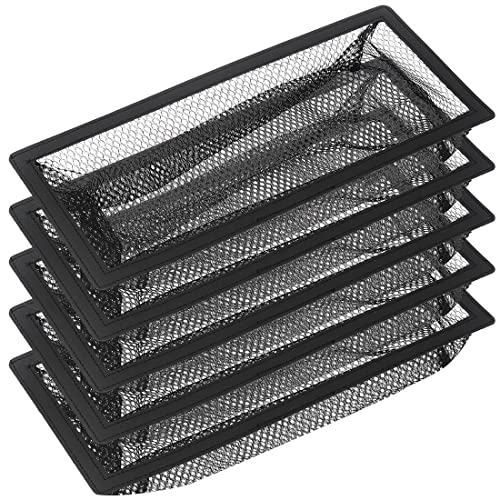
For a 4-by-10-inch duct opening, these five removable mesh traps catch small objects and are also described as preventing living creatures from crawling in. Their netted construction is intended to allow ventilation while trapping debris. The maker warns that they are not for flush-mounted registers, a key limitation if the register sits level with the floor. The product is framed as a general creature barrier, not explicitly as mouse-proof, so match it to the opening and register style before relying on it for rodents.
Bottom line: Choose this for a standard 4-by-10-inch register that is not flush mounted.
4×10 Net Traps with Steel Frames

Steel spreader frames distinguish this four-pack from the simpler mesh traps: the maker says the bars keep the fabric from obstructing the floor register. The set fits 4-by-10-inch openings and is designed for metal, plastic, or wooden registers. The fabric catches small items such as coins, toys, and pet food, but the maker does not specifically claim a mouse barrier. Its frame-based construction is for buyers prioritizing support beneath the register; confirm that the opening size matches your vent.
Bottom line: Choose this when you want frame-supported mesh for a 4-by-10-inch register.
Modern Wave Magnetic Screens, 5×11 in.

Modern Wave combines a five-pack with magnetic attachment and a perforated screen intended to pass airflow while catching debris. The maker says the 5-by-11-inch covers suit several standard vent sizes, including 4-by-10, 4-by-12, and 6-by-10 inches. That broader fit range distinguishes it from the products sized for only one opening. However, the product is not explicitly described as mouse-proof, and the magnetic fit requires a surface the magnets can hold; choose it for a magnetic debris screen, not a guaranteed rodent barrier.
Bottom line: Choose this for multiple listed vent sizes when magnetic attachment suits your register.
How to choose mouse proof floor vent covers
Start with the vent opening measurement and the register surface, because a mesh cover that misses the opening or cannot attach will not provide a dependable barrier. Measure the duct opening beneath the register, not the outer trim; common residential floor register openings include 4 by 10 and 4 by 12 inches. Next, decide whether you need a removable trap that fits under the register or a magnetic screen that attaches to exposed metal. Magnetic screens require a magnet-attracting surface; a quick magnet check distinguishes steel from wood, plastic, or aluminum. For a rodent concern, favor a product whose maker explicitly identifies mouse exclusion, then check that edges are secured and gaps are closed.
Mesh traps and magnetic vent screens
Mesh traps sit beneath or within a floor register, while magnetic screens cover the face of a compatible metal register. Traps may catch objects that fall through the grille and can fit nonmagnetic materials when their frame or design allows; magnetic screens are easier to lift away but depend on a magnetic surface. Mesh opening size and edge fit matter more for exclusion than the product label alone: a gap around the perimeter can defeat a fine screen. Use this comparison to narrow the type, then confirm the exact opening and register construction before choosing.
| Need | Suitable type | Check before choosing |
|---|---|---|
| Cover a magnetic metal grille | Magnetic screen | Magnet attraction and screen dimensions |
| Fit a trap beneath a grille | Mesh register trap | Opening dimensions and register style |
| Exclude mice specifically | Explicitly described mouse barrier | Mesh edge coverage and secure fit |
Measure floor vent openings accurately
Measure the duct opening in inches after lifting the register, since outer grille dimensions can be larger than the opening a trap is meant to fit. Record width and length separately: a 4-by-10-inch opening is not interchangeable with a 4-by-12-inch opening. Magnetic overlay screens may use a different sizing rule, with their own stated coverage dimensions; compare the screen size to the metal register face, not the duct opening alone. If a register is flush-mounted or unusually shaped, avoid assuming a standard trap will seat correctly; check the fit requirement before ordering.
Keep airflow and rodent exclusion in balance
A mesh barrier should cover the opening without loose edges, while retaining enough open area for air to pass. Any added screen adds resistance, especially if dust and hair accumulate, so inspect it regularly and clean it when visibly dirty or airflow appears reduced. Do not use a solid improvised cover over a supply or return vent; blocking HVAC airflow can interfere with heating and cooling circulation. A mouse may enter elsewhere in the building, so a vent screen is only one part of exclusion: close gaps around pipes and doors and address signs of infestation rather than relying on a cover alone.
Frequently Asked Questions
Do mouse proof vent covers stop mice completely?
A vent cover can block access through its own opening only when the mesh, edges, and fit leave no gaps. Mice can enter through other openings, so seal other building gaps as well.
How do I measure a floor vent for a cover?
Lift the register and measure the duct opening width and length in inches. Match both dimensions to the trap’s opening size; magnetic overlays may instead specify the grille face they cover.
Will magnetic vent screens stick to every floor register?
No; magnetic screens need a surface that attracts a magnet, typically steel. Test the grille with a magnet, since wood, plastic, and aluminum will not hold a magnetic screen.
Can a mesh screen reduce heating or cooling airflow?
Yes, any screen adds resistance, particularly when it is clogged with dust or hair. Use a clean, open mesh and inspect it when airflow seems weaker.
Can I use a vent trap on a flush floor register?
Not every trap suits a flush-mounted register; one 4-by-10-inch trap specifically excludes that style. Check whether the trap sits beneath the grille or needs a raised edge to fit.