
DLP Smart Mini Projectors: 4 Models Compared

The AKASO WT50 suits buyers who want a DLP smart mini projector with WiFi, Bluetooth, an Android system and a built-in battery rated for about 2 hours of projection. Choose another model if you need a tri-fold stand, more connection options or a specific native resolution; a DLP projector uses a micromirror chip to form the image.
We earn a commission if you buy through links on this page. As an Amazon Associate I earn from qualifying purchases. Products are compared on manufacturer specifications, not hands-on testing.
- Best overall: AKASO WT50 – Combines WiFi, Bluetooth, an Android system and a built-in battery rated for about 2 hours.
- Best for wired connections: AKASO Type-C Pocket DLP Projector – Has Type-C, HDMI, AV and Micro SD ports, plus AirPlay or EZCast mirroring.
- Best for compact setup: APIO 640×360 DLP Pocket Projector – Folds down to wallet size and includes a built-in Z-shaped stand.
| Product | Best for | Weight | Battery runtime | Shop |
|---|---|---|---|---|
| AKASO WT50 | Smart portable viewing | 0.64 lb | About 2 hours | Check Price on Amazon |
| AKASO Type-C Pocket DLP Projector | Wired device options | 0.46 lb | — | Check Price on Amazon |
| APIO 640×360 DLP Pocket Projector | Native resolution clarity | 0.84 lb | Up to 2 hours | Check Price on Amazon |
| Aurzen ZIP Tri-Fold DLP Projector | Foldable travel setup | 0.62 lb | 1.5 hours | Check Price on Amazon |
DLP smart mini projectors
Compare the core differences in portability, runtime and image specifications before choosing a use case.
AKASO WT50
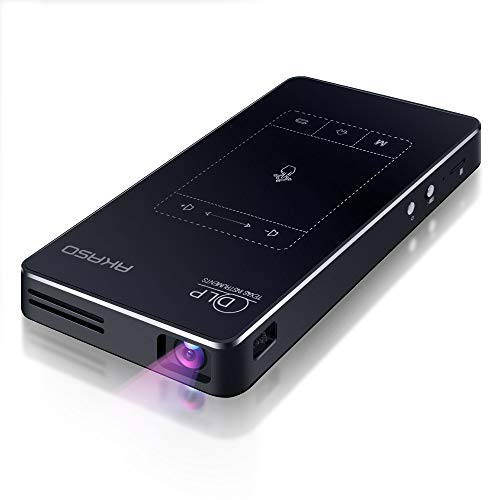
The WT50 is the only model here identified with an Android system as well as WiFi and Bluetooth, making it the clearest fit when built-in smart functionality matters. Its dimensions are 5.71 × 3.15 × 0.79 inches, and it weighs 0.64 lb. The built-in 5,000 mAh battery is rated for approximately 2 hours of projection. AKASO says its DLP optics maintain image sharpness at different sizes.
Bottom line: Pick this if built-in smart features and a roughly 2-hour battery are the deciding factors.
AKASO Type-C Pocket DLP Projector

The Type-C AKASO stands out for its range of physical inputs: Type-C, HDMI, AV and Micro SD, alongside AirPlay or EZCast wireless mirroring. It weighs about 0.46 lb and supports an adjustable image up to 150 inches, according to AKASO. The maker also describes it for tracing and presentations as well as video. This model is a useful alternative when connecting several kinds of source devices matters more than having an identified Android system. Its battery runtime and native resolution are not among the figures, so buyers who need either specific value should verify it before deciding.
Bottom line: Choose this when multiple wired input types are more important than built-in Android.
APIO 640×360 DLP Pocket Projector

The APIO is the only model here with a native resolution: 640 × 360, distinct from its support for 1080p input. Its brightness is 20 lumens, so the maker positions it for dark environments rather than bright rooms. It weighs 13.4 oz (0.84 lb), measures 3.46 × 3.46 × 1.69 inches and has a rechargeable battery rated for up to 2 hours. Two 1 W speakers are built in. Choose it when knowing the native pixel count and having onboard sound are priorities; its low brightness makes room lighting an important constraint.
Bottom line: Choose this for a 640 × 360 native resolution and built-in stereo speakers.
Aurzen ZIP Tri-Fold DLP Projector

The Aurzen ZIP is distinguished by its tri-fold body and built-in Z-shaped stand, which can simplify positioning in a compact travel setup. It weighs 0.62 lb and has 1.5 hours of playtime. The projector supports USB-C and Bluetooth. Aurzen says built-in screen mirroring does not directly support DRM-protected content; its separately sold CastPlay Pro dongle can expand supported content from compatible USB-C devices that support DisplayPort. That extra compatibility condition matters for protected-video playback, and the shorter stated runtime may matter for longer viewing sessions.
Bottom line: Pick this if a foldable body and integrated stand suit your travel setup.
How to choose a DLP mini projector
Choose by native resolution, usable brightness, source connections and power before comparing image-size claims. DLP forms images with a digital micromirror device (DMD), whose tiny tilting mirrors direct light to create pixels; that technology alone does not establish resolution or brightness. Native resolution is the pixel grid the projector displays, while a supported input resolution describes what signal it accepts. For example, 1080p input support does not mean 1080p native output. Brightness should be compared using the same measurement method, such as ANSI lumens; do not treat a plain lumen figure as directly interchangeable with an ANSI-lumen rating. If you will watch in a room with lights on, favor a model with a clearly stated brightness measurement and plan to dim the room.
What projection size and room setup need
Projection size depends on throw ratio and the distance between lens and screen, not just a maximum diagonal claim. Throw ratio is the lens-to-screen distance divided by image width; for instance, a 1.5:1 ratio needs 6 feet of throw for a 4-foot-wide image. Check available distance and screen width together before planning a setup. A larger image spreads the same light across more area, so a dim pocket projector generally needs a darker room as the image grows. Keep the screen flat and avoid projecting onto patterned or strongly colored surfaces, which can reduce perceived detail and color accuracy. For a portable setup, confirm the stand or mounting angle can aim the lens without blocking its vents.
Battery and connectivity for portable viewing
Battery runtime is a planning estimate, not a guarantee of uninterrupted movie time: wireless use, audio output and brightness settings can change power draw. A 90-minute film fits within a 1.5-hour rating only with little reserve, so a longer program calls for a power option or a model with more stated runtime. Wired video typically requires a compatible source port or adapter; wireless mirroring requires compatible devices and network or casting support. Protected streaming content can impose extra restrictions, as some mirroring methods do not pass DRM-protected video. Confirm the exact playback path for the app and device you intend to use rather than assuming that general screen mirroring will display every service.
Safe placement and care for a pocket projector
Keep the projection lens out of direct eye contact: projector light is concentrated, and viewers should not stare into the beam or place a projector where someone can look into the lens. Set the unit on a stable, ventilated surface and keep air vents clear; heat buildup can shorten electronic component life. Dust on a lens can soften the image, so use a clean, soft lens cloth rather than abrasive tissue or household cleaner. Avoid carrying a projector while it is hot, and allow it to cool before packing it in a confined bag. For outdoor use, protect the projector and its power connections from moisture, since portable size does not imply water resistance.
Frequently Asked Questions
Does 1080p support mean native 1080p?
No; input support and native resolution are different specifications. A projector with 640 × 360 native resolution can accept a 1080p signal but still display its native pixel grid.
How dark should a room be for a mini projector?
A darkened room is the safer choice for a low-brightness pocket projector. The APIO model’s brightness is 20 lumens, so even modest ambient light can make a large projected image harder to see.
Can a mini projector stream protected video wirelessly?
Not always; DRM rules can block screen mirroring for protected video. The Aurzen ZIP’s built-in mirroring does not directly support DRM-protected content, and its optional dongle requires a compatible USB-C source with DisplayPort support.
How much battery time should I plan for a movie?
Allow runtime beyond the movie’s length rather than relying on a battery rating exactly. A 1.5-hour rating leaves no reserve for a 90-minute movie, while a 2-hour rating leaves about 30 minutes before accounting for settings or conditions.
Can I use a pocket projector outdoors?
Yes, when the surroundings are dark and the projector is protected from moisture. Ambient light washes out the image, and portable design alone does not establish water resistance.