
Cut N Crown Jig: Crown Molding Options Compared

The Rockler Cut Crown jig is the closest match for a Cut N Crown jig, with adjustable fence risers for molding up to 6 inches wide and compatibility with 10-inch-and-larger miter saws. Choose a different jig if you need a spring-angle range, an angle finder, or a tool that measures corner angles.
Crown-molding jigs hold trim at its installed spring angle so a miter saw can make the joint without a compound-angle setup.
We earn a commission if you buy through links on this page. As an Amazon Associate I earn from qualifying purchases. Products are compared on manufacturer specifications, not hands-on testing.
- Best overall: Rockler Cut Crown Jig – Its adjustable risers support crown and cove molding up to 6 inches wide on 10-inch-and-larger saws.
- Best for angle adjustment: Kreg Crown-Pro KMA2800 – Its spring base adjusts from 30° to 60° and it measures corner and molding angles.
- Best for common spring angles: General Tools Crown King #881 – It supports 45° crown and includes adapters for 52° and 38°.
| Product | Best for | Molding capacity | Spring-angle support | Product weight | Shop |
|---|---|---|---|---|---|
| Rockler Cut Crown Jig | Wide molding | Up to 6 in. | Adjustable fence risers | 1.25 lb. | Check Price on Amazon |
| Kreg Crown-Pro KMA2800 | Angle measuring | Up to 5.5 in. | 30°–60° adjustable base | 1 lb. | Check Price on Amazon |
| General Tools Crown King #881 | Angle adapters | — | 45°; 52° and 38° adapters | 0.85 lb. | Check Price on Amazon |
| AltitudeCraft Jig and Protractor Set | Nested repeat cuts | — | 45° cuts | — | Check Price on Amazon |
Cut N Crown Jig Options
Compare the closest match with other jigs that handle crown-molding cuts in different ways.
Rockler Cut Crown Jig
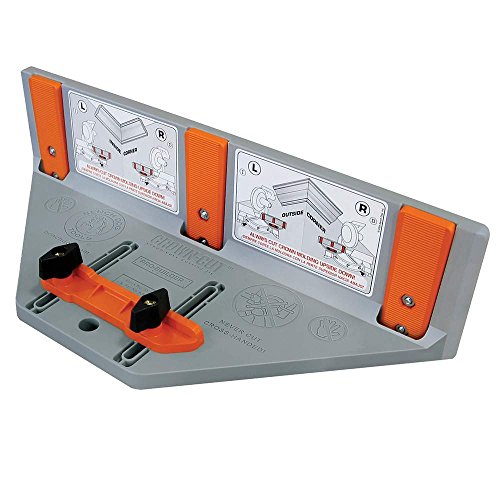
The Rockler Cut Crown jig stands out for its adjustable fence risers, which hold crown and cove molding up to 6 inches wide. The maker says it fits 10-inch-and-larger miter saws, including sliding models, and includes a setup guide. It is the closest fit for someone seeking a Cut N Crown-style jig with broad saw compatibility.
Bottom line: Choose this if you need adjustable risers for molding as wide as 6 inches.
Kreg Crown-Pro KMA2800

The Kreg Crown-Pro differs from the closest match by pairing an angle finder with a spring base adjustable from 30° to 60°. Its angle finder measures inside and outside corner angles as well as molding spring angle, and the tool handles molding up to 5 1/2 inches wide. Kreg says it eliminates compound-angle cuts and works with 10- and 12-inch miter saws. Its saw-size range is narrower than Rockler’s 10-inch-and-larger fit, so check saw size before choosing.
Bottom line: Choose this if measuring corner and spring angles is important to your setup.
General Tools Crown King #881
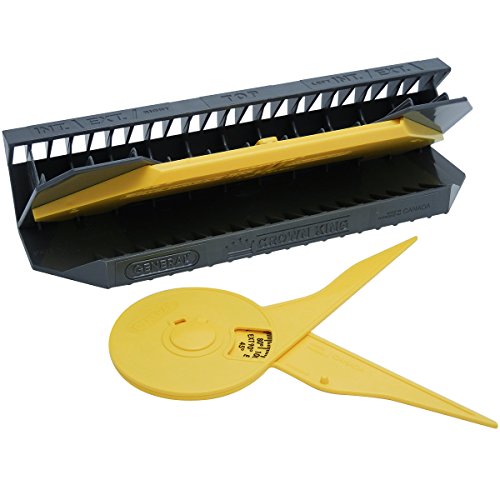
The Crown King #881 takes a fixed-angle approach: its jig supports 45° spring-angle crown, with adapters for 52° and 38°. It also includes an adjustable angle finder for inside and outside corners, and General Tools describes a four-step setup for interior and exterior joints. This option may suit trim with one of those supported spring angles. Unlike the adjustable-base Kreg, the Crown King does not offer a continuous 30°–60° range, so match the molding’s spring angle to a supported setting.
Bottom line: Choose this for crown with a 45°, 52°, or 38° spring angle.
AltitudeCraft Jig and Protractor Set

The AltitudeCraft set combines a protractor with metal stops for nested crown cuts, rather than using adjustable fence risers or a spring base. Its protractor has an inner miter-cut scale, while the stops hold molding in position for repeatable 45° cuts; the maker says the stops are DEWALT-compatible. It suits a buyer prioritizing a paired measuring-and-holding setup for nested cuts.
Bottom line: Choose this if you want a protractor and stops for nested 45° cuts.
How to Choose a Crown Molding Jig
Choose a jig by matching its supported spring angle, molding width, and saw fit to your trim. Crown molding is commonly made with 38° or 45° spring angles; 52° is another profile, so identify the angle from the trim maker or a sample before cutting. A jig that supports only one angle may not hold a different profile correctly. For these options, the Kreg base spans 30°–60°, while the Crown King is centered on 45° with 52° and 38° adapters. If your molding is wider than 5 1/2 inches, the Kreg capacity is a mismatch; the Rockler supports up to 6 inches. Measure both the trim and saw before settling on a setup.
Nested Cuts and Flat Cuts
Nested cutting holds crown upside down and backward, as it sits against the wall and ceiling, so the saw makes a miter while the molding remains at its spring angle. That setup avoids compound-angle calculations when the jig supports the profile. Flat cutting lays the molding on the saw table and generally requires compound miter and bevel settings; the exact settings change with the corner angle and spring angle. A jig’s capacity does not guarantee every profile fits: verify that the trim rests securely against the jig and saw fence without rocking. Use a test piece of the same molding before cutting finished lengths.
Match the Jig to Your Miter Saw
Check saw size, fence height, and clearance before setup. The Rockler jig claims fit for 10-inch-and-larger saws, while Kreg names 10- and 12-inch saws; the other options do not provide an explicit saw-size range. A sliding saw also needs enough rear clearance for its head to travel without striking the jig or trim. Use the table as a first-pass fit check, then compare the jig’s position with your saw’s fence and table.
| Need | Option to consider | Check before cutting |
|---|---|---|
| Trim up to 6 inches wide | Rockler Cut Crown | Saw fence and sliding clearance |
| 30°–60° spring-angle adjustment | Kreg Crown-Pro | Trim width and saw size |
| 45°, 52°, or 38° spring angle | General Tools Crown King | Use the matching adapter |
| Nested 45° cuts with protractor | AltitudeCraft set | Trim capacity and saw compatibility |
Safe Setup and Common Cutting Errors
Secure the molding and keep hands outside the blade’s cutting path whenever the saw is powered. A crown jig helps stabilize the work, but it does not replace the saw’s guard or a firm hold against the fence; never reach near the blade to catch a cutoff. A frequent fitting mistake is mixing up spring angle with corner angle: spring angle describes how the molding sits between wall and ceiling, while corner angle describes the wall joint. Measure the actual corner, since walls that are not exactly 90° can leave a gap with a standard 45° miter. Make a trial pair, then adjust the cut to the measured corner.
Frequently Asked Questions
How do I find the spring angle of crown molding?
Measure the angle between the back of the molding and a wall held square to the ceiling, or check the trim maker’s profile specification. Common spring angles include 38° and 45°, with 52° also used; choose a jig or adapter that matches.
Can I cut crown molding with a 10-inch miter saw?
Yes, two listed jigs specify 10-inch saw compatibility: Rockler says its jig fits 10-inch-and-larger saws, and Kreg specifies 10- and 12-inch saws. Confirm that the jig and molding clear the saw fence and, for a sliding saw, its travel path.
Why do crown molding corners have gaps?
A corner that differs from 90° can make a standard 45° miter leave a gap. Measure the actual wall angle and adjust the cut; also verify that the molding’s spring angle matches the jig setup.
Should crown molding sit upside down in a cutting jig?
For nested cuts, crown typically rests upside down and backward, matching its position against the wall and ceiling. Keep it seated firmly against the jig and saw fence, and make a test cut before cutting the finished pieces.
Do I need a compound miter setting for crown molding?
A jig that holds the molding at its installed spring angle can allow a simple miter cut, while flat cutting generally uses both miter and bevel settings. The needed setup changes with the spring angle and the measured corner angle.