
Highest Rated Wheeled Battery Chargers Compared by Fit

No highest-rated wheeled battery charger can be identified from these specifications alone, but the Schumacher DSR140 stands out for buyers who need 12V/24V compatibility and 10A charging; choose an automatic model instead if you want charging that does not rely on a manual timer.
A wheeled battery charger combines charging and engine-start functions in a mobile shop-style unit. The options here vary in voltage, charge control and starting output, so match those specs to your battery and intended use.
We earn a commission if you buy through links on this page. As an Amazon Associate I earn from qualifying purchases. Products are compared on manufacturer specifications, not hands-on testing.
- Best overall: Schumacher DSR140 – Supports 12V and 24V batteries and combines a 135-minute manual timer with 10A charging.
- Best for automatic charging: Schumacher SC1400 – Offers automatic 6V/12V charging and maintaining, plus a desulfation mode.
- Best for 6V batteries: Schumacher SC1446 – Supports 6V and 12V battery types and provides 200A engine start.
- Best for built-in testing: Schumacher SC1353 – Includes a battery and alternator tester alongside 6A charging and a 40A boost mode.
| Product | Best for | Voltage compatibility | Charge control | Engine start | Shop |
|---|---|---|---|---|---|
| Schumacher DSR140 | 12V/24V charging | 12V/24V | 135-minute manual timer | 200A at 12V | Check Price on Amazon |
| Schumacher SC1446 | 6V/12V versatility | 6V/12V | 135-minute manual timer | 200A | Check Price on Amazon |
| Schumacher SC1400 | Automatic operation | 6V/12V | Automatic | 300A at 12V | Check Price on Amazon |
| Schumacher SC1353 | Battery testing | 6V/12V | Automatic trickle charge | 200A | Check Price on Amazon |
Wheeled battery chargers
Compare voltage support, charging controls and starting output before choosing a model for your batteries and vehicles.
Schumacher DSR140

The DSR140 is the only option here with 24V support, making it the clearest fit for buyers who need one charger for both 12V and 24V batteries. Schumacher says it handles standard, AGM, gel and deep-cycle batteries, and its charging modes include 10A charging, 25A or 50A boost, and a 200A 12V engine start. A 135-minute manual timer and analog ammeter give the operator direct control and a visible current reading. This manual approach requires supervision; buyers seeking automatic charge management should choose an automatic model instead.
Bottom line: Choose this if you need 24V support and prefer manual charge control.
Schumacher SC1446

The SC1446 adds 6V compatibility, unlike the 12V/24V DSR140, while retaining a manual timer-based approach. It supports standard, AGM, gel and deep-cycle batteries, with 10A charging, 20A/40A boost options and a 200A engine start. Its 135-minute timer lets the operator control charging duration rather than relying on automatic operation. That can suit a shop or garage where someone can monitor charging, but it is a less hands-off choice than the automatic SC1400. Confirm that the 6V/12V range matches the batteries you intend to charge.
Bottom line: Choose this for 6V and 12V batteries when manual timing suits your workflow.
Schumacher SC1400
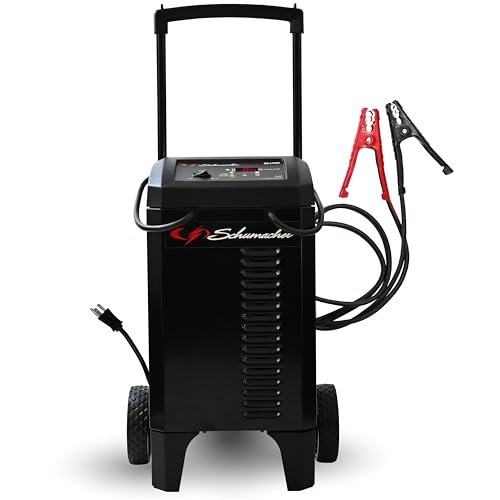
The SC1400 is the automatic option among these chargers, distinguishing it from the manual-timer models. Schumacher says it charges and maintains at 6A to 2A for 12V batteries and at 2A for 6V batteries; the unit also includes a desulfation mode. Starting output is 300A at 12V and 200A at 6V, with boost up to 60A. Compatibility covers standard, AGM, gel and deep-cycle batteries. The automatic charge rates are lower than the 10A charging modes on the manual models, so buyers prioritizing a higher stated charging rate may prefer one of those alternatives.
Bottom line: Choose this if automatic charging matters more than a manual timer.
Schumacher SC1353

The SC1353 pairs a battery and alternator tester with a 6A charger, a combination the other options do not specify. It supports 6V and 12V batteries, provides a 40A boost and a 200A engine start, and uses automatic trickle charging for maintenance. That mix suits buyers who want basic electrical-system checks built into a wheeled charging unit.
Bottom line: Choose this if built-in battery and alternator testing is useful to you.
How to choose a wheeled battery charger
Start with battery voltage, then choose manual or automatic control based on how closely you can monitor charging. A 12V lead-acid battery has six cells, while a 6V battery has three; connecting a charger at the wrong voltage can damage a battery. Engine-start amps, boost amps and ordinary charging amps are different operating modes, so compare the number tied to the job you need rather than treating them as interchangeable.
Charging rate also matters: a common lead-acid rule of thumb is to charge at roughly 10% of the battery’s amp-hour capacity. For a 100Ah battery, that points to about 10A, though the battery maker’s recommended rate takes precedence. Use a manual-timer model only if you can monitor charge duration; automatic operation is more suitable when you want the charger to manage the process.
Matching voltage, battery type and charging rate
Match the charger’s voltage setting to the battery label before connecting clamps. A 12V/24V charger offers a different range from 6V/12V models, and none of the products covers all three voltage groups. The models support combinations of standard, AGM, gel and deep-cycle batteries; compatibility with one chemistry does not mean every charge mode is appropriate for every battery.
Battery capacity and condition affect charging time, so a higher boost or engine-start rating should not be read as a faster normal charge. For routine charging, use the charging-amp figure; reserve boost and engine-start settings for their intended purpose. If a battery label or manual calls for a specific chemistry setting or maximum charge rate, use that limit rather than assuming the charger’s highest output is suitable.
Manual timers versus automatic charging
A manual timer leaves charge duration under the operator’s control, while automatic charging adjusts or stops the charging process according to the unit’s operation. Manual control can suit a mechanic who can watch the ammeter and battery, but it is a poor fit when the unit will be left unattended. A 135-minute timer is a maximum setting, not a promise that every battery will reach full charge in that time.
Automatic maintenance charging is useful for batteries kept between uses, but a maintenance mode is not the same as a high-current start or boost function. For any charging setup, work in a well-ventilated area and keep sparks and flames away: lead-acid batteries can release explosive hydrogen gas while charging. Inspect cables and clamps before use and follow polarity markings to avoid a short circuit.
Wheeled charger types at a glance
Use the charging job to choose between the main wheeled-charger approaches, not just the highest amp number. The table separates voltage range, control style and a distinct secondary feature; starting and boost values remain separate from ordinary charging current. Before using any charger, make sure its voltage matches the battery and that its chemistry is supported.
| Charger approach | Useful when | Trade-off |
|---|---|---|
| 12V/24V manual | You need compatibility with both voltage groups | Charge duration requires operator attention |
| 6V/12V manual | You work with both 6V and 12V batteries | Timer-based operation is less hands-off |
| 6V/12V automatic | You want automatic charging or maintenance | Charging-rate options differ by model |
| Charger with tester | You want battery and alternator checks in the same unit | Testing does not replace a full diagnosis |
Frequently Asked Questions
What voltage battery charger should I use?
Use a charger setting that matches the battery’s labeled voltage: 6V for a 6V battery and 12V for a 12V battery. A 24V battery requires a charger with 24V support; do not assume a 6V/12V model can charge it.
How many amps should a battery charger have?
A common lead-acid charging rule of thumb is about 10% of battery capacity in amp-hours, so a 100Ah battery points to roughly 10A. The battery maker’s specified charge limit takes priority, especially for AGM or gel batteries.
Can I leave a manual timer charger connected?
A manual timer charger needs monitoring because the operator selects the charge duration. A 135-minute timer does not mean every battery is fully charged at the end, so check battery condition and charging progress rather than leaving the process unattended.
Is engine-start amperage the same as charging amperage?
No; engine-start amps describe brief starting assistance, while charging amps describe the charging mode. A unit with a 200A start rating may have a much lower normal charge rate, so choose based on the function you need.
Where should I charge a lead-acid battery?
Charge lead-acid batteries in a well-ventilated area away from flames and sparks because charging can release explosive hydrogen gas. Keep clamps from touching each other and observe the battery’s polarity markings.