
Trailer Tires 12 Inch: Five Sizes and Fits Compared

For a 12-inch trailer tire with the highest per-tire capacity here, choose 5.30-12 Load Range C Assembly: its 5.30-12 tire is rated for 1,050 pounds, while its 5-lug wheel must match your hub. Choose a different assembly if your trailer needs a 4.80-12 tire or a 4-lug wheel, since tire size and bolt pattern must both match.
These assemblies pair a trailer tire with its wheel, so confirm the tire size, bolt pattern, and clearance before replacing a set.
We earn a commission if you buy through links on this page. As an Amazon Associate I earn from qualifying purchases. Products are compared on manufacturer specifications, not hands-on testing.
- Best overall: 5.30-12 Load Range C Assembly – Its 5.30-12 tires have the highest per-tire capacity at 1,050 pounds.
- Best for 4-lug hubs: Garvee 4.80-12 4-Lug Load Range C – The 4.80-12 tires come on 12-by-4-inch wheels with a 4-on-4-inch bolt pattern.
- Best for 5-lug hubs: GarveeTech 4.80-12 5-Lug Assembly – The 4.80-12 tires pair with white spoke wheels using a 5-on-4.5-inch pattern.
| Product | Best for | Tire size | Bolt pattern | Max load per tire | Shop |
|---|---|---|---|---|---|
| 5.30-12 Load Range C Assembly | Higher stated capacity | 5.30-12 | 5 on 4.5 in | 1,050 lb | Check Price on Amazon |
| Garvee 4.80-12 5-Lug Assembly | 5-lug 4.80-12 fit | 4.80-12 | 5 on 4.5 in | 990 lb | Check Price on Amazon |
| Garvee 4.80-12 4-Lug Load Range C | 4-lug utility trailers | 4.80-12 | 4 on 4 in | 990 lb | Check Price on Amazon |
| GarveeTech 4.80-12 4-Lug Assembly | Black 4-lug wheels | 4.80-12 | 4 on 4 in | 990 lb | Check Price on Amazon |
| GarveeTech 4.80-12 5-Lug Assembly | White spoke wheels | 4.80-12 | 5 on 4.5 in | 990 lb | Check Price on Amazon |
12-inch trailer tires
Compare the tire size, hub pattern, and stated load limit before choosing a replacement assembly.
5.30-12 Load Range C Assembly

5.30-12 Load Range C Assembly is the only 5.30-12 option among these assemblies, with a maximum load of 1,050 pounds per tire. The set includes two bias-ply tires mounted on 12-by-4-inch white wheels, rated Load Range C and 6-ply, with an 80 PSI maximum. The tire measures 5.3 inches wide and 21.5 inches in overall diameter, making its size different from the 4.80-12 choices. The wheel uses a 5-on-4.5-inch pattern; buyers whose hubs use four lugs or a different pattern need another assembly.
Bottom line: Pick this set if your trailer accepts 5.30-12 tires and 5-on-4.5-inch wheels.
Garvee 4.80-12 5-Lug Assembly

Garvee 4.80-12 5-Lug Assembly combines 4.80-12 tires with white 12-by-4-inch rims and a 5-on-4.5-inch bolt pattern. Each tire supports up to 990 pounds, with a maximum inflation pressure of 90 PSI; the overall diameter is 20.6 inches and section width is 4.8 inches. The package contains two complete tire-and-wheel assemblies. This is a different fit from the 4-lug 4.80-12 sets, despite sharing their nominal tire size, so check the trailer hub pattern and available tire clearance before selecting it.
Bottom line: Choose this set for a 4.80-12 replacement on a compatible 5-lug hub.
Garvee 4.80-12 4-Lug Load Range C
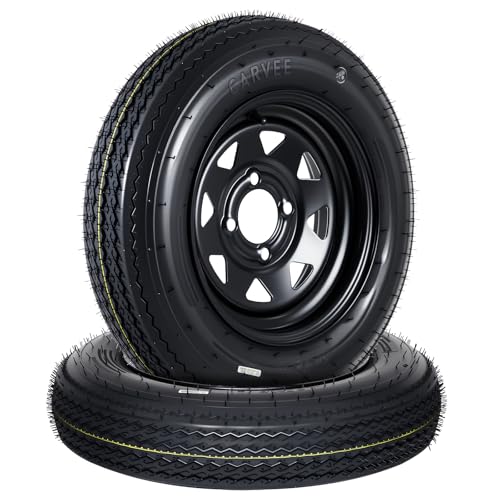
Garvee 4.80-12 4-Lug Load Range C uses the common 4.80-12 tire size but pairs it with black 12-by-4-inch steel rims drilled for a 4-on-4-inch pattern. Its tires are 6-ply, Load Range C, and rated for up to 990 pounds at 90 PSI. The package is a two-assembly set intended for compatible four-lug trailers. Unlike the 5-lug 4.80-12 options, this wheel pattern will not fit a 5-on-4.5-inch hub; confirm the bolt circle rather than relying on tire size alone.
Bottom line: Pick this set when your hub is 4-on-4 inches and your trailer uses 4.80-12 tires.
GarveeTech 4.80-12 4-Lug Assembly

GarveeTech 4.80-12 4-Lug Assembly is another 4.80-12 assembly for a 4-on-4-inch hub, with black 12-by-4-inch rims and a 2.8-inch center bore. The tire is listed at 990 pounds maximum load and 90 PSI, with a 4.7-inch section width and 20.3-inch overall diameter. Its 6PR construction is identified as Load Range B, unlike the Load Range C assemblies in this group. The product’s fit reminder makes measurements especially pertinent: compare the hub pattern, center bore, and tire clearance with your trailer before buying.
Bottom line: Choose this set if the 4-on-4-inch pattern and 2.8-inch center bore match your hub.
GarveeTech 4.80-12 5-Lug Assembly

GarveeTech 4.80-12 5-Lug Assembly pairs 4.80-12 bias-ply tires with white spoke wheels using a 5-on-4.5-inch pattern, a distinct combination from the four-lug assemblies. The two tires are Load Range C, 6PR, and rated for up to 990 pounds at 90 PSI. The dimensions include a 20.39-inch height and 4.8-inch width. Nylon cords and double steel belts are part of the construction; the maker says they provide towing stability. This set suits a compatible five-lug hub, but it is not interchangeable with a 4-on-4-inch wheel.
Bottom line: Pick this set for a matching 5-on-4.5-inch hub and white spoke wheel preference.
How to choose 12-inch trailer tires
Choose by the tire size printed on the current sidewall, the wheel’s bolt pattern, and the trailer’s required load capacity. A 4.80-12 and a 5.30-12 tire both fit a nominal 12-inch rim, but the larger size has a wider section and greater overall diameter, so it needs more clearance. The assemblies here span 20.3 to 21.5 inches in stated diameter and 990 to 1,050 pounds in per-tire maximum load. Compare the axle’s rating and the loaded trailer weight; tires on an axle must collectively support its load, and the axle itself remains a limit. If you have less than 1 inch of clearance above or beside the tire, verify the replacement’s loaded clearance before ordering.
Match the wheel bolt pattern and center bore
Match the number of lugs and bolt-circle diameter before considering color or tread. A 5-on-4.5-inch pattern has five studs on a 4.5-inch circle; a 4-on-4-inch pattern has four on a 4-inch circle, and they are not interchangeable. Center bore also matters because the wheel opening must clear the hub. Measure across the center of opposite studs for an even-lug wheel; for a five-lug wheel, measure from the center of one stud to the far edge of the stud across from it. The 4-lug assembly with a 2.8-inch center bore needs that clearance, too. A wrong pattern can prevent secure mounting even when the tire size is right.
Understand 4.80-12 and 5.30-12 tire sizes
The first number in these tire sizes is the approximate section width in inches, while the final number indicates the rim diameter. The middle number differs here: 4.80-12 tires are narrower and shorter than the 5.30-12 option. Actual dimensions can vary by tire design, so use the overall diameter and width when checking fender, frame, and suspension clearance. A larger tire may change loaded clearance and can contact trailer parts during suspension movement. For a replacement, keep the existing size unless the trailer maker permits a change; do not assume every 12-inch tire has the same outside diameter. The assemblies use 12-by-4-inch wheels.
Trailer tire load and inflation basics
Use trailer tires within both their load rating and the trailer axle’s rating; a higher tire capacity does not raise the axle, wheel, or trailer limit. These products give maximum capacities per tire, so account for the load distribution across each axle rather than dividing total cargo weight evenly without checking balance. Inflate cold tires to the pressure appropriate for the tire’s required load, never beyond the tire’s maximum pressure; the products here state maxima from 80 to 90 PSI. Trailer tires can build heat when overloaded or underinflated. Before towing, inspect tread, sidewalls, and pressure, and replace a tire with damage or exposed cord rather than relying on remaining tread alone.
Common mistakes when replacing trailer tires
The most common fit mistake is matching “12 inch” while overlooking the tire width, outside diameter, or hub pattern. A 4.80-12 tire on a 4-lug wheel is not a fit substitute for the same tire on a 5-lug wheel unless the hub pattern matches. Another mistake is selecting on capacity alone: the 5.30-12 option has a higher stated load limit, but its 21.5-inch diameter may not clear a trailer designed around a shorter tire. Also compare the wheel width and center bore, then confirm the loaded trailer remains within all axle and tire limits. Recheck lug nuts after mounting according to the trailer or wheel maker’s instructions; loose hardware can cause wheel separation.
Frequently Asked Questions
Can 4.80-12 and 5.30-12 tires be interchanged?
Not automatically: both use a 12-inch rim, but the 5.30-12 size is wider and has a larger outside diameter. Confirm fender clearance and the trailer maker’s approved tire size before changing sizes.
How much weight can a 12-inch trailer tire carry?
Capacity depends on the tire size and construction, not just the 12-inch rim diameter. The options here state maximums of 990 or 1,050 pounds per tire; the axle and trailer ratings may impose lower limits.
How do I measure a trailer wheel bolt pattern?
Count the lug holes and measure the bolt circle: these assemblies use either 4 lugs on 4 inches or 5 lugs on 4.5 inches. The patterns must match the hub exactly; also verify the center bore clears the hub.
What pressure should I use in a 12-inch trailer tire?
Use the pressure that supports the tire’s load, measured when cold, while staying at or below its maximum PSI. The products here specify maxima between 80 and 90 PSI, so do not assume all 12-inch trailer tires use one pressure.
Can I use a passenger-car tire on a trailer?
Use a trailer tire specified for the trailer rather than substituting a passenger-car tire based only on matching dimensions. Trailer tires are built for trailer service, and the replacement still must meet the required load and fit.